
Straight from the horse’s back
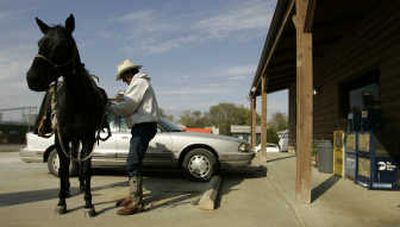
FREDONIA, Kan. – When Oregon rancher Bill Inman decided to show there’s more to America than what’s seen on the nightly news, he hopped on his horse Blackie and started riding.
And riding, and riding.
Weary of the daily drumbeat over war, crime, poverty and assorted social ills, he and his wife are burning through their life savings to tell the stories of hardworking, honest everyday people in rural America. Inman soaks it all in atop Blackie, a 16-year thoroughbred-quarter horse mix who’s averaging 20 to 25 miles a day along backroads from Oregon to North Carolina.
“Unfortunately, the image they are portraying is there’s corruption in every politician and there’s criminals running everywhere,” he said. “I guess guys that rope like me, we wouldn’t need to rope steers. You could just sit out there and rope a criminal because they’re coming by every 10 minutes.”
Inman, 48, started June 2 from his hometown of Lebanon, Ore. Halfway through his cross-country trek, dubbed Uncovering America by Horseback, he’s rolled up 1,700 miles. His wife, Brenda, also 48, drives ahead in a pickup and horse trailer filled with water and provisions for Blackie, three dogs and themselves.
“The scenery in America is changing, and I’m really proud we’re taking a snapshot at slow motion of this time period, because 20 years from now it will be different,” he said.
‘All our savings’
The couple estimates the journey will cost them $45,000. They want to make a documentary film and write a book, and a filmmaker and Web site operator are tagging along.
“If we waited until we could afford to do it, we could never do it. It was do it now or never do it,” Brenda said. “We gave everything up in our lives to do this. We used all our savings and everything else.”
Said Bill: “It’s probably the most stupid thing I’ve done financially, but I truly believe in it.”
Hundreds of interesting people have greeted Inman along the way. There’s the Dodge City man who collects bridle bits, spurs and barbed wire. A Wyoming deputy sheriff who drove 25 miles through a rainstorm to bring dinner to the Inmans where they were camped. A Wyoming woman who gave Bill a pair of stirrups she bought as a Christmas present for her grandson before he was killed in a car wreck.
He arrived in this rural town with jeans tucked into boots with spurs, a sweat-stained Stetson and a weathered face, leaving no doubt that ranching has been part of him all his life. As with most stops, they rely on a combination of media coverage and word of mouth to let people know.
Raised on a Texas ranch, he’s worked cattle, herded wild horses and managed a ranch on an Indian reservation in Nevada before moving to Oregon last year and selling horses. He’s also an auctioneer and has done horseshoeing for nearly 30 years.
Joyce Cross met Inman when he came to her restaurant in Fall River, about 10 miles to the west, looking for a place to sleep for the night. She found a place for them and allowed her 4-year-old son, Kadyn Covey, to ride with Inman the next day. “The diversity he has unveiled is a lot of forgotten heritage in this country. It’s a great eye opener for anybody who runs into him,” she said.
‘Image of America’
Mention diversity and Inman talks about the retired rancher in Idaho whom he considers “a true image of America with his honesty and hospitality,” or people he’s met working multiple jobs to make ends meet, or another Idaho rancher e-mailing the progress of the journey to his son in Iraq.
“There is nothing like riding across the nation to learn about the people of this country,” he said.
Inman has Oregon, Idaho, Wyoming, Colorado and most of Kansas behind him. Ahead are Missouri, Tennessee and North Carolina, where he hopes to spend Christmas his wife’s family in Hendersonville.
They often rely on strangers since they don’t have national sponsors to underwrite them. Sometimes it’s a meal, a place to sleep, some cash or donated feed for Blackie, who daily eats about 20 pounds of high-fat feed.
Inman bought Blackie in 2001. The two have clearly bonded.
“I know his capabilities and I know his flaws and I think he can say the same thing for me,” he said. “Now if you think we’re constantly kissing buddies, I don’t think so. Do I brag about him a lot? Yeah.”