
Depot neighbors tired of noise

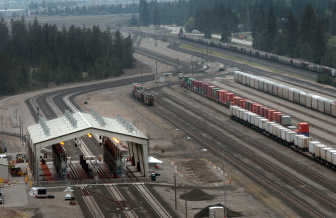
HAUSER – Debbie Gremillion’s neighbor is keeping her up at night with ear-piercing whistles that come regular as clockwork.
“Eleven-thirty p.m., 3 a.m., 3:20, 4, 4:15,” she recounts.
The nightly wake-up calls also disturb fellow South View Mobile Home Park resident Bob VanZandt, except VanZandt, who is disabled and uses a portable oxygen bottle, must contend with the neighbor’s clouds of diesel gas fumes, too.
Gremillion, VanZandt and other park residents live about three blocks north of Burlington Northern Santa Fe Railway’s train refueling depot, and contend the noise and soot levels from the trains has increased by 50 percent over previous years.
They want some peace and quiet.
“Why, if the city of Spokane Valley has no-whistle zones, can’t we, too?” wondered fellow mobile home park resident Jack Barber.
Opened in August 2004, the depot is an important pit stop for the railroad’s transcontinental freight line. Instead of the eight hours it takes to unhook a locomotive from its rail cars and fill it with fuel in the company’s cramped Seattle yard, the Hauser mainline fueling depot is capable of loading a locomotive with 10,000 gallons of diesel in about 45 minutes.
With activity at the depot and at nearby railroad crossings at Prairie and Pleasant View roads, the noise from train whistles at times is near-constant, mobile home park residents said.
Approaching the crossings and depot, locomotive operators sound one long blast from the whistle, two shorts and another long. Residents said that by the time one train is finished blowing its whistle, another starts, creating a mile and a half of solid sound. In the same area, near the refueling depot, there are seven parallel tracks, as well as several sidings and spurs.
VanZandt, who retired from the Marine Corps, then a career in law enforcement, now lives with an oxygen bottle connected to him. He is disabled and said he can’t sleep at night with the constant blast of the air horns in the near distance. He claims that this is interfering with his health as well as his well-being.
On a tour of the area, Barber, a former long haul trucker, noted that both BNSF and Union Pacific had tracks in the area, some with safety arms at crossings, some without. The area is growing as an industrial center, with the Atlas pellet factory moving operations from the Spokane River to Hauser, as well as a gigantic asphalt storage facility.
Under construction nearby is the Kootenai County Solid Waste Transfer Station.
BNSF spokesman Gus Melonas said his company will look into the residents’ noise complaints and discuss them with crews.
“Other areas have no-whistle zones, but they must be approved by the government,” Melonas said. “If the citizens affected wish to call me, I’ll be glad to discuss it with them.”
Melonas can be reached at (206) 625-6220.