
Medical school rises in Yakima
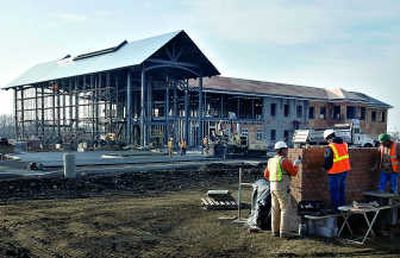
YAKIMA – Businessman Al DeAtley initially thought the idea of building an osteopathic medical school here was absurd.
“When they first brought it to me, I thought it was a pipe dream,” DeAtley said. He had been approached by people who wanted to launch the school as part of the new Pacific Northwest University of Health Sciences.
But the retired millionaire and philanthropist, who made his fortune building roads, is a believer now. It helped that his wife was a nurse at the old Yakima Valley Osteopathic Hospital in the 1950s and their children’s doctors were osteopathic physicians, not the more common allopathic physicians who have M.D. after their name.
Ultimately, though, DeAtley said he was persuaded to back the effort because the founding doctors were able to attract a significant amount of money for the venture from outside Yakima. They persuaded an out-of-state financier, who doesn’t want to be identified, to invest $13 million in a for-profit holding company for initial construction. The school is set to receive its inaugural class of 70 in August.
DeAtley, who has held several fundraisers for the school at his Scenic Drive home, thinks Pacific Northwest University will transform Yakima’s identity and boost its economy.
“I think it will make us more sophisticated, which should help recruit companies to expand here,” DeAtley said. “It’s going to bring some high-wage faculty. I think it means Yakima is at the tipping point.”
Pacific Northwest already is delivering an economic and intellectual punch. It has a $3 million-a-year operating budget and 17 employees. Local contractors are building the first two campus buildings. Eventually, if all goes according to the board’s ambitious plan, the 42-acre campus will be home to as many as 10 other training programs for allied health professions, from pharmacy to physical therapy. When fully built, classrooms and student housing will cover 500,000 square feet.
So far, eight osteopathic and two allopathic physicians have been recruited to work as instructors and practice medicine locally. Officials said most of the faculty has been hired and is expected to start arriving in February and March.
Dr. Linda Welch left private practice in San Antonio to become director of faculty development. She taught medicine earlier in her career.
“The opportunity to get back into teaching combined with the fact that this is a brand-new university really appealed to me,” said Welch, who has purchased a home.
Welch cited another plus – the nearby mountains and the fresh fruit and produce.
“My first night here I spent in a B&B and woke up in the middle of a cherry orchard,” she marveled. “It was beautiful.”
According to Fred Tinning, Pacific Northwest’s outgoing interim president, who has had a hand in starting five other osteopathic medical schools, many of these schools have started in rural areas like the Yakima Valley because part of their mission is to train primary-care physicians for underserved regions.
The state Department of Health says 38 of 39 Washington counties are short of family and primary care physicians. But Tinning said the shortage is most acute in the agricultural regions of Eastern Washington. Only one medical school serves the entire state – the University of Washington, an allopathic college. The nearest osteopathic medical schools are in Colorado and California.
Carlos Olivares, chief executive officer of the nonprofit Yakima Valley Farm Workers Clinic, said he currently needs at least 20 physicians to meet demand at his organization’s nine clinics across the state and in Oregon. That’s why, he said, the board of the Farm Workers Clinic gave a substantial loan to the university.
“We have to prepare for the future, and part of that is to grow our own people who want to be physicians,” Olivares said.
Last year, Pacific Northwest University officials hired Cascade Planning Group of Camas, Wash., to estimate the economic and fiscal benefits to the community of an osteopathic school in Yakima. Using conservative projections of the spinoff benefits of dollars spent and jobs created, economist Paul Dennis estimated an economic benefit to Yakima County from first-phase construction of $23 million.
Dennis said the county will see the biggest long-term benefit from the arrival of faculty and students.
“That’s probably one of the best impacts that comes out of it because these people are going to be spending money that’s new to the economy,” he said in an interview.
Fundraising will continue to be a big job for the school’s new president, Dr. Stan Flemming. He said the school is on target to raise $20 million to finish and equip the 60,000-square-foot, two-story college and hire faculty and staff for the August opening.
The second phase of the development, to begin in 2012, will cost an estimated $100 million. 2012 is when the first class is set to graduate.
As far as recruiting quality faculty and staff, Flemming said that’s been easier than expected. Most of the 25 positions are filled.
Flemming said his other major priority is to attract top students – whom he defines as only those who can survive a multi-layer screening process that begins with grades and medical admissions aptitude tests and ends with a personal interview.
So far, more than 1,200 students have applied for the 70 seats.
Flemming rejects the idea that his new school can’t compete with the University of Washington medical school for the best students – even though the state school charges $17,400 a year tuition compared with $30,000 at his school.
“I have no concerns about losing the best students to UW,” he said.