
Bishop White Seminary house may face demolition
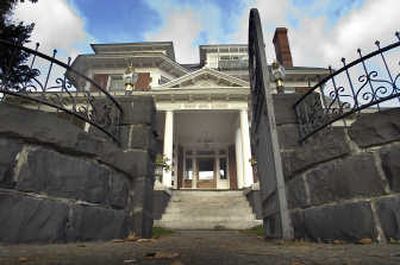
A stately brick home important to Gonzaga University history is facing possible demolition by the Catholic Diocese of Spokane, although diocese and university officials both say they are looking for a way to save the house that is a prominent part of the Bishop White Seminary.
The Georgian Revival home at 429 E. Sharp Ave. was built at the turn of the 20th century by construction contractor John T. Huetter, who also built the Gonzaga Administration Building, Heath Library, DeSmet Hall, the former St. Joseph’s Orphanage and other large brick and stone buildings in the Spokane region, many of which have been demolished, including the orphanage.
Huetter, Idaho, between Post Falls and Coeur d’Alene, takes its name from Huetter’s quarry, brick yard and lumber mill that he established there in the 1890s to take advantage of a clay deposit and rail service.
The Catholic Diocese of Spokane wants to replace the seminary and Huetter House with a larger, more cohesive facility. The project is slated to begin next year. The existing seminary combines the historic home with a series of additions, and does not offer a suitable layout for its mix of education, worship, private living quarters and public activities, said the Rev. Darrin Connall, rector of the seminary.
All but a handful of the 50 active priests in the Spokane Diocese spent part of their ecclesiastical formation at the seminary, Connall said.
Members of the Spokane Preservation Advocates and neighborhood leaders have been working quietly behind the scenes to convince diocese and university officials to move the Huetter House because of its long history in Spokane’s North Side and its connection to the university and religious communities in the region.
Joanne Moyer, of the preservation advocates group, said the Huetter House could become a valuable asset for Gonzaga if it were to convert the elegant home into a facility for receptions, board meetings, fundraising or maybe even the university president’s house in the future.
“We have so few landmarks on the North Side,” Moyer said. “It has to be preserved.”
Dale Goodwin, director of public relations at Gonzaga, said the university is considering various options, and has identified a tentative site for relocation, but he declined to disclose any details. However, the university has moved other buildings in the past successfully, he said.
Huetter family members also are urging the diocese and university to preserve the house that holds so much significance to them.
“I think it’s something they should do instead of tearing everything down and making it all new,” said Paul Huetter, of Coeur d’Alene, a grandson of John T. Huetter.
He said that about half a dozen family members still live in the Spokane and Coeur d’Alene areas, while a much larger extended family can be found throughout the western U.S.
The German-Catholic Huetters raised eight children in the home. One of the daughters, Agnes, became a Holy Names nun. In her journal, Agnes Huetter wrote that the family attended daily Mass, and said evening prayers, including the rosary, in German, said Esther Huetter, a great-granddaughter living in Ashland, Ore.
Bing Crosby, who grew up across Sharp Avenue, was a childhood friend of the family.
John T. Huetter was born in Germany in 1866 and came to Spokane in 1892 as a skilled stonemason. In addition to his works at Huetter, he owned and operated the East End Granite Co. in Spokane and Blue Rock Quarries at Garden Springs, according to an article by historian Nancy Compau in the September 2002 edition of Nostalgia Magazine.
He established Huetter Construction Co.
Granite spheres that adorn the entrance to Gonzaga are one of his lasting signatures.
He died in 1918 after suffering a fall while building large grain elevators in Cheney, Paul Huetter said.
Two of his eight children, including Paul Huetter Sr., continued to live at the home through the late 1930s. The home was sold privately in the early 1940s and donated to the diocese, which turned it into the St. John Bosco center for homeless boys in 1942. Later, the house was used as a men’s home, and became the Bishop White Preparatory Seminary in 1956, Compau wrote.
The house was designed by architects Herman Preusse and Julius Zittel, who also designed the GU Administration Building.
Today, about a dozen seminarians attend Gonzaga, studying philosophy and other academics, while the diocese provides spiritual and pastoral education, also known as “formation.”
After their undergraduate work is completed, the seminarians go on to an additional four years of education and religious study to become priests.
Karen Byrd, chairwoman of the Logan Neighborhood Council, said the diocese had been talking about building a new seminary a number of years ago, but the project was delayed by the bankruptcy case surrounding sexual abuse claims involving diocesan priests over the past three years.
She and her husband at one point offered to move the Huetter House onto nearby property they own, she said.
Connall has agreed to attend a Logan Neighborhood Council meeting on Jan. 15 to update neighbors on the progress at finding a new location for the Huetter House, she said.