
Once there were nine, now there are three windmills
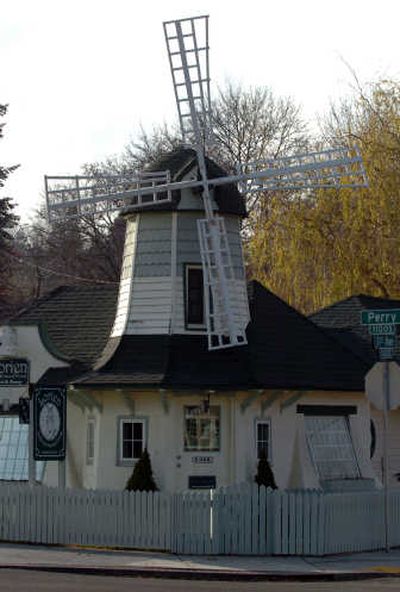

There used to be nine of the eye-catching little windmill buildings around Spokane, but now there are just three.
The buildings, originally situated in residential areas, are prime examples of novelty commercial architecture from the 1920s. According to a registration form for listing on the National Register of Historic Places, the best-preserved of the Cambern Dutch Shop Windmill buildings is the one at 1102 S. Perry St.
It is “one of the finest examples of novelty architecture in Spokane,” the National Register form reads.
The frame structure with projecting bay windows has an octagonal tower with four blades of a windmill prominent. It was designed as a retail shop and visual advertisement for the Cambern Brothers bakery and dairy line of “Dutch Main” products in the mid-1920s. Brothers Robert and Cecil Cambern, of Colbert, applied their skills (Robert having worked at a flour mill and Cecil at a bakery) to building up their new bakery business in 1924, which prospered to the point where they decided to market directly to consumers. Hence, the retail windmill buildings.
The South Perry building was one of 13 such structures designed by architect Charles Wood (who had been employed previously by noted architect Kirtland Cutter), of which nine were constructed – at 307 S. Cedar St., 831 W. Garland Ave., 1318 S. Grand Blvd., 1818 N. Hamilton St., 126 N. Howard St., 4112 N. Market St., 401 W. Sprague Ave., 1627 W. First Ave.
Under the Dutch Main label, the shops sold dairy products, baked goods and approximately 150 varieties of pastries. Unfortunately, the Cambern business failed during the Great Depression, and by 1943, most of the windmill structures had been sold, and nearly all were demolished.
Today, the Cambern Dutch Shop Windmill on South Perry, which received National Register of Historic Places designation in the 1980s, is home to a natural foods store in the eclectic business district. The windmill on West First Avenue in historic Browne’s Addition has been converted into a private residence.
The details of the journey of the third remaining Cambern windmill are a bit lost in history. In the not too distant past, one of the windmills had been located on East Trent Avenue under the name of the Lucky Penny, though it is unclear which of the original structures had been moved to that location. It was again moved from East Trent and is now situated on East Appleway in Spokane Valley, between Long and Greenacres roads, near the Greenacres Shopping Center. A beauty shop operates in that facility.
The windmill buildings remain from an era when novelty structures were designed to be eye-catching for an emerging new automobile society – in the 1920s and ‘30s, when the idea was to get passing motorists to take notice and stop to make a purchase.
There are about a dozen or so examples of this kind of novelty architecture in the state including the Benewah milk bottles in Spokane and the Teapot Dome Service Station in Zillah.