
Volunteer equine rescue group looks out for horses
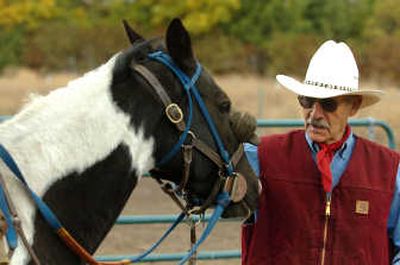
RATHDRUM – The first series of pictures Bob McMurray pored over show an animal in distress, with ribs prominently projecting, little muscle tone and sluggish from neglect. At roughly 25 years old and only about 750 pounds, the horse ranked at about a one – poor – on the equine condition rating chart, McMurray said.
“The horse should be at least 1,000 pounds,” he noted about the animal discovered with several others living in squalid conditions several weeks ago.
For the 100 or so volunteer members of Panhandle Equine Rescue, including McMurray who serves as the group’s president, it was a sight they’ve seen hundreds of times before. As the county’s lone large-scale group capable of taking in the single-hoofed animal through their network of members, the nonprofit rescuers work side by side with Kootenai County Sheriff’s Department in responding to and taking in animals in need.
“We try to stay within Kootenai County,” McMurray said, adding that there are an estimated 30,000 heads of horse within the area’s nearly 1,300 square miles. “We stay plenty busy right here.”
Since Panhandle’s inception in 1992, the group has become an essential appendage for the Sheriff’s Department in dealing with cases of equine neglect, said Karen Williams, an investigator for the county’s animal control department. Since the department lacks any large holding facility, trained staff for equine care and a trailer to haul the animals, Panhandle Equine Rescue “is a blessing for us,” she added.
As North Idaho’s population continues to increase, so do the calls about potential animal abuse. Every year the equine rescuers field more than 500 calls to investigate possible cases of neglected horses, often from onlookers passing by a field and spotting a skinny animal in a field or pasture. Many cases like that turn out to be unfounded, but Panhandle will try to take a look at the equine, though they aren’t legally able to step onto private property. If they do spot obviously neglected or undernourished equines, they call animal control to look into it further since, as Williams said, “the Sheriff’s Department is the only one who can take your horse.”
“A lot of people who buy horses really don’t know, they aren’t privy to all that it takes to care for the animal,” McMurray said, though he added the number who care for their horses far outweighs those who don’t. But if an animal needs to be rescued, like the 11 horses taken in last year, McMurray said, “When it comes down to legal situations, (the Sheriff’s Department) relies on us as a holding hospital area for the animals.”
Someone in Panhandle’s association will keep the animal on a steady supply of food and water until its adoption.
Evidence of the group’s success is found in their many picture albums, full of before-and-after shots showing the rescued equine’s physical transformation.
Sitting at a table in the Rathdrum home of Pam Scollard, the group’s treasurer, McMurray details the marked improvement from the after shots of the gelding he mentioned earlier. Under a steady new diet that’s added more than 100 pounds, the hardier horse’s pin bones near his tail aren’t as distinguishable, muscle tone has rounded out several parts of his body and the ribs are now mostly hidden under a slight fat cover.
“It’s a different horse,” Scollard said, as McMurray offered, “it takes us quite a while to get them back – eight, nine, 10 weeks.”
Panhandle Equine Rescue’s success rate, with only a few horses throughout their history that have had to be euthanized, is due in part to the collaboration of the group’s members, their president said. “People in the equine community are all kind of joined at the hip … We can get a hold of anybody and, for whatever problem, we can find an answer.
“We just have a touch,” Scollard added.
But McMurray’s quick to add there is an important distinction about the North Idaho organization.
“We’re not in the horse buying and selling business at all,” he explained. “Our primary function is to bring back the quality of life for an animal that has lost it, for whatever reason.”
All those sitting at Scollard’s kitchen table agreed on one taxing topic: Instances of animal abuse are only going to grow. “You can’t ignore the problem. It’s going to get worse and worse,” Williams said.
With that in mind, Kootenai County Sheriff’s Department has tasked her with designing a regional shelter for animals of all species. “It’s needed,” Williams said, adding that she’ll consult other counties across the country for advice as well as the equine experts sitting right next to her and found throughout Kootenai County.
With the instances of animal abuse, “A lot of it is about education” within the public, Williams said. In that regard, the shelter will also serve as an educational outlet for the community. “It makes sense to do it right the first time,” she said.