
Woman in the woods
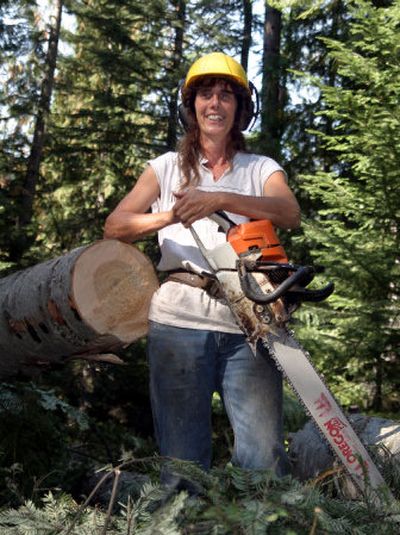

Running a farm, logging and operating heavy equipment would be a full load for many people, but add mother and wife, and you’ve got Sandy Schelpp.
Ask her: “Are you nuts?”
She’ll tell you: “Isn’t this a way of life in Idaho?”
Schelpp’s day starts off on the phone while she’s making the rounds on the farm. Cows, goats, sheep and horses all need to be fed and watered.
Next, she sends her daughter to school.
Then she meets with state workers to make sure her fuels and skidding operation are in compliance.
From there, Schelpp takes off her shoes and puts on her eight-inch leather boots, straps on chaps, puts on a yellow hard hat, grabs her Stihl 44 saw with a 28-inch blade and scurries up the hill to meet her husband, Paul.
Today, he already has several trees on the ground.
Sandy Schelpp’s grace, agility and speed are to be admired as she maneuvers on top of a fir tree, running a tape measure at the same time she de-limbs and bucks the tree into logs.
“She’s a lot faster than me,” her husband admits.
Although she doesn’t consider her lifestyle unique, most men wouldn’t want to be in her shoes. At a time when the logging industry is losing young men in the field, according to Kathryn Tacke, regional economist for the Department of Labor, Sandy Schelpp loves the work.
But her job still has its drawbacks. After 16 years, she says, “I still have a hard time getting respect from the men who never met me.”
Tacke agrees. “When women take nontraditional occupations,” she says, “there are some who assume they need to be baby-sat.”
But Tacke also believes that as men see their daughters entering occupations that weren’t open to women in the past, the men are becoming more respectful.
Being “baby-sat” is hard for Sandy Schelpp. She doesn’t want to be perceived as aggressive, so she takes it for half an hour or so while the men tell her what levers to pull to get the Cat here and the brush there.
“It takes courage for women to take nontraditional jobs,” says Tacke. “There are fewer than 2 percent of the women who are in the logging and heavy-equipment-operators field in the state of Idaho.”
“As far as muscle strength,” says Schelpp, “no woman will out-lift a man. You’ve just got to get creative.
“But the logging world today is hydraulics. Women can do hydraulics just as well as anyone else,” she said.
The hardest part of running machines, according to Schelpp, is that they are designed for a man’s build.
But for Schelpp, being creative helps. She changes all the grips on a chain saw so it fits her hand. Her excavator is what she calls “made by Japanese people. The cab is little, but everything fits me.”
In most heavy equipment, the levers are too far back for a woman, and Schelpp has a hard time reaching the foot pedals. That’s when some engineering could be changed.
But until there’s demand for that, creativity is what women need to cope with the conditions.
Sandy Schelpp has been in the woods most of her life, working beside her dad as a child, doing some slash work.
But it wasn’t until she married Paul that she really got into logging. The two started out with a horse and a 1-ton 1960 Ford when they got one little job.
From there, they borrowed money, got a mill to back them up and got a Forest Service contract, their first big job. That was 16 years ago.
Today, they have branched out from their meager beginnings, but they still do horse logging as well as Cat logging, road construction, off-site construction and some septic work. Most of their jobs come from word of mouth.
They have 10 horses, an excavator, a couple of bulldozers, a dump truck and an equipment-hauling truck. It’s a long way from the one-horse operation.
Sandy Schelpp enjoys the different jobs but says, “I like to look back on my logging jobs and see a healthy forest.”
She enjoys tree farming. “That’s when you leave all the little trees, not like a clearcut where you just run over them.
“I like coming back and seeing the little trees grow.”
Then she adds, “I am not trying to be macho or prove anything, I just enjoy it.”