
Bogus buck targets road hunters
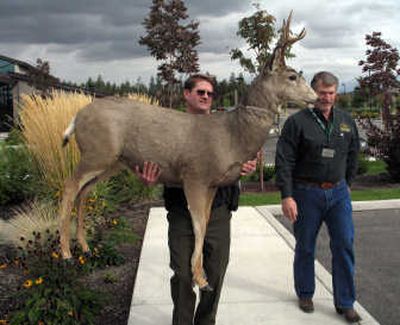
While the Bionic Woman is dealing with evil on TV this fall, Robo Deer will be haunting poachers in Eastern Washington.
The mechanical mule deer buck, with a tail that twitches and a head that rotates, was among $3,500 in equipment donated to the Washington Fish and Wildlife Department last week by the Mule Deer Foundation’s Spokane Chapter.
For years, wildlife agents have used full-size stuffed deer to make cases against road hunters, spotlighters and other game-law violators in areas of high poaching activity. The equipment takes a beating from weather and lead from high-powered rifles.
“We’re very thankful to have this new equipment to help us do our job,” said Capt. Dan Rahn. “These are the kinds of tools we need but usually can’t afford.”
The deer has a remote control unit that enables agents to give it lifelike motion. Video cameras also were included in the donation, presented by Mike Jones, Mule Deer Foundation state chairman, and a group of local members.
The deer decoy will join other high-tech equipment, including surveillance cameras, metal detectors, range finders and mapping equipment used by Spokane-area enforcement officers. Much of this type of equipment is supplied to the agency by sportsmen’s groups, such as the foundation as well as Safari Club International and the Inland Northwest Wildlife Council.
The Mule Deer Foundation has been a steady supporter of wildlife management. The Spokane Chapter has donated about $15,000 to the Fish and Wildlife Department in the past three years and the state’s seven chapters have donated about $100,000 in equipment and thousands of hours of volunteer labor since 1988, said Madonna Luers, agency spokeswoman.
The foundation’s largest contribution in Washington has been a total of about $40,000 since 2001 for the department’s Eastern Washington Cooperative Mule Deer Study. Grants covered radio and satellite telemetry equipment, aerial animal capture and surveying flight time and construction materials and labor for captive mule deer pens at Washington State University.
Restoring wildlife habitat is one of the foundation’s primary goals, Jones said. Spokane Chapter volunteers joined Forest Service biologist Mike Borysewicz to plant natural vegetation along a branch of LeClerc Creek in Pend Oreille County last weekend.
Mike and Roxanne Beshoar celebrated their 22nd wedding anniversary by planting larch, kinnikinick and snowberry in another sort of enduring relationship with the land. They also brought their son, Kyle, a sophomore at East Valley High School.
Being a member of the Mule Deer Foundation makes easy work of getting the 40 hours of volunteer service EV requires for graduation, Kyle said.
“Besides our fundraising for donations, we’re about boots-on-the-ground to help mule deer,” he said. “A few people, each doing a little, can accomplish a lot.”