
High court won’t hear CIA abduction case
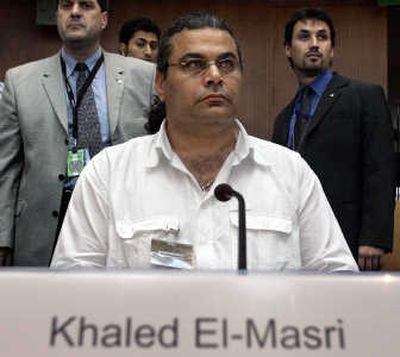
WASHINGTON – In a victory for the Bush administration and its use of the “state secrets” defense, the Supreme Court refused Tuesday to hear a lawsuit from a German car salesman who said he was wrongly abducted, imprisoned and tortured by the CIA in a case of mistaken identity.
The court’s action, taken without comment, was a setback for civil libertarians who had hoped to win limits on the secrecy rule, a legacy of the Cold War.
Since the attacks of Sept. 11, 2001 , the so-called state-secrecy privilege has been invoked regularly to bar judges or juries from hearing claims of those who say they were beaten, abused or spied on by the government during its war on terrorism. Administration lawyers have argued successfully that hearing such claims in open court would reveal national security secrets.
Civil libertarians complained Tuesday that the government was using the secrecy defense to cover up its own wrongdoing. They also said broad use of the rule was further damaging the nation’s image, already sullied by international condemnation of the “extraordinary rendition” program of arresting terrorism suspects and transporting them to foreign countries for interrogation.
“In a nation committed to the rule of law, the government’s unlawful activity should be exposed, not hidden behind a ‘state secrets’ designation,” said Steven Shapiro, legal director for the American Civil Liberties Union, which had urged the high court to hear the case of Khaled el-Masri, a German citizen of Lebanese descent.
Civil libertarians had hoped the Supreme Court would reconsider the secrecy rule in el-Masri’s case because U.S. officials had acknowledged privately that he was innocent.
A car salesman from Germany, el-Masri went on a holiday trip to the Balkans in the last days of 2003. He was stopped at a border crossing in Macedonia, and his passport was taken. He said he was questioned intensely and accused of associating with Islamic radicals.
According to his complaint, he was blindfolded, taken to an airport and stripped of his clothes by men who wore masks and black clothing. They drugged him and chained him inside an airplane, and he was flown to Afghanistan, the complaint claims. He was held there in a CIA-run prison for five months.
Then intelligence agents concluded they had the wrong man. He was not Khalid al-Masri, a wanted terrorist and a member of the Hamburg cell that organized the Sept. 11 attacks on the World Trade Center in New York and the Pentagon.
American officials did not apologize to el-Masri for the mistake or return him to his home. Instead, he was dropped from a truck on a hillside in Albania. From there, he returned to Germany and contacted a lawyer.