
Spirit Lake the holder of a dark secret
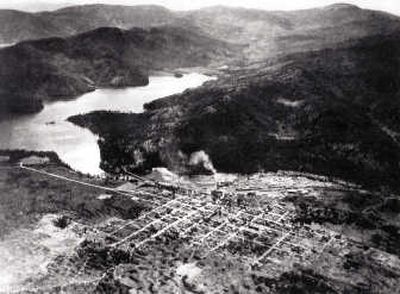
Editor’s note: This is the first in a series of articles exploring the history of Spirit Lake and its environs as the community nears its centennial next August. Spirit Lake native Keith Spencer became interested in local history when he came across some old photographs while remodeling his home. He and his wife, Janette, researched their origins, began collecting old documents for posterity and now can’t seem to stop.
SPIRIT LAKE – As Spirit Lake looks toward its 100th birthday next August, it is exciting to be able to tell a few stories about this beautiful area, historical town and the characters that brought it to life.
This small city has a rich and interesting history. How many towns were carved from total wilderness into a modern and bustling community of over 1,000, including a large sawmill, a railroad and major railroad shops, in less than eight months? How many lakes are built on a huge gravel bar, owing its very existence to a fragile sealed bottom? Which local lake early became the playground for the Spokane’s rich and famous?
Let’s start from the beginning. About 10 to 15,000 years ago the climate began to cool and the chill was on. The Cordilleran Ice Sheet grew south. Lobes penetrated well into what would become the United States, covering much of northern Washington and Idaho. A major ice lobe dammed the Columbia River in north-central Washington, forming Lake Columbia, whose waters eventually inundated Coeur d’Alene and Spokane and likely the Spirit Lake area.
The Purcell lobe also grew south, covering much of North Idaho with ice, and soon dammed the Clark Fork River east of Sandpoint. At its maximum advance, this ice dam was more than 2,000 feet high. The trapped water rose eventually forming a vast lake, Glacial Lake Missoula. At its highest level, this lake contained about 500 cubic miles of water, an amount roughly half the size of Lake Michigan. The water depth measured about 950 feet at the current Missoula town-site.
Ultimately, the ice dam failed, causing what is known as an “outburst flood,” thought to be the largest ever. This torrent scoured everything in its path, including Lake Pend Oreille, the Rathdrum Prairie and the Spokane Valley. As the flow slacked, vast quantities of rock, gravel, sand and other debris began to settle, forming a new firmament along the Rathdrum Prairie, Spokane Valley and beyond.
The Spirit Lake area was at the fringe of this turmoil; it was first scoured and then, as the flow slowed, inundated with rock debris of every size and composition (there are boulders the size of a truck sitting around the area just south of the lake). When the mists cleared, 500 to 600 feet of sand and gravel had been deposited across the small waterway flowing from Mount Spokane and now called Brickell Creek. As the flood further eased, the finely ground particles of silt in the water settled into the Spirit Lake bowl behind the new dam, creating a concrete-like sealed bottom.
Thousands of years later, temperatures moderated and the glaciers were replaced with green and growing habitat. Animals returned, later to be followed by the migration of American Indians.
Numerous tribes settled in the general area. These were nomadic people who followed the seasonal food supply and spent their summers hunting buffalo in what is now Montana.
A vast network of trails developed. Some of these trails may date back a thousand years. Two of these trails are of interest to the Spirit Lake story: the famous Suneacquoteen trail between Spokane Falls and the Pend Oreille River, and the trail splitting off the Suneacquoteen trail at Twin Lakes, which ran northerly along the east side of Spirit Lake. While there is little evidence that the Indians spent much time at Spirit Lake, they passed by there regularly and they eventually named this lovely lake “Tesemini,” loosely interpreted as “Lake of the Spirits.”
According to Indian legend, something awful happened here, and for centuries Indians would not go near the place. I have heard at least four different tales and am inclined to believe that something bad did indeed happen. Others disagree with this position and view the legend as hokum.
The most popular story involves a young Indian princess who was forced to marry a chief’s son from another tribe rather than the young brave she loved. As the story goes, the lovers leaped from the 150-foot-high cliff at the southeast corner of the lake. Supposedly, they landed in the water and were never seen again. This story has to be phony; if one were to leap off this cliff you would splatter onto big rocks at a point at least 50 feet from the lake’s high-water line, a very messy ending.
I tend to believe the story told by Spirit Lake’s first settler, Pete Rhodebeck as told to John R. Reavis, a New York journalist, and published in the Spokane Falls Review on May 16, 1889:
“The legend is, that once upon a time a canoe containing seven braves was moving across its surface, when suddenly and without warning the canoe and all of its occupants were swallowed up and lost forever. The dire disaster was attributed to some evil spirit that was believed to rule over the surrounding country. From that moment the Indians have never hunted on its shores or fished in its waters.
Rhodebeck, who had long been the only resident of that region, said he has often seen Indians pass on the regular trail, but he never knew one to stop. They shook their heads ominously and passed on.