
Dig into spring: Plant bulbs now for April flowers
DETROIT — Think spring. Plant bulbs.
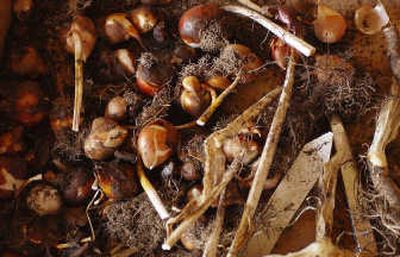
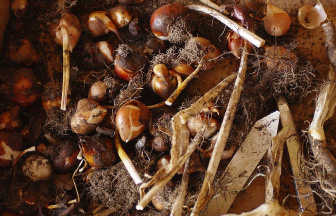
They look like papery brown onions now. But come March, April and May, the bulbs will produce the flowers of spring, like snowdrops, daffodils and tulips.
So invest some time this fall to plant bulbs.
Opt for heavy, big, firm bulbs, even though they’ll cost more than bargain sacks filled with seconds. The better bulbs will produce more flowers as well as stronger, larger blooms.
Each fall, Adrienne O’Brien plants 200 to 300 bulbs, a task she says is not as daunting as it sounds.
“It’s important for people to know it takes longer to think about it than to do it,” says O’Brien, a horticulturist at the University of Michigan’s Matthaei Botanical Gardens in Ann Arbor. She also runs the annual bulb sale.
Can you ever have too many bulbs?
“No, I don’t think so,” O’Brien says.
Here are six of her favorite spring harbingers.
Red Emperor Tulip
Bloom time: Early to mid-April.
How to plant: In groups of five to seven bulbs in full sun and well-drained soil.
Why plant: “Nothing is more beautiful to me than Red Emperor, with its petals spread wide open on a sunny April day. They close up at night and, if it’s cool, they last a long time,” O’Brien wrote in an e-mail.
Cost: Prices vary quite a bit, depending on where the bulbs are purchased and the quantity, but figure you’ll spend up to $1 to $2 each for the bulbs described here, except for the Gladiator allium ($5 or more).
Insider tip: Red Emperor tulips generally return year to year, more than some tulips. Tulip bulbs are especially appealing to squirrels.
Pink Impression Tulip
Bloom time: Early May.
How to plant: In groups of at least five, in full sun and well-drained soil.
Why plant: Pink Impression is a tall Darwin tulip with large, long-lasting flowers and strong stems.
Insider tip: Pink Impressions are good cut flowers.
Thalia Daffodil
Bloom time: Late April.
How to plant: Cluster a quantity of bulbs about 5 inches apart in sun and well-drained soil.
Why plant: Thalia is an unusually delicate, bright white daffodil with nodding or hanging flowers. Some call it the orchid narcissus.
Insider tip: Thalia is fragrant so plant it near a doorway or another spot where people will pass by. Squirrels, rabbits and deer find them unappealing.
Te Te-A -Te Te Daffodil
Bloom time: March to early April.
How to plant: This is one of the first daffodils to bloom, and stands just 6 to 8 inches tall. Put it where it will get early season full sun before the deciduous trees and shrubs leaf out.
Why plant: These miniature yellow trumpets are a joyful call to spring.
Insider tip: Plant with large crocuses or Siberian squills, which bloom about the same time. Tete-a-tete is good for forcing in pots.
Snowdrop (Galanthus Nivalis)
Bloom time: February or early March.
How to plant: Plant at least 20 of these small bulbs in a group so the flowers will show up. They can be tucked under trees and shrubs.
Why plant: “They laugh at the snow as they push their way up,” O’Brien writes .
Insider tip: Common snowdrops (there are others) self-seed and eventually form large clumps. They can be transplanted “in the green,” after they flower but before their leaves disappear in early summer.
Gladiator Allium
Bloom time: Late May into June.
How to plant: Place in a group of three in full sun and well-drained soil.
Why plant: Gladiator is showy, with a tightly packed flower on a 4-foot stem. “They are expensive but it’s worth getting three or five and wowing the neighborhood,” O’Brien writes.
Insider tip: Those with deep pockets could space Gladiators evenly throughout a perennial garden for a stunning formal effect.
♦ ♦ ♦
Bulbs 101
Bulbs are planted in the fall to produce spring flowers like daffodils, crocuses and tulips. Adrienne O’Brien says she usually plants her bulbs between mid-October and mid-November.
If the planting soil is heavy clay, she mixes in compost and peat before placing the bulbs. To make digging the holes easier, she uses a stand-up bulb planter. A shovel or, for small bulbs, a trowel can be used.
The general rule is to plant a bulb, pointy end up, three times as deep as the bulb is wide. Cluster bulbs in groups for a natural look and bigger color impact next spring.
Next year, after the bulbs bloom, cut off the flowers with their stems. But leave the foliage in place for several more weeks until it ripens or turns yellow and brown. During that time, the leaves are making and storing nutrients for the following year’s flowers. If hostas or daylilies are planted nearby, their enlarging leaves will help hide the unsightly bulb foliage.
Species tulips and those marked as perennials are more likely to flower for more than one or two seasons than some other tulips.
Most bulbs require full sun and well-drained soil. Early bloomers like snowdrops can be planted under trees; the bulbs will finish flowering and storing nutrients before the trees leaf out.
While some gardeners scatter bulb food in fall or spring to nourish established bulb beds, O’Brien lets them go it alone.
♦ ♦ ♦ Bulb Prices Spring Up
The euro is up, and so are some bulb prices. In Holland, Mich., where 400,000 tulip bulbs are planted each fall for the Tulip Time festival, the city had to pay 18 percent or $11,000 more for Dutch tulip bulbs this fall compared to last year.
♦ ♦ ♦
No Garden, No Worries
Don’t have a garden? You can still plant certain bulbs in pots, stash them away for several months where they’ll stay cool but not freezing, and then bring them indoors to enjoy as flowers this winter.
When shopping for bulbs, check the labels for ones good for forcing.