
Russell trial begins in Kelso
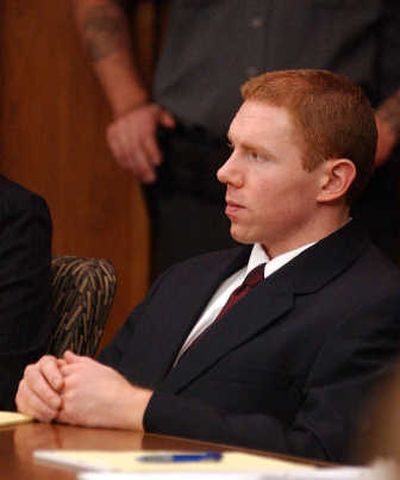
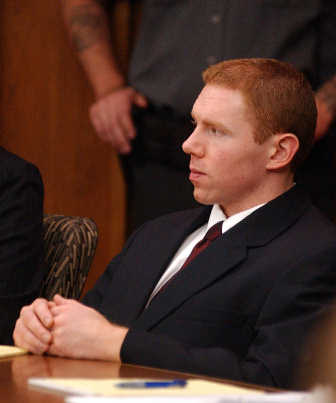
KELSO, Wash. – After more than six years and a pursuit halfway around the world, the trial of former Washington State University student Fred Russell began Monday in this rainy mill town.
“This is going to be a somewhat lengthy trial,” Whitman County Superior Court Judge David Frazier warned a courtroom packed with dozens of potential jurors. Frazier moved the trial across the state because he feared that years of news coverage would make it hard to find an impartial jury.
Russell, 29, is charged with three counts of vehicular homicide and three counts of vehicular assault, and court papers say he was drunk and speeding when he caused an accident that killed three fellow Washington State University students and injured three others on June 4, 2001.
Russell skipped bail, disappeared, and was eventually arrested in Ireland, working as a store security guard. Extradited to the United States, he faces 10 to 14 years in prison if convicted.
At a recent hearing, Frazier said he liked Kelso because it was near a major metropolitan area – it’s about 45 minutes north of Portland – but outside Washington’s major media markets.
Cowlitz County is providing the courtroom and the jury; everything else – prosecutor, defense team, potentially dozens of witnesses, courtroom staff, judge, even most of the reporters covering the case – are from other cities. Jury selection is expected to take two to three days; opening arguments are tentatively slated for Wednesday.
Russell sat quietly in court Monday, chatting with one of his attorneys and occasionally looking at documents. He avoided looking at the news cameras in a corner of the room.
Among those watching from the gallery Monday: Russell’s mother, Linda, and his aunt Carol, who sat directly behind him. Both declined comment.
The 77 potential jurors filed into the courtroom silently Monday – a man in a brushcut and western shirt, a woman carrying a World Wildlife Fund tote bag, a young man in paint-splattered pants and work shirt, carrying his ball cap in his hand. They looked curious, or nervous, or bored. Two were excused immediately, one for being sick, the other because she brought her young daughter.
“If it’s a crying child, I’ll excuse her,” the judge said.
Among those squeezing into the cramped courtroom Monday: Rich Morrow, a West Seattle man whose 21-year-old daughter, Stacy, was one of the three students killed in the wreck.
Stacy’s body was so damaged that her family had her cremated, Rich Morrow said.
“The day I had to stand in the Kimball Funeral Home in Pullman, and they handed my daughter to me in a box … that undid me,” Morrow said.
It shouldn’t be hard to find jurors untainted by publicity, judging by Mayor Don Gregory’s reaction when told last week that an internationally watched trial is landing in his town, once known as the Smelt Capital of the World.
“Holy Criminy!” he said. “I read the paper every day, and I’m totally oblivious to it.”
Longtime City Councilman Alan Slater – who’d heard of the case – said he’d heard no mention of the case from anyone.
“Not a word,” the 78-year-old said Thursday night, sipping a martini after mowing his lawn.
Slater, who has a medical waiver from jury duty, said he’s confident local residents will give Russell a fair shake.
“They’ll listen to the facts,” he said. “We believe in truth, and we believe in fairness.” The city slogan these days: “City of Friendly People.”
Still, Slater added, many residents have children attending Washington State University.
“We also believe in justice,” he said. “We don’t look kindly on deaths by idiocy.”
The community where Russell’s fate will be decided is a longtime timber town, once home to the largest sawmills in the world. Today, the diameter of the trees much reduced, Kelso and adjacent Longview continue to be anchored by large industrial employers – two paper companies, a lumber mill, a chicken processing plant.
“It’s a working community, Democrat-leaning,” said the mayor. “A lot of logging trucks in town. It’s a progressive, laid-back town.”
Defense attorney Francisco Duarte, of Bellevue, declined to reveal whether Russell will testify. But the defense plans to challenge the competence of the crash investigation and the conclusion that Russell caused the accident.
“We believe the government failed to properly investigate this case,” Duarte said.
The defense will also argue that a blood test showing Russell was drunk was flawed, and cannot be independently verified because it was accidentally destroyed in 2004, while Russell was in hiding.
According to police reports, Russell and a friend were drinking in a Pullman bar when they got into Russell’s Chevy Blazer and drove toward Moscow, Idaho, eight miles east on a busy two-lane road that connects the two college towns.
Russell came upon a slower vehicle and, even though he was in a no-passing zone, tried to pass at 90 mph, police said. Police believe that Russell’s vehicle struck a car heading in the opposite direction, then plowed into a Cadillac carrying seven Washington State University students back from a movie in Moscow.
The crash killed three Washington residents: Morrow; Brandon Clements, 22, of Wapato; and Ryan Sorensen, 21, of Westport.
John Wagner, of Harrington, Wash.; Kara Eichelsdoerfer, 21, of Central Park, Wash.; and Sameer Ranade, 20, of Kennewick, were injured.
Russell suffered minor injuries. He was taken to an Idaho hospital, where his blood-alcohol level was measured at 0.12 percent, well above the legal limit of 0.08 percent, according to court records.
Charged with vehicular homicide and assault, he was released on a $5,000 bond that outraged victims and families. He received several threats, including a card on his apartment door saying he wouldn’t live to see trial.
Russell failed to show up for a hearing Oct. 26, 2001. According to police, he sold some baseball cards, took $1,300 from his father’s checking account and a photo of the family dog, and fled.
Shortly thereafter, The Spokesman-Review and two other local newspapers received a handwritten letter from Russell, saying he left because he had no choice.
“Since the first day after the tragic accident, horrible things have been printed about me,” Russell wrote. “Now people are so enraged that they would rather see me dead than receive a fair trial. I maintain my innocence.”
Bernadette Olson, a family friend and WSU graduate student, later admitted that she drove Russell to a Canadian airport and intentionally misled investigators about his whereabouts. She was sentenced to six months in federal prison for lying to a U.S. marshal and grand jury.
Russell’s father Greg, then the dean of WSU’s criminal justice department, told police he had no idea his son planned to flee. Shortly afterward, Greg Russell took a job in Arkansas.
With his red hair, pale skin and fake Irish accent, Fred Russell blended into the underground economy of Dublin, Ireland, U.S. Marshal Mike Kline said. He had a girlfriend and worked for years as a security guard at a women’s clothing store. He sported an Irish Cross tattoo on his arm and a shamrock tattoo on his back.
In 2005, the U.S. Marshals Service placed Fred Russell on their Most Wanted list, the only drunken-driving suspect to make the Web site.
A man in Ireland saw the picture and called authorities. Four years to the day after becoming a fugitive, Russell was taken into custody by the Irish National Police. In October, he was extradited to the United States.