
Flashes of brilliance
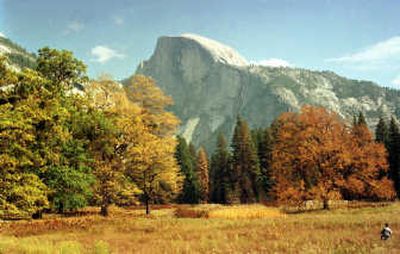
YOSEMITE NATIONAL PARK, Calif. – This isn’t the Fall Color Capital of Anything. That doesn’t mean fall color’s not here, if you know where and how to look, and if expectations are rational.
Plus, it’s Yosemite, which means, in any color, it’s flat-out gorgeous. So this is a legitimate autumn destination – but understand that Yosemite in mid-October isn’t mountains and valleys covered with reds and golds and rusts.
We also discovered that Yosemite in mid-October isn’t the Yosemite of mid-May.
For instance:
In the entire national park system, there may be no more spectacular view than the one from Yosemite’s Glacier Point.
Spread before us is the incomparable Yosemite Valley. From 3,200 feet above the valley floor, Half Dome, the park’s iconic split rock, is dramatic beyond description, which is why we’ll pass on trying to describe why. It just is.
Nevada Falls and, below them, Vernal Falls are little more than vertical white twine from this distance, but somehow beautiful nonetheless.
And Yosemite Falls? The stuff of all those Ansel Adams notecards?
“Is that smudge where Yosemite Falls would be?”
“Yep,” replies park ranger Dick Ewart, “that’s it. Yosemite Smudge.”
By now – for the record, it was Columbus Day weekend – the snow-melt has pretty much melted and gone. Streams, most of them, no longer rush. Mirror Lake has shrunk to Mirror Puddle.
Yosemite Falls, at 2,425 feet America’s tallest, is just a 2,425-foot shadow on granite.
That’s fine. We’re here to savor fall colors at Yosemite, not colorful falls at Yosemite.
But from Glacier Point, there is nary a smidgen, much less a smudge, of changing leaves.
So if not from Glacier Point, we ask Ranger Dick, where is the very best place to see them?
“Go to New England,” he replies.
But seriously, sir. We’re here to savor fall colors at Yosemite …
“OK,” he says, sensing in the writer’s question a desperate need to rationalize an airfare, “there’s some dogwoods around 5,000 feet or so, and they do turn red, and that’s nice.
“And the oak trees, they turn a little yellow – but mostly they just sort of get brown, then they fall off …”
The writer’s face droops. The ranger’s brightens a smidge.
“There is one tree in the valley,” he says. “The early pioneers – they all came from back east – they came out here and they went, ‘There’s no fall color!’ So they planted a sugar maple tree.”
(We find it. It’s across the road from Yosemite Chapel, and on our visit, some of the leaves indeed were flashing reds and yellows – just enough to draw three leaf-peeping Japanese with cameras and, well, us with ours.)
But there are subtle seasonal changes here among the dominant conifers and rocky cliffs, domes, half domes and outcrops that make Yosemite so irresistible in any season, including this one.
For the uninitiated, here’s a quickie tour of Yosemite National Park:
There’s Yosemite Valley, focus of most visitors, with its views of waterfalls, meadows, mountains, and majestic granite things like Half Dome and El Capitan – along with one of those singular park lodges with quadrupular room prices, the 80-year-old, still-grand Ahwahnee Hotel.
There’s the Wawona Road, which runs along the park’s southwestern edge and provides access to, among other attractions, the Mariposa Grove of very big sequoias.
There’s the Tioga Road, the weather-sensitive, high-altitude roadway that, open or not (and in mid-October it might be either), bisects the park horizontally and has its own amazing views and sequoia grove.
There are some other roads, including Glacier Point Road, which twists and turns from the valley to the Point.
There are hiking trails, some gentle and some not, extending from all those roads. There are trails that lead to straight-up walls of rock that lure climbers drawn to such madness.
There are black bears and mule deer and bobcats and coyotes and ground squirrels and bighorn sheep and the occasional mountain lion and other critters. Birds. Wildflowers.
There’s lots and lots of wilderness most of us will never see but, in our heart of hearts, are comforted still exists.
And evergreens. Zillions of them. Trees with cones. Trees that have needles. Trees that wear ornaments at Christmastime.
Trees that … don’t change color.
Except – not counting when they die – when the setting sun hits them just right.
There was, one very late afternoon, a startling moment when that sun hit a mountainside of deep-green conifers along the Merced River and turned them a deep-orange worthy of, dare we say it, New England.
But that was, as we said, just a moment.
The rest of the time, those of us who go nuts over autumn leaves settle for ferns that turn light tan when the chill hits, the reddish dogwoods, a hit of bright yellow from a stray aspen, dots of orange on an oak before the brown takes over and reluctant edges of color from a few maples.
“California,” explains Ewart, “has such a drought every summer. It’s just a natural, super-dry environment. Broadleaf trees – the oaks, maples, cottonwoods, beeches, birches, with such huge, delicate leaves – they can’t live.
“Pine trees are really well-adapted. In order to survive, you really need to be, you know, a needle.”
What’s amazing, though, is how satisfying the little spots of color can be.
We see those golden ferns in the shady areas around Siesta Lake, reachable by Tioga Road, and on the roadside heading up to Glacier Point, and they grab our attention.
Along the trail, much of it paved, to the nearly dry Mirror Lake are oaks whose leaves, however reluctantly and briefly, do exhibit a little brightness. Beside Tuolumine Grove’s evergreen giant sequoias, the occasional red-leafed dogwood reminds us that change does happen here, if not in preponderance then at least in a gesture that provides an honest sense of season.
Below Bridalveil Fall – in October, water falls at Bridalveil – a splash of color.
But come to Yosemite for fall colors?
“Definitely,” says another Yosemite ranger, Ariel Kelly.
“I mean, it’s one of the most beautiful sites as it is. Adding a little color here and there makes it even more enjoyable.”
As an excuse to see Yosemite, as if we needed another one – it’s golden.