
Pakistan blast targets troops
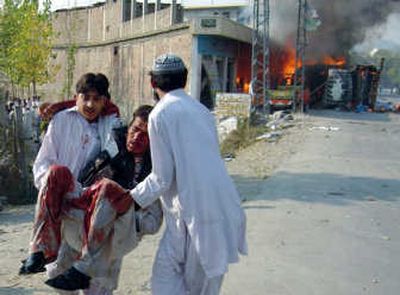
KARACHI, Pakistan – A suspected suicide bomber attacked a Pakistani military convoy on Thursday, killing at least 21 people in a scenic valley that has become another front in the nation’s war with Islamic extremists. Most of the dead were Pakistani troops.
The blast in the Swat district set fire to a military truck that was laden with ammunition, according to officials and witnesses. Scores of people, including civilians, were injured.
While battles have been raging for years in the Pakistani tribal areas that line the border with Afghanistan, a relatively recent surge of violence in Swat, to the northeast, illustrates the potential for a widened war that also takes in Pakistan’s so-called settled areas. The valley, considered one of the country’s most naturally beautiful regions, has long been known as “the Switzerland of Pakistan.”
The attack came as the military moved 3,000 security personnel into Swat in a possible prelude to a confrontation with Maulana Fazlullah, the region’s pro-Taliban cleric.
Fazlullah – who leads the Movement for the Implementation of Mohammad’s Sharia Law – uses an illegal FM radio signal to regularly broadcast calls for Islamic revolution. In recent days, he has taken to the airwaves to warn the government of devastating consequences if the military launches an offensive.
Fazlullah is believed to have thousands of black-turbaned followers who are willing to fight to defend him.
The group was officially banned in 2003 by Pakistan’s president, Gen. Pervez Musharraf, but has continued to operate illegally.