
City weighing Playfair site options
A horse track in the East Central neighborhood that once was a place to make quick cash is being hailed as property that could someday generate steady cash flow.
Later this month, the Spokane City Council will consider a plan from Mayor Dennis Hession to sell 45 vacant acres of the former Playfair race track, owned by the city’s utility division, to another part of city operations so it can be used to promote job growth.
Exactly what the city will do with the land, which borders BNSF and Union Pacific rail lines, is unclear. But there’s a clear consensus among leaders that it’s best to use the land to promote economic development.
“East Central needs employment more than it needs parks,” said Jim Hanley, president of the East Central Business Association.
Similar to the Kendall Yards property on the north bank of the Spokane River, the Playfair land has been hailed as a chance to transform empty property in central Spokane into a source of economic prosperity with new jobs and a new tax base.
But there’s some debate about how to do it.
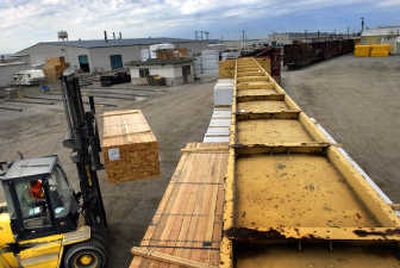
Councilman Al French supports building a train loading center – called a transloader – on the site. Because the land is near Interstate 90 and the proposed northbound freeway through Hillyard, he said it would make a perfect location for trains to unload goods to trucks and vice versa.
Citing a report the county completed last year to justify building a transloader on the West Plains, French said a transloader could create thousands of jobs from businesses that would use it to ship their goods.
The East Central Business Association, however, prefers utilizing the land for a mixed-use development that would include light industrial and residential uses.
“We’re talking about a business community that could possibly employ hundreds,” said Hanley, who owns ACME TV.
Hanley said the freeway could displace more than a hundred businesses.
“Where are these businesses going to go?” Hanley said. “They’re either going to stay in East Central, or they’re going to move out of Spokane.”
Councilwoman Mary Verner, who is challenging Hession in November’s city election, supports the land transfer and said she’s open to French’s proposal.
“I’m looking at job creation and commercial tax base creation, which we can’t do as long as it’s owned by the water and sewer departments,” Verner said.
As part of the proposal to transfer the land, the council will consider spending $25,000 to study how to best use it, including an examination of the transloader idea.
BNSF and Union Pacific officials said they are open to the idea but aren’t looking for additional transloaders.
Both railroads use Inland Empire Distribution Systems, a private company located in the Spokane Business & Industrial Park, to handle much of their freight in Spokane.
Matthew Ewers, co-owner of Inland Empire Distribution, suspects that tax dollars would be necessary to keep a city transloader operating, if one were built. He said his business couldn’t survive simply on transloading; it also offers warehousing and other services to survive.
With Spokane County considering building a transloader on the West Plains, “In my opinion, (the city) will be disappointed,” Ewers said. “This town doesn’t have enough volume to support three transloaders.”
Gary V. Hunter, CEO of Railroad Industries, said railroads in general are running out of places to locate industries, and the Playfair site could be an ideal place for a transloader. Railroad Industries is a Reno, Nev., consulting firm that is expected to research the possibility of starting a transloader for the city.
New jobs could be created at existing businesses if they start using rail to haul their goods longer distances, he suggested.
“In and around there, there seems to be an awful lot of industries that we don’t think are utilizing rail at this point,” Hunter said.
There’s also some debate – should the city reject the transloader concept – about whether the city should maintain ownership of the acreage or sell it to the private sector. Chief Operations Officer John Pilcher, for instance, has proposed leasing the land to businesses.
“We think there’s more to the property in the public’s best interest than just selling it to the highest bidder,” Pilcher said.