
In celebration of ‘Sparky’
SANTA ROSA, Calif. – Sparky Schulz always said he would end “Peanuts” when he finally wore a hole in the drawing board he used for 50 years. Sadly, that day never came.
The famous piece of hardwood now resides in a re-creation of his working studio at the Charles M. Schulz Museum and Research Center, which recently kicked off a yearlong fifth-anniversary celebration.
Schulz’s old drawing table stands at a permanent tilt in front of his favorite leather swivel chair.
“Peanuts” fans who never set foot in his longtime studio down the road at One Snoopy Place can linger here and imagine. Charlie Brown, Linus, Lucy, Pigpen, Peppermint Patty, Woodstock and the smartest beagle ever, Snoopy, came to life on this table, born out of the mind of a shy, funny, bespectacled man known since age 2 as “Sparky.”
Here, too, are old studio wall paneling and draperies, along with some of Schulz’s favorite books and knickknacks. A 1963 documentary with rare footage of him drawing “Peanuts” characters plays in a continuous loop on a small TV set.
Schulz was diagnosed with colon cancer in November 1999 and announced his retirement a few weeks later. He died at age 77 on Feb. 12, 2000, the day before the last original “Peanuts” appeared in Sunday newspapers.
A fresh “Peanuts” had been in the funny pages every day since Oct. 2, 1950, and those closest to Schulz believed he simply couldn’t bear to see it all end.
Seven years later, “Classic ‘Peanuts’ ” still appears in 2,400 newspapers worldwide, including The Spokesman-Review.
“We all continue to see ourselves in the strip, in how we connect to the world and how we relate to other people,” says museum director Karen Johnson. “And we see our own hopes, dreams, wishes and fears.
” ‘Peanuts’ is decent and it’s funny and it’s whimsical and it’s everlasting, because it’s just about being human.”
Since the museum’s opening on Aug. 17, 2002, a quarter-million visitors have gazed upon and pondered original “Peanuts” strips.
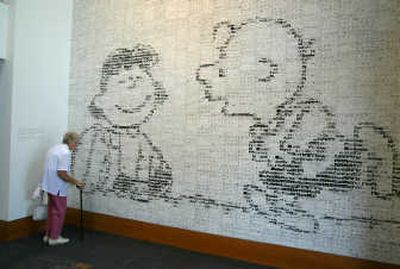
The museum is at once classy and whimsical. It’s a modern-looking building made of slate, glass and rich-looking woods with more than 6,000 square feet of gallery space and a 2,000-square-foot Great Hall dominated by Japanese artist Yoshiteru Otani’s two large, “Peanuts”-inspired art installations.
One is a layered-wood wall sculpture depicting Snoopy as he morphs from looking like Schulz’s childhood pet, Spike, to the beagle he is today.
The other is a mammoth mural showing mischievous Lucy holding the football for good ol’ Charlie Brown. The surprise is that, on closer inspection, the mural is composed of 3,588 ceramic tiles, each a miniature “Peanuts” strip.
There are smaller exhibit spaces on two floors, a research library, a 100-seat theater and a room where kids create their own art. Among the outside attractions are a labyrinth that looks like Snoopy’s head and a “kite-eating” tree.
This tribute to a comic strip stands a few blocks west of Highway 101 in a neighborhood that should, by all rights, be called Schulz Acres.
Across the street is the Swiss-themed Redwood Empire Ice Arena that Schulz built for this community in 1969. He competed in a Tuesday night hockey league and in the annual Senior World Hockey Tournament, which he founded.
The hockey tournament goes on every summer, but the elaborate, professional ice show he put on every Christmas doesn’t.
Schulz’s properties were so close together that he could walk in a matter of minutes from his studio to the ice arena (where he dined twice a day at the Warm Puppy Cafe), his indoor tennis court and the baseball field he built for neighborhood kids.
The idea for the museum originated with two friends of Schulz, cartoon collector Mark Cohen and longtime attorney Ed Anderson, while he was still alive. It took Schulz and his wife a while to embrace the notion, though.
“Ed began to think about Sparky’s legacy and how we were going to preserve it,” says Jeannie Schulz, who was married to the cartoonist for 26 years.
“He and Mark said to Sparky, ‘We need to do something, to have a museum.’ And I thought, ‘What do you mean, a museum? Sparky is here.’
“I don’t think I ever thought (the comic strip) would end, but finally I began hearing what they were saying and thinking how it could really happen.”
The Schulzes financed the $8 million museum, which operates as a nonprofit. Schulz, reluctant at first, warmed to the idea of the museum as a place where “Peanuts” fans could see his original artwork.
As much a part of popular culture as “Peanuts” has been for more than a half-century, Jeannie Schulz thinks scholars will someday study her late husband’s work. And they can do that in the museum’s vast research center.
“I think ‘Peanuts’ is going to have a revival among people who are going to come at it from a different point of view, not as a popular thing people read every day and forgot about, or that was in the back of their brain,” she says.
“I think they’re going to come at it from the point of view of its humanity and how, despite the way the world changed, it always tapped into basic human philosophy, fears, feelings and needs.”
Schulz, the son of a Minneapolis barber, introduced the phrases “happiness is a warm puppy,” “security blanket” and “good grief!” into the languages of 64 countries.
The images of Snoopy on his doghouse roof, Linus and his blanket, and Lucy pulling the football away from Charlie Brown at the last moment are forever fixed in the minds of fans.
The characters live on with young fans who every year watch the animated specials “A Charlie Brown Christmas,” which premiered on television in 1965; “It’s the Great Pumpkin, Charlie Brown” (1966); and “A Charlie Brown Thanksgiving” (1973).
And now Snoopy is about to rock the Big Apple.
Top fashion designers, such as Betsey Johnson and Isaac Mizrahi, have created “Peanuts”-inspired frocks for the “Snoopy in Fashion” runway show Friday during Fashion Week in New York City. Afterward, the clothes will be sold on eBay, with proceeds going to Dress for Success.
Despite “Peanuts’ ” continuing popularity, Jeannie Schulz was surprised when the museum’s staff proposed celebrating its fifth anniversary.
Her husband won his first Reuben Award – the top honor given by the National Cartoonists Society – in 1955, five years into the five-decade run of “Peanuts.”
“That was pretty amazing and a great vote of confidence for the comic strip,” she says, “but he had to keep working at it, to keep ahead of the competition.
“So I’m like Sparky: When the museum is 50 years old, we’ll consider it a success.”