
NIGHT VISION
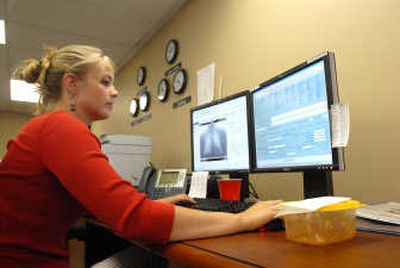
When Dr. Bill Portner’s beeper would go off at night, the radiologist from southern Maine would stumble to his home computer to read the latest CT scan sent from Stephens Memorial Hospital’s emergency room.
The rural hospital has only 50 beds. But Portner could be awakened a half-dozen times each night to determine whether the scan from an accident victim showed a head injury, or whether a patient’s abdominal pain was caused by a ruptured appendix.
By 4 a.m., he often wondered if he was dreaming or awake. “That’s a dangerous thing,” said Portner, who worried about diagnostic errors caused by sleep deprivation.
For the past six years, however, Portner has slept soundly. He now relies on Nighthawk Radiology Holdings of Coeur d’Alene to provide nighttime readings for the hospital.
The firm has built a $150 million business out of relieving doctors like Portner. Nighthawk contracts with 118 radiologists – some as far away as Sydney, Australia, and Zurich, Switzerland. Awake and alert in other time zones, they read CT scans, MRIs and X-rays sent by high-speed data lines from hospital emergency rooms on the globe’s dark side. Within 30 minutes, the hospitals receive a written report by fax or e-mail.
“That’s pretty damn good,” said Portner, who reviews each image and diagnosis the next morning for accuracy.
He pays roughly $50 for each CT scan image that Nighthawk’s radiologists interpret. But Portner, who spends 26 weeks per year on call, says a full night’s sleep is well worth the cost.
Nighthawk was founded in 2001. It’s the brainchild of Dr. Paul Berger, a radiologist with plenty of experience in late-night readings. At a radiology practice that Berger headed in Long Beach, Calif., doctors working the night shift were called nighthawks. It’s a slang term for helicopter pilots who flew night missions in Vietnam.
In 1996, Berger moved to North Idaho. After five years in a practice where he was frequently summoned from bed for work, Berger figured it was time to tap the market for after-hours radiology. Not only was the use of images as diagnostic tools expanding rapidly, but radiologists were in short supply nationally. Technology, meanwhile, had advanced to the point where large data sets could be sent overseas in minutes or seconds.
“It’s been good for everyone,” said Berger, Nighthawk’s chairman and chief executive officer. “The doctors are happy, and the patients get better care.”
At the company’s Sydney office, radiologists are working 17 hours ahead of the Pacific time zone. In Zurich, the office is nine hours ahead. Nighthawk also employs contract radiologists in different U.S. time zones.
The images – along with a patient history and past scans – are sent out to Nighthawk’s U.S. board-certified radiologists. If doctors at the hospitals have questions about the results, they can call an 800 number and speak directly to the radiologist.
Dr. Jim Norconk spent 18 months at Nighthawk’s Sydney operation. From an office with views of the city’s harbor and famed opera house, he looked at images generated 9,000 miles away.
The volume of scans he read daily sharpened his skills in specific areas, Norconk said. Multiple images for head trauma, ruptured spleens and possible appendicitis poured in during each shift.
“In a private practice, you might get one to two scans to rule out appendicitis per night,” Norconk said.
Norconk, 60, and his wife, viewed the overseas assignment as a great way to travel. He also worked in Zurich for Nighthawk Radiology, and now reads images from his home.
Nighthawk isn’t the only firm that provides nighttime radiology, but it is one of the largest and the only publicly traded firm. Over the past three years, Nighthawk’s revenues have grown by 40 to 60 percent annually.
Since becoming a Nasdaq-traded firm in 2006, Nighthawk has purchased several smaller firms. Its business focus has broadened to include daytime readings and businesses services for radiology offices, such as transcriptions. Nighttime readings, however, remain the company’s core business.
Nighthawk has been in the forefront of after-hours radiology, said Dr. Arl Van Moore, chairman of the American College of Radiology’s Board of Chancellors. The company works with more than 1,300 U.S. hospitals. As a tribute to the firm’s prominence, the term “nighthawk” has become a generic industry reference.
As other firms join the field, however, questions have arisen about liability issues related to diagnoses made overseas. Two years ago, the American College of Radiology issued an informational report on the topic. Moore said it stemmed from reports that some companies were using radiologists that weren’t U.S. trained or U.S. board-certified.
At least one malpractice suit involving another firm has arisen. A Pennsylvania hospital and one of its ER physicians were sued when a radiologist based in India gave a wrong diagnosis, according to a Washington Post article. The patient, who was sent home, later died when an artery burst in his heart.
U.S. hospitals are “vicariously” accepting liability for work done overseas, Moore said. “Can the U.S. courts subpoena someone in Bangladesh or India?” he said. “The real person doesn’t have to show up.”
Nighthawk’s radiologists have always met high standards, Berger said. All of them are U.S. board-certified. They also are licensed in the states where the images they are reading originate. And they have privileges at the hospitals where the scans are taken, just like any other physician who works at that hospital, Berger said.
“This is not sending Mrs. Smith’s images to Afghanistan,” he said.
After Norconk was hired by Nighthawk, for instance, the former private practice radiologist from Florida had to get licenses in multiple states and privileges at 700 hospitals, before he could read images in Sydney. The process took more than six months, Norconk said.
Portner, the radiologist from Maine, said he’s pleased with the quality of readings from Nighthawk’s radiologists.
The reality is that all doctors occasionally make mistakes, he said. If a pattern develops, it’s spotted, just as it would be in a stateside radiologist, Portner said. “If there’s a bad physician, we find him.”
Portner said put he’s put Nighthawk’s services into two different hospitals in Maine. All but one hospital in Maine now use Nighthawk for nighttime radiology readings, according to the company.
As much as he likes the service, Portner said it isn’t foolproof. Occasionally, the Internet is down. Then, he’s back on call.