
Climbers give Q’emiln a makeover
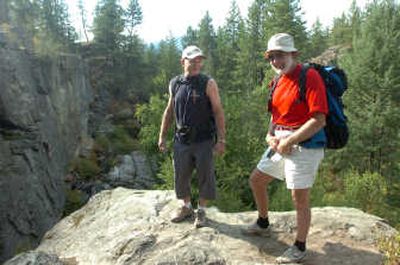
POST FALLS – The rock-climbing bolts embedded in the craggy cliffs of Q’emiln Park may last longer than the rock itself.
At least that’s the hope of Rusty Baillie and Richard LeFrancis, who have dedicated thousands of hours in to improving the safety and quality of rock climbing in the Post Falls park.
The pair, who founded Kootenai Klimbers, have replaced climbing bolts, cleaned up rock faces and smoothed out trails in the riverside park. The men hope their efforts will boost safety and protect the environment.
“The traditional climbing area (was) in pretty rough shape at Q’emiln,” said Baillie, who lives in Dalton Gardens. “We didn’t want to Band-Aid it anymore.”
The pair’s efforts have won appreciation from climbers, including North Idaho College Outdoor Pursuits coordinator Paul Chivvis.
“I noticed a difference in the trail maintenance to and from climbing areas. The bases in the climbing areas are a lot nicer,” Chivvis said.
With the help of volunteers and cooperation and funding from the Post Falls Parks and Recreation Department, Baillie and LeFrancis have approximately doubled the number of climbing routes, improved safety by replacing beat-up bolts and protected the environment by designating clear trails.
The marked trails help prevent hikers and climbers from “wandering helter-skelter,” Baillie said.
It took three or four full days to shape up each climbing route: studying it, scrubbing the rock, pulling down loose boulders and outfitting it with stainless-steel bolts.
More than 80 routes are available for climbers now, said LeFrancis, who lives in Coeur d’Alene.
The routes are mostly for sport climbing, for which bolts are pounded into the rock face that climbers can clip into. A few of the routes are for traditional climbing, a riskier method using a system of removable wedges that climbers slip into cracks and crevices.
Baillie’s and LeFrancis’ efforts have made Q’emiln Park safer, especially for beginning climbers, Chivvis said.
“I definitely see Rusty as someone who has adopted the area. It definitely shows it,” Chivvis said. “He’s put a lot of heart and soul into it.”
Both men are avid rock climbers, so “it was sort of practical altruism,” Baillie said.
Baillie, a retired college professor of outdoor education, grew up in Rhodesia, now Zimbabwe, in southern Africa. He has climbed in the Alps and participated in the first Canadian expedition to Mount Everest more than two decades ago.
LeFrancis, a retired businessman, has climbed for years and credits Baillie with continuing to challenge him.
The two founded Kootenai Klimbers as an advocacy group, representing climbers during the re-licensing of the Post Falls dam by Avista Utilities. Now, the group of about 30 members meets occasionally, participating in “Adopt a Crag” events to spiff up Q’emiln Park.
“Adopt a Crag” is sponsored by the Access Fund, a nonprofit organization that helps keep rock-climbing crags open and clean nationwide. Kootenai Klimbers won an award from the group three years ago for its efforts in Q’emiln Park.
North Idaho is a mecca for recreational activities, so it makes sense to enhance the opportunities, Baillie said.
Baillie and LeFrancis have big plans and dreams, including expanding the rock-climbing areas in Q’emiln Park, establishing a hiking loop trail in the 78-acre park and creating more parklands along the Spokane River.
“People like to recreate. That’s one of the reasons people come to the Northwest,” Baillie said.