
Vials lost as policy relaxed
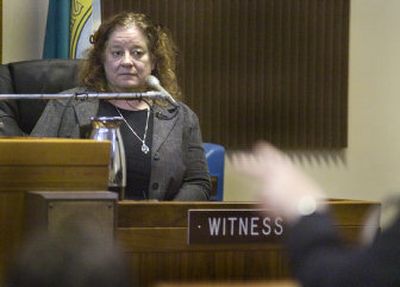
The former manager of the Washington state toxicology lab testified Thursday that she relaxed procedures for preserving blood samples around the time that prosecutors were eager to hang on to two vials of Fred Russell’s blood.
Instead of separating vials to be saved, they were labeled and left among thousands of others headed for destruction.
“The idea was that they would be pulled out at the time the samples were discarded,” said Ann Marie Gordon, who ran the Seattle lab until resigning under criminal investigation in July.
But that didn’t happen when Gordon herself threw out more than 9,000 vials in July 2004, accidentally discarding several meant to be saved – including Russell’s.
Gordon testified in Whitman County Superior Court during a hearing on Russell’s vehicular homicide and assault case. Russell is set to stand trial next month on charges that he was driving drunk when he caused an accident on the Moscow-Pullman Highway that left three dead in June 2001.
His defense has focused on the issue of his lost blood, the performance of the toxicology lab and Gordon’s own credibility.
King County prosecutors are considering criminal charges against Gordon over allegations that she committed perjury by testifying and signing statements asserting she had performed tests that had actually been done by someone else.
Francisco Duarte, Russell’s attorney, is asking Judge David Frazier to throw out the charges against Russell because of the lost blood samples and a pattern of “misconduct” on the part of the lab and the state. He argues that Russell’s right to a fair trial is compromised by the inability to independently verify the blood test that showed he was drunk at the time of the crash.
Prosecutors have said that the mistake was inadvertent and that a hospital blood test at the time corroborated the test results.
Gordon refused to answer questions Thursday about the recent allegations against her, asserting her Fifth Amendment right against self-incrimination at her lawyer’s direction. But she testified about the circumstances surrounding the destruction of the Russell samples and procedures in the lab at that time.
Gordon said she regrets the decision to leave the “save” samples in among the others sometime before 2004, but her lab staff had requested the change to ease a burdensome workload.
“These people were doing probably three times the number of cases the average lab would do,” she said. “They were overworked.”
But the change failed to ensure the samples were saved. One problem was that the red “save” labels were the same color as other common labels on samples, and that confusion apparently contributed to Gordon overlooking the Russell samples and others when she threw them out on July 11, 2004, she said. She said perhaps three samples other than Russell’s were mistakenly thrown out, but none of those cases was affected.
Gordon said destroying a large batch of blood samples is difficult work, and she came in on a Sunday to clear out a years-old backlog of blood samples.
“I do remember that day because my back was killing me after I finished and I was soaking wet because it was so hot in there,” she said.
Duarte challenged whether she had been careful in checking the vials.
“I did not pick up each and every vial,” she said. “I picked up the rack, I went through the rack, and when there were no samples to be saved, I threw them out.”
Moments later, Duarte said, “And you call that being careful?”
“It was the best I could do at the time,” she said.
Samples are typically saved for at least nine months, though Gordon said it’s often longer. In 2004, the lab hadn’t thrown out any samples at all since 2001, and it only started doing so because it was running out of room, Gordon said.
Russell’s blood was in the first batch of samples to be destroyed at that point.
Gordon discovered it missing in February 2005. After that, the lab resumed a policy of separate storage for samples to be saved.
“In retrospect, I wish I hadn’t changed that” to begin with, Gordon testified.