
Reactor a draw for Cold War buffs
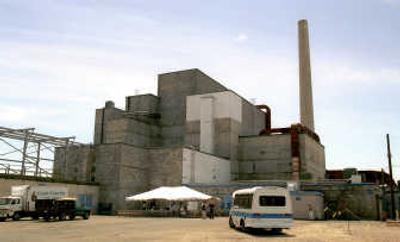
RICHLAND – The sight of it rising from the sagebrush – hulking, gray, sinister – evokes an era of top secrets and spies, when a mysterious concoction being brewed out here in the desert would change the world. Or maybe destroy it.
B Reactor looks like what it is: a weapon of war. It was the world’s first production-scale nuclear reactor, source of plutonium for the first atomic bomb and tritium for the first hydrogen bomb.
And now, a tourist attraction.
In an attempt to capitalize on the shuttered reactor’s role in nuclear weapons development and the Cold War, people here want to open it to regular public bus tours.
There’s plenty of demand. When B Reactor is opened on occasion to visitors (U.S. citizens only), slots fill up online in about a minute. Russ Staska, who snared a ticket for a tour in June, compares it to “hitting the lottery.”
The reactor was built in just 11 months during World War II. It’s the oldest of nine reactors on the government’s Hanford nuclear site, created in 1943 when a judge confiscated an area half the size of Rhode Island. He gave the residents some money, no explanation and 30 days to move.
The other decommissioned reactors have been or will be fenced off and sealed while radiation in their cores slowly decays.
But the National Park Service is considering whether B Reactor should be preserved as a museum.
It’s part of a study of facilities built for the Manhattan Project, the crash wartime effort to harness the power of the atom before Hitler did. Some others are at Los Alamos, N.M., where the first atomic bomb was assembled and test-detonated in 1945, and Oak Ridge, Tenn., which produced the enriched uranium used in the A-bomb dropped on Hiroshima.
The study reflects a growing interest in “nuclear tourism,” whose devotees make the rounds of installations such as the Park Service’s Minuteman missile silo in South Dakota.
“Cold War history is hot stuff,” says Michele Gerber, Hanford site historian and a member of the local Committee to Save B Reactor. Still, B Reactor is an unusual candidate for preservation and visits for at least two reasons:
•It helped produce the most deadly weapons in history. That includes the A-bomb dropped on Nagasaki, which killed up to 70,000 civilians.
•It’s on the most polluted site in North America. B-Reactor is safe to visit – the Department of Energy says there’s no airborne radiation and no chance of exposure as long as visitors stay behind the ropes.
Hanford generated the largest single collection of nuclear waste outside the Soviet Union. About 440 billion gallons of contaminated liquid were intentionally dumped into the parched soil, leaving an 80-square-mile plume of contaminated ground water. In addition, 53 million gallons of highly radioactive waste are stored in 177 underground tanks, some of which leak.
The drive to preserve B Reactor is part of an attempt to create a viable future for the Tri-Cities.
The Manhattan Project transformed Richland from a sleepy agricultural settlement to a construction camp of 50,000. After the war, it evolved into a centrally planned, government-built community of engineers, technicians and managers.
B Reactor closed in 1968, and by the late ‘80s so had all Hanford’s weapons reactors. The local economy has continued to thrive, however, thanks to a soil and water cleanup on which the government spends $2 billion yearly, supporting about 12,000 full-time jobs.
But even the Hanford cleanup can’t last forever. “How do we diversify ourselves from an artificial economy?” asks Carl Adrian, president of the Tri-City Development Council, which promotes the area. One answer is tourism.
Kris Watkins, head of the visitors bureau, says visitors could combine a visit to B Reactor with a dinner cruise on the Columbia or a tour of nearby wineries. Gerber says B Reactor tourism is vital to the image of the Tri-Cities.
“We want to become a full part of Washington state,” she says. “We don’t want to be isolated as we were. We want to be a center of Cold War studies.”