
Last Air Guard tankers take off
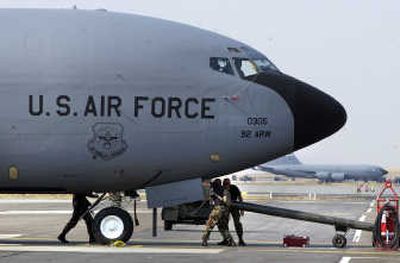
The last two Washington Air National Guard tankers stationed at Fairchild Air Force Base took off Thursday, headed for their new home in Iowa.
The tankers’ departure ended a long era of Guard airplanes in Spokane on the same day the Guard and Air Force embarked on a new journey together – sharing planes.
In a first-of-its-kind agreement, the Washington Air National Guard’s 141st Air Refueling Wing, based at Fairchild, will be able to use the Air Force’s 92nd Air Refueling Wing’s active-duty planes for daily training exercises and to respond to emergencies.
Washington Gov. Chris Gregoire filed a lawsuit to fight a federal decision to move the Guard’s nine planes as part of the 2005 Base Realignment and Closure process, but on Thursday announced the settlement agreement.
The agreement dictates that the Guard will be able to use two 92nd Wing KC-135 Stratotankers each day for training. Two more will be available with 15 days’ notice for Guard missions, and up to eight can be requested on short notice to respond to emergencies.
“We have got to have the ability to respond to local emergencies whether it be forest fires or national emergencies like what happened in Louisiana with Hurricane Katrina,” Gregoire said.
Gregoire called the agreement a model for other states’ Guard units.
Both the Guard’s 141st Wing and the Air Force’s 92nd Wing are located at Fairchild. They have a history of cooperation, said Brig. Gen. Gary Magonigle, Washington Air Guard adjutant general and a former commander of the 141st.
“I’m told we have one of the best partnerships to be found anywhere,” Gregoire said.
Col. Roger Watkins, vice commander of the 92nd, agreed, calling the settlement the next step in the Guard and Air Force’s relationship at Fairchild.
A crew from the 141st already used a tanker from the 92nd to return personnel from Iowa, where they had flown their KC-135s to turn over to a Guard unit.
Guard and Air Force officers have already started hammering out how the sharing will proceed, Watkins said.
Some aspects of implementing the agreement will be challenging, he said.
The 92nd is assigned 34 tankers, but some are deployed overseas.
On any given day the 92nd has some KC-135s in the air and some in maintenance. And while there are often some on the flightline or in hangars without a specific mission, there are days when the 92nd flies every available tanker.
Such high-demand times will have to be sorted out to meet Air Force and Guard demands.
“We will make it work,” Watkins said.
If Washington’s governor determines tankers are needed and they are not immediately available at Fairchild, the agreement stipulates that the Air Force’s Air Mobility Command find them someplace else.
The agreement gives the 92nd Air Refueling Wing commander the ability to determine, however, whether a situation constitutes an emergency.
Gregoire used Hurricane Katrina as an example of why Washington’s governor needs access to the tankers.
When the state of Louisiana was hit by the storm in 2005, a call to Gregoire for help was answered in short order when she was able to mobilize Washington National Guard members with a single phone call. They flew down to Louisiana on Air Guard KC-135s.
Rep. Cathy McMorris Rodgers, R-Wash., called the settlement of the lawsuit and the 16-page agreement “an important step in the implementation of BRAC.”
If the guidelines work properly, Fairchild could become a model for other bases where an Air Guard unit and an active-duty unit are forced into these types of associations, McMorris Rodgers said.
The 141st and the 92nd have a history of cooperation but have different missions, which complicates the sharing of planes and equipment, she said.
After the state filed its lawsuit, the Air Force began raising questions about how well realignment was working at Fairchild. In conversations over the past year, Air Force officials raised the possibility that Fairchild would not be the first base to get a new generation of air refueling tankers, currently known as the KC-X, when they are available early in the next decade, McMorris Rodgers said. When Congress first approved a replacement for the KC-135 in 2002, Fairchild was listed as the likely home for the first 32.
“The Air Force has made it clear that when it comes to delivering the first KC-Xs, how well the Air Guard and the active duty are associating is a concern,” she said.
The agreement represents “a step in the right direction” to keep the new planes coming to Fairchild, she added.
Sen. Patty Murray, D-Wash., agreed that the settlement was “a significant step in a long process” of determining where the first new tankers would be located. But there may not be a direct correlation between the settlement and assigning new planes to the base, a spokeswoman added.
Naming Fairchild as the new home for the first 32 new tankers was politically contentious at the time – and other bases, as well as the members of Congress from the districts where they are located – would like that distinction, too.
“We’re going to work with everyone to get the first new tankers to Fairchild,” said Alex Glass, a Murray spokeswoman.
Both Gregoire and Adjutant Gen. Timothy Lowenberg negotiated the settlement with the Air Force.
Several other states are fighting legal battles to keep resources taken from Guard units as part of BRAC, said Ret. Brig. Gen. Stephen M. Koper, president of the National Guard Association of the United States.
“I’m not aware of anyone else who’s approached it in the same way,” Koper said, adding that the development is encouraging. “I’m pleased to hear there’s been a settlement.”