
Olmsted aficionados get a tour
Spokane’s 100-year-old legacy of natural parks and open spaces is being recognized this weekend by a group of national experts who know something about great parks.
The board of the National Association of Olmsted Parks is meeting in Spokane today and Saturday, and getting a close-up look at how the city made good on recommendations in 1908 by the nationally renowned Olmsted Bros. Landscape Architects firm, of Brookline, Mass.
“Part of their genius was they had great respect for the natural surroundings,” said NAOP board member Jerry Baum, of Baltimore.
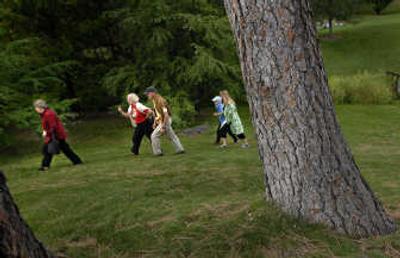
Baum and other board members on Thursday got a look into a deep gorge and trickling waterfall at Indian Canyon Park natural area, which was acquired under the Olmsted plan.
“This is certainly a good example” of the Olmsteds’ vision, Baum said.
John C. Olmsted and Frederick Law Olmsted Jr. were the stepson and son of Frederick Law Olmsted, who designed New York’s Central Park and started the landscape firm. John Olmsted led the Spokane effort at the same time the firm was working in Seattle and Portland.
Under the Olmsted recommendations, city park holdings expanded from 173 acres in 1908 to 1,934 acres in 1913, when the plan was published. A $1 million ballot measure in 1910 paid for many of the acquisitions.
Since 1913, the park system in Spokane has doubled to about 4,000 acres.
The Olmsteds recommended buying and preserving large swaths of land along the Spokane River. They also called for landscaped boulevards, large city parks and neighborhood play areas. Their 1907 commission resulted in a series of detailed drawings for several of the city’s older parks. The Olmsteds were leaders in the historic City Beautiful movement, which was embraced by Spokane.
Sally Reynolds, a Spokane preservation consultant and member of an Olmsted Centennial Committee, said Spokane has lived up to the Olmsted legacy over the years. “We should be proud of our parks,” she said.
On Oct. 6, the Northwest Museum of Arts and Culture will open an exhibit titled “Olmsted Brothers: Designing Spokane Landscapes,” which will run through Aug. 17. It will include framed original park designs and other historic documents.
In describing the exhibit, the museum Web site says, “Their correspondence, photographs and planting plans offer a personalized local story, set into the broader context of western city planning.”
In addition, the 1913 park board report, which includes the Olmsted plan, has been republished and is available at the MAC and the city Parks Department on the seventh floor of City Hall for $15.
Some of the firm’s work can be seen in the historic Rockwood Neighborhood on the South Hill. Three Garfield Street traffic islands were named in June as the Olmsted Triangle Parks.
Baum said the Olmsteds left a 90-year national legacy of 650 public parks and 2,500 private commissions. They worked on several national parks and the U.S. Capitol. The preservation and open spaces seen in their designs are relevant today, and the National Association of Olmsted Parks is working to protect and advance that legacy, Baum said.
By comparison to Spokane’s open spaces, Boston and Brookline have their Emerald Necklace of parks and Colorado has its Denver Mountain Parks, both Olmsted-inspired, board members said.