
Requiem for a heavyweight
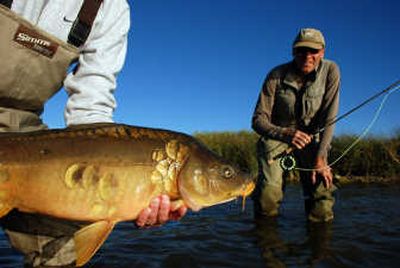
The underrated scrapper took a hook to the jaw and then battled back in the fight of its life. Fifteen minutes later, the fish was still taking everything his foe could dish out with a 10-pound leader, leaving an arm-weary Bill Mulvihill to consider throwing in the towel.
A champion by angling standards of size, brute strength and invincibility, the carp still had not rolled on its side to give up when Mulvihill’s fishing partner, Tom Munson, stepped in and broke up the contest. He grabbed the fish by its tail and groaned as he hoisted the heavyweight from the water for a photo.
“It’s a beauty!” I said in spontaneous praise befitting any 15- to 20-pound fish landed in a freshwater lake.
Then we all chuckled.
“Beauty” is not a term most people, especially fly fishers, attribute to carp.
But one man’s trash fish is another man’s treasure. Being in the minority is what carp fishing is all about.
While anglers compete for good runs on the region’s rivers, Mulvihill and Munson wade out of the mainstream to catch carp running three times larger than the average Snake River steelhead.
“We have this all to ourselves,” said Munson as he stood thigh-deep in the lake’s lonesome south shoreline waters. “That’s part of the attraction.”
Of course, the featured attraction in this particular arena will soon be gone. The Washington Fish and Wildlife Department is planning to deliver a sucker punch to the carp in October by treating Sprague Lake with rotenone to kill the current fishery.
“We’re enjoying this while we can,” Munson said.
A member of the minnow family, the carp comes in about 1,500 varieties around the world. The common carp is the only widely available species in the Inland Northwest, where it was introduced officially and unofficially in the 1800s as a hardy food fish.
Indeed, the carp is durable enough to out-compete almost all native fish, but few people in the West have developed a taste for its oily flesh.
Most anglers are repulsed by the sight of a carp on the end of their line, but truth is, few anglers have had to suffer that indignity.
Carp are not easy to catch.
“They can be pretty temperamental about hitting a fly,” said Mulvihill, who then quietly presented a master’s clinic on how to catch them.
The method was simple: He waded the shoreline looking for stirred mud or bubbles indicting that carp were feeding. Then he stealthily moved toward the fish and cast among them using a weighted black and white Woolly Worm on a size-10 hook.
Even though I was using the same fly, Mulvihill outfished me seven carp to zip until I realized he was using a longer leader with his floating line. I extended my 10-pound leader to 11 feet and quickly caught two carp.
I never caught up to the masters, but hooking even a few of these fish is an accomplishment.
“This is poor man’s bonefishing,” Munson said.
Carp are robustly built with bony, oily flesh and muscular “shoulders” that blend into a triangular head.
A hooked carp could tow a barge around a lake without leaving the slightest rip in its rubbery, round mouth.
Common carp generally have an armor of coarse scales, although the “mirror carp” variety has patches of scales. A carp with no scales is called a leather carp.
They have teeth in their throats for chewing and enhanced systems for hearing and feeling that enable them to find food in mucky waters.
These same assets help them sense danger, making them extremely easy to spook.
Carp are shoaling fish, that is, they swim in groups to enhance feeding and security from predators.
Scare one carp and you likely will spook them all.
They are omnivores, eating virtually anything, including snails and seeds. A 100-degree afternoon that sends trout gasping to the deep-water springs doesn’t deter carp from coming into the shallows to poke their faces into the mud.
Other than Woolly Worms (without the red tail), favorite fly-fishing patterns include small crawdads, leeches and chironomid nymphs.
Some fly fishers use a strike indicator and strip slowly. If the indicator goes down, point the rod directly at the fish and strip again. If the fish is on, lift the rod. If not, continue to strip.
Munson and Mulvihill, however, use bare leaders and flies weighted enough to tick the bottom as they retrieve.
Carp are found in Newman Lake and the Spokane River impoundments including Long Lake. Carp flourish in the reservoirs and sloughs along the lower Snake and Columbia rivers. Potholes Reservoir and Moses Lake have burgeoning populations of the prolific carp. Banks Lake, with it’s wealth of bays and flats, is perfect for poling a boat or wading for carp.
But you’ll find more fire-breathing dragons than carp fishermen on these waters.
The carp’s poor reputation among anglers is only part of the reason the Washington Department of Fish and Wildlife has spent millions of dollars controlling carp in smaller waters throughout the state.
“They’re a real pain for us,” said Chris Donley, department fisheries biologist in Spokane. “They muck up the water, reducing photosynthesis and causing problems for the entire food chain.”
Virtually all native fish species suffer when carp move in. Even ducks have trouble finding enough aquatic vegetation growing through the dim light of carp-infested waters.
The October rotenone treatment will knock out the carp and give restocked sport fish a chance to flourish in the clearer waters of a rejuvenated Sprague Lake.
“Unfortunately, carp are survivors and there’s no way to kill them all,” Donley said. “It’s not a permanent goodbye. I wish it was, but it isn’t.”
The two Spokane anglers were philosophical about the looming doom for their personal trophy fishery.
They released Mulvhill’s lunker back into Sprague Lake even though they know it will be among the thousands of fish that will belly up to the rotenone treatment during the week of Oct. 8.
“We’ll probably be back out here in 15 years catching monster fish like that again,” Munson said as the carp disappeared into murky waters where the sun doesn’t shine.
“Until then, I’m looking forward to coming out here after the rehab and catching bluegills.”