
Fruit growers feel the cold

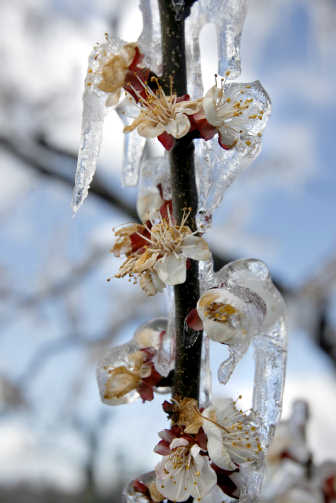
YAKIMA – Fruit growers are tallying losses from an unusually cold spring across Eastern Washington.
Temperatures recently dropped into the upper 20s and 30s across most of the region.
“That should be the last of the widespread freezing,” said Mary Johnson, a meteorologist with the National Weather Service in Pendleton, Ore.
From the Wenatchee area northward, average temperatures for the first 20 days of April were the coldest on record for the month, said Robert Tobin, senior forecaster at the National Weather Service in Spokane.
Across the central part of the state, growers have been using wind machines, irrigation water and propane heaters to protect fruit buds nightly since March 13, said Jim Holcomb, co-owner and meteorologist of Clearwest Inc., an agricultural weather service in Wenatchee.
Scott McDougall, vice president of McDougall & Sons Inc. of Wenatchee, said he couldn’t remember a spring in 30 years when it has been so cold for so many weeks.
The National Agricultural Statistics Service estimated cherry crop loss at 5 to 10 percent for Chelan and Douglas counties but had no figures for other counties.
Overall, “it’s too early to tell what happened,” said Dave Carlson, president of the Washington Apple Commission.
Washington’s apple industry is worth more than $1.3 billion and the state’s cherries add another $350 million a year.
Dennis Jones, of Zillah, estimated he would lose 15 to 20 percent of his apples.
McDougall said his company’s 50-acre cherry orchard in Quincy had 90 percent damage or worse Sunday night.
“We feel like we lost the crop there,” he said.
Gary Middleton, owner of Middleton Orchards in Eltopia, said about a third of his organic cherry crop was lost. “It devastated a 17-acre block of cherries,” he said.
Trees fared better in areas where late cold snaps are more common, said Teresa Baggarley, spokeswoman for the Washington State Fruit Commission.
“Growers in the Okanogan area were OK,” and the same was true for Chelan, Baggarley said.
Elsewhere in the north-central part of the state, it was another story.
“The cherry crop in Wenatchee seems to be hit pretty hard. Some pockets might be OK, but overall there’s potential for a pretty high percentage of damage,” said Ron Gonsalves, general manager of Blue Bird Inc., a fruit cooperative in Peshastin.
Pear buds are damaged significantly when the temperature drops below 25 and unwanted skin markings develop from exposure to the upper 20s, Gonsalves said.
“We have a serious problem, but we don’t want to make it bigger than it is until we get out there and assess the damage,” he said, adding that most operations will have a more complete picture later this week.
Don Weippert, owner of Weippert Orchards, said he’s never seen weather like this. “We’re getting damage in areas that we typically don’t frost-protect because historically it hasn’t been cold.”
Peter Verbrugge, chairman of Sage Fruit in Basin, reported spotty damage throughout the company’s 20,000 acres of orchards.
“We were hit in areas we don’t normally worry about,” Verbrugge said, “and then in places like west Wapato, which is normally very cold, there’s little damage.”
Some growers gave up and didn’t try to protect against frost over the weekend, Jones said.
Those who did take protective measures face hefty costs. Some say they used five times the usual amount of propane to power wind machines and orchard heaters.
The weather has cost growers “millions and millions, and we aren’t done yet,” Middleton said.
So far, growers said, the losses do not appear to be disastrous.
“There was a large bud set on cherries. We are expecting a really large crop, so some cherry orchards could sustain a 50 percent kill rate and still have an adequate crop,” said West Mathison, president of Stemilt Growers Inc. in Wenatchee.
Less fruit on the trees generally means higher quality, so “the cherries that are going to be on the market will likely be outstanding,” Middleton said. “Anything that was weak is dead.”