
Bluebirds relocated to San Juans
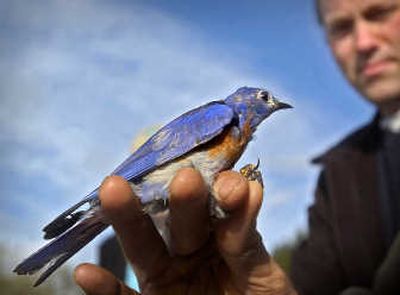

FORT LEWIS, Wash. – In the 1980s, volunteers erected hundreds of small cedar nest boxes and revived a Fort Lewis songbird population that had nearly vanished.
Now, with Army approval, four conservation groups are trying to piggyback on that success and return Western bluebirds to native oak woodlands on San Juan Island.
On Wednesday morning, biologists used recorded bird songs and chatter to lure two nesting bluebird pairs from Fort Lewis’ prairies into fragile mesh traps.
Then, after banding and measuring each bird, the men carefully caged them for transport to Friday Harbor, where it’s hoped they will nest and breed. Gary Slater, the biologist who did the banding, deliberately kept each pair together.
“Holy matrimony and all that,” he joked. “We want them to be happy.”
This is the second year of a five-year relocation effort involving 50 nesting pairs of the brightly colored birds.
Once as common as robins, Western bluebirds are heralds of spring that typically lay their eggs in small holes in trees. While the Fort Lewis population is thriving, the birds have disappeared from much of their historic range, which includes the San Juans.
When people farmed and built homes in the open oak woodlands where bluebirds flourished, they destroyed many of the dead and dying trees where the birds once nested.
“A critical element of their habitat has been lost,” said Slater, research director for Ecostudies Institute, a nonprofit based in Mount Vernon.
The institute has teamed up with the American Bird Conservancy, the San Juan Preservation Trust and the San Juan Audubon Society to sponsor the Western bluebird reintroduction.
Until last year, when the first Fort Lewis transplants arrived, no one had seen a Western bluebird on San Juan Island since 1940, Slater said.
While San Juan Island is the initial focus, the conservation groups also plan to bring back bluebirds to Whidbey Island and Vancouver Island in Canada, he said. The last breeding pair of bluebirds on Vancouver Island was seen in 1992, he said.
“These are all areas where they were historically,” Slater said.
Bluebirds typically occupy 60 percent of the 220 nest boxes on Fort Lewis, he said. And last year, Sam Agnew, a Spanaway birder, banded more than 300 baby birds on the post.
Plans for the birds’ release on San Juan Island have been modified since last spring, when three of the pairs flew back to Fort Lewis, Lynch said. In one case, it took less than a week, he said (One pair stayed on the island and produced three nestlings, Clouse said).
To encourage the birds to stay and raise young on the island, Slater said they plan to hold the birds until they begin building new nests.
On Wednesday morning, it took Slater and Lynch only a few minutes to trap a pair of birds.
Fort Lewis biologists had scouted the prairies for pairs that had hooked up around a nesting box but hadn’t settled down.
When they wanted to trap a pair, they used the recorded songs to dupe the bluebirds into believing another pair had intruded. Clouse said that made the birds think: “This is our territory. What are you doing here?”
Initially, the bluebirds perched in the branches of the oak tree above their chosen box. When they swooped down to investigate, they were caught in the fine mesh net.
“This doesn’t hurt them. They just get tangled up,” Clouse said, as he watched the biologists work. “You just have to get them out right away.”