
Hunters’ sights on gray wolves
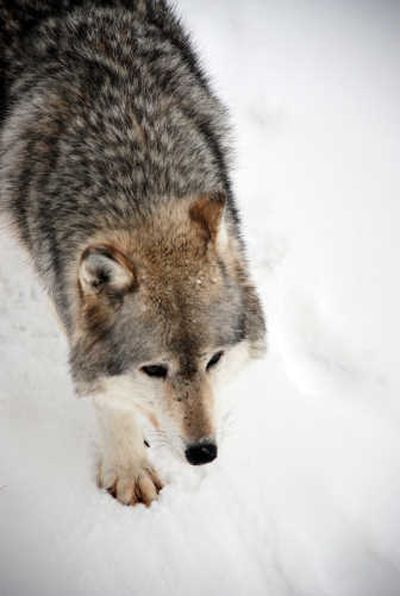
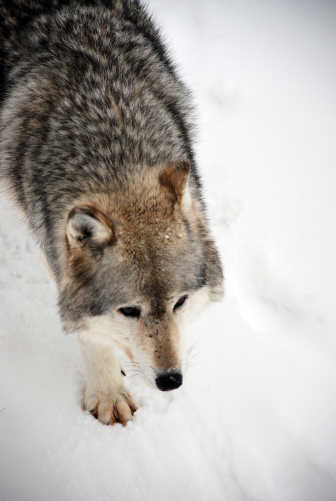
BILLINGS – Tony Saunders stalked his prey for 35 miles by snowmobile through western Wyoming’s Hoback Basin, finally reaching a clearing where he took out a rifle and shot the wolf twice from 30 yards.
“It’s hard for people to understand how devastating they can be,” said Saunders, 39, who ranches at Bondurant, Wyo., and blames wolves for the loss of two horses.
Gray wolves in the Northern Rockies have been taken off the endangered species list and are being hunted freely in Wyoming for the first time since they were placed on that list three decades ago.
Since federal protection was lifted March 28, 37 wolves have been killed by Wyoming hunters, just over 2 percent of the estimated 1,500 wolves in the West. Idaho and Montana are making preparation for legal hunts this fall.
But a coalition of 12 environmental and animal rights groups filed a lawsuit Monday seeking an emergency injunction to block the killings. They want wolves back on the endangered list.
National groups in the lawsuit include Defenders of Wildlife, the Natural Resources Defense Council, the Sierra Club and The Humane Society of the United States. A hearing before Judge Donald Molloy has yet to be scheduled.
The groups predict that if states continue to control the animals’ fate and proceed with public hunts, wolves could be nearly exterminated from the West.
“If anybody can kill wolves, you have no way of ensuring wolf killing isn’t excessive,” said Doug Honnold, the Earthjustice attorney preparing the lawsuit.
Despite years of federal protection, killing wolves in the Northern Rockies is nothing new. Last year, a record 186 were shot, primarily by wildlife agents, for killing and harassing livestock.
But since the beginning of this year, 59 wolves already have been reported killed in the three Northern Rockies states – about three times the number over the same period last year. Most were killed just in the month since they lost federal protection.
State officials blamed this year’s increased hunting in part on heavy snow, which kept wolf packs at lower elevations where sheep and cattle range.
“That’s the reality of managing wolves in a modern landscape. Some of them are going to be removed,” said Eric Keszler, spokesman for the Wyoming Game and Fish Department.
Sharon Rose, a spokeswoman for the U.S. Fish and Wildlife Service, said her agency had not yet received the lawsuit and could not comment on the allegations.
Rose did say the agency’s decision to delist wolves was based on science that will hold up in court.
“We believe we made the right decision – that the wolf had recovered and the regulatory mechanisms are there” to ensure its continued survival, she said.
The animal’s population has grown by about 25 percent annually in the region since the mid-90s, when 66 wolves were reintroduced to Yellowstone National Park and central Idaho.
When they came off the endangered list, federal biologists argued the wolves’ rapid reproductive rate would allow them to withstand increased hunting. Federal biologists have projected the three states will maintain a population of 883 to 1,240 wolves. The Fish and Wildlife Service has said it will put them back on the endangered list only if the population dips below 300 animals.
The lawsuit filed Monday argued a “spate of wolf killings” in the last month showed state management could quickly reverse the wolf’s fortunes. The injunction said state officials would allow wolves to be eliminated across most of Wyoming and large parts of Montana and Idaho – hobbling the species’ genetic diversity and preventing a lasting recovery.
Wolf advocates contend a minimum of 2,000 to 3,000 wolves are needed to protect their genetic diversity. The groups said the increased killings also threaten to block the spread of wolves to other states in their historical range, including Colorado, Utah and Oregon.
Idaho state Sen. Jeff Siddoway, R-Terreton, acknowledged recent wolf killings in his state “probably added gasoline to the fire” and helped spur the environmentalists’ lawsuit.
But Siddoway, a rancher who had wolves attack his livestock three times in the last three years, said the predator’s population needs to be brought under control. Earlier this year, he sponsored an Idaho law that allows ranchers to shoot wolves for harassing, attacking or simply “annoying” livestock or dogs.
“The laws have been changed, and some of those wolves are dying out there,” he said. “But biologically that just doesn’t have any real effect. We have wolves, and they’ll be here forever now.”