
Obama’s former pastor defends, amplifies remarks

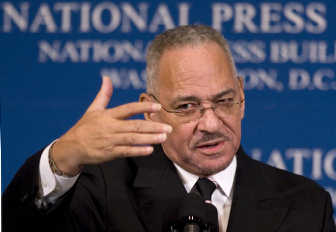
WASHINGTON – At a moment when Barack Obama is struggling to win over white voters worried about the economy, a series of public appearances by his former pastor is threatening to revive a tempest over race, patriotism and religion that the Democratic presidential front-runner hoped he had quashed.
The Rev. Jeremiah Wright appeared at the National Press Club on Monday, delivering a defiant address in which he defended and amplified some politically and racially charged remarks from past sermons.
The speech was the third nationally televised appearance Wright has made since Friday, in what Democratic strategists and pollsters described as an unwelcome distraction for an Obama campaign that would prefer to see Wright fade from the scene.
Taking questions Monday, Wright stood by some of the most divisive assertions he had made in church sermons – statements that Obama has denounced.
He declined to retract a statement from a post-Sept. 11, 2001, sermon that “America’s chickens are coming home to roost.”
“You cannot do terrorism on other people and expect it never to come back on you,” Wright said. “Those are biblical principles, not Jeremiah Wright bombastic divisive principles.”
Asked about his prior suggestion that the government created AIDS to harm black people, Wright said that “based on the Tuskegee experiment and based on what has happened to Africans in this country, I believe our government is capable of doing anything.” He was referring to an infamous experiment conducted over decades in which the government allowed blacks to go untreated in order to study syphilis.
He spoke admiringly of Nation of Islam leader Louis Farrakhan, long criticized for making anti-Semitic comments. Wright described Farrakhan as a hugely influential figure – “one of the most important voices in the 20th and 21st century.”
“Louis Farrakhan is not my enemy,” Wright said. “He did not put me in chains, he did not put me in slavery, and he didn’t make me this color.”
Wright had kept a low public profile since portions of his sermons were widely played on television in March, including snippets in which the pastor said “God damn America.” Obama, a longtime member of Wright’s church in Chicago, partially quelled the controversy with a speech on race in Philadelphia that month. But Republicans use Wright’s comments in advertisements against Obama.
Hillary Rodham Clinton, Obama’s rival for the Democratic nomination, has said that Wright would not be her pastor.
The Obama campaign said it had no role in Wright’s emergence in public, which included his appearance on a PBS program broadcast Friday, sermons Sunday morning in Dallas and a televised speech before an NAACP dinner in Detroit on Sunday night.
“We were told he was going to do it,” said David Axelrod, a top campaign strategist for Obama. “There wasn’t anything we could do about it. We have no control over Rev. Wright. Is it bad or good for the campaign? I think candor requires me to say it’s not ideal.”
Obama responded to Wright on Monday, noting that he considered Wright to be his “former pastor.”
“Any of the statements he’s made – both that triggered this initial controversy and those he’s made over the last several days – are not statements that I heard him make previously,” Obama said. “They don’t represent my views, and they don’t represent what this campaign is about.”