
New call to arms
YAKIMA FIRING CENTER, Wash. – There are lessons for the eyes, the brain and the muscles as the Washington National Guard’s 81st Brigade prepares this summer for its second tour of duty in Iraq.
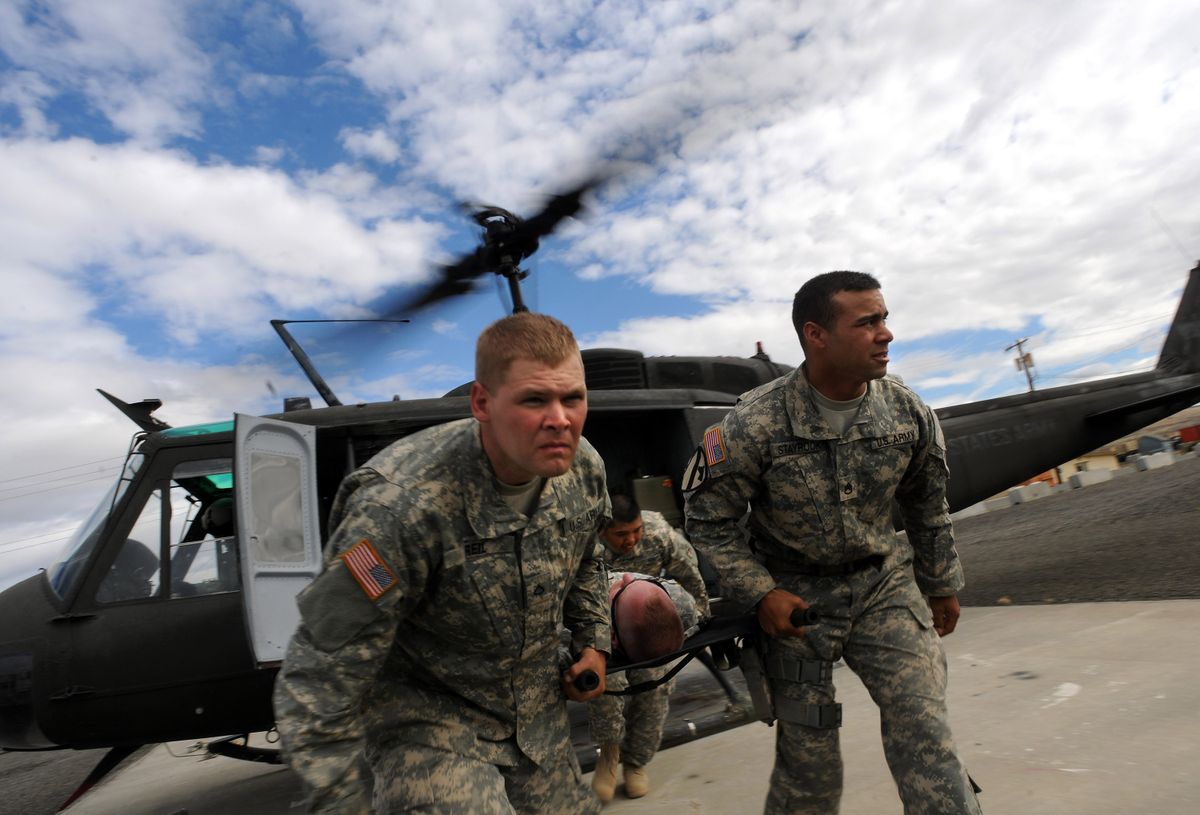
Hundreds of rounds of ammunition to shoot at targets in the sagebrush. Threats against imaginary convoys to “surpress” along desert roadways. Stretchers of comrades pretending to be wounded to load into Medivac helicopters.
In a few months, the targets will be shooting back, the convoys will be real, and the casualties could be, also. The 81st, which usually trains with tanks and Bradley fighting vehicles, is leaving its heavy armor behind, trading it for the quicker, but lighter, armored Humvees and other vehicles used to protect convoys of supplies moving around Iraq.
Before they arrive in Iraq, however, the roughly 3,400 members of the 81st face months of training, first in Yakima, then at Fort McCoy in Wisconsin, and finally in Kuwait.
“There’s a general misconception with the public that the Army just picks a unit up and puts them into Iraq, and that’s really not the case,” Capt. Clayton Colliton, commander of Hotel Company, 1st Battalion, 161st Infantry, said last Friday above the steady popping of M-4 rifles as about 30 of his soldiers practiced on one of the firing center’s many ranges.
Soldiers in the gray-green digitized patterns of the Army’s new desert camouflage uniforms were shooting at green dummies that pop up and down at the command of a computer in the nearby control tower. Each was issued 40 rounds and must hit the targets at least 25 times out of those 40 shots.
All the dummies are called “Ivan” – a holdover, Colliton said, from the Cold War when the Soviet Union was the biggest threat, and the 81st and its tanks represented the conventional war counterbalance to that threat.
The computer records their scores, the soldiers get a copy and the numbers go into the stack of paperwork being compiled to make sure each soldier is ready to deploy. “I don’t think al-Qaida worries much about its paperwork,” the former Ferris High School history teacher and military science instructor at Washington State University said.
‘This is my duty’
About 70 percent of the men and women going to Iraq with the 81st have served at least one tour there, although not always with the Washington National Guard. Some have served more.
Sgt. Wayne Leyde, of Mead, served two tours in Iraq with the regular Army before joining the 81st, and when the Washington National Guard got its call-up orders in October, he was told he didn’t have to go. He volunteered anyway.
In civilian life, Leyde is a banker at Wells Fargo’s downtown Spokane office. In February, he scratched off a lottery ticket he bought at a Zip Trip and found a $1 million prize underneath. But the 26-year-old soldier doesn’t regret his decision to go to Iraq with his unit.
“We each have a duty,” Leyde said as he and other members of 1st Platoon, Delta Company, prepared to practice loading stretchers into a UH-1N Huey Medivac helicopter. “This is my duty. I chose it.”
The two weeks of training has helped him work on “mental toughness,” Leyde said. “You start with your family and you go from there.”
In the bay of the Huey, Spc. Robert Armani, a paramedic, is explaining to the platoon how to get a wounded comrade into a helicopter on a stretcher. Getting casualties on the helicopter and away quickly is important, he says, because “this big red cross right here is the international bull’s-eye” and when enemy troops see a helicopter hovering or landing, they know exactly where the soldiers are on the ground.
Among the rules, approach and leave from the front or side.
“That tail rotor is a killer,” Armani said, and visibility to the rear is severely limited for the crew onboard. “We’re not going to know until it’s too late if you’re trying to get around the back.”
Still, when ordered to go to the other side of the helicopter to practice stretcher drills, some soldiers walk around the back. “What did you do wrong?” Armani asks them pointedly.
Muscle memory
In four-man teams, the soldiers practice lifting a stretcher loaded with one of their own, walking toward the helicopter in a crouch, rotating the stretcher so it goes in feet first, and getting safely away from the helicopter. For the first dry run, the helicopter sits quiet; for the second, the rotors are spinning and the soldiers have donned their helmets, body armor and other gear, which weighs about 75 pounds.
“If you show ’em, they retain things a lot better than reading about it,” Sgt. 1st Class Steve Williams says as the platoon worked through the drills.
Much of the training is for what the Army calls “muscle memory” – a type of reflex action that becomes so instinctive a soldier doesn’t even have to think about it, he or she just does it. That’s particularly important when the stretcher is loaded with a wounded soldier who ate, slept and fought next to you for months.
They train on their jobs, then they train on the jobs of the soldiers around them, said 1st Lt. Mason McCoy of Pullman, the leader of 1st Platoon, Delta Company 1st Battalion 161st Infantry. “Everybody’s trained two jobs up, so you can take over if something happens.”
One thing that’s hard to prepare for is the heat, said Williams, a 20-year veteran with 18 of those in the Washington National Guard, including the unit’s last tour in Iraq.
“I can tell you 149 degrees in August over there sucks. When you go outside, it was like somebody turning a blow-dryer on you,” Williams said. People would send the unit temperature gauges, the soldiers would set them outside and they’d explode. “They don’t go high enough.”
He has a civilian job as a nuclear and chemical operator on the Hanford Nuclear Reservation, where his bosses are supportive and his co-workers send care packages. But preparing for this deployment is a little more difficult.
He’s married, with five children, ages 20, 7, 3, 2 and 2 months.
“The hardest part is leaving when you’ve got a 2-month-old baby at home. But you look at those 32 guys there,” he said, nodding at his platoon, “you just got to do it.”
Threat suppression
Soldiers who have been to Iraq before know what to expect in terms of the climate and the people, said Sgt. Brent Gibbons, of Yakima, but many have to train for a different mission. Some may have manned security checkpoints, patrolled neighborhoods or escorted coalition officials to meetings with village leaders; this time, they’ll be escorting convoys moving across Iraq.
“Some things are the same, like the climate and life on the base,” Gibbons said. “The job is different every time, the people are different.”
Gibbons, 29, is single and studying network engineering at Yakima Valley Community College. This will be his fourth overseas deployment – third to Iraq. Last time he worked at a detention facility and sees escort duty as “a little more pro-active.”
Last Friday, he commanded a Humvee while Pfc. Clifford Imanshah, of the Tri-Cities, drove and Spc. Thomas Hart, of Wenatchee, operated a .50-caliber M-2 machine gun that poked from the vehicle’s roof and swiveled 360 degrees to find targets and “suppress threats” – an Army term for laying down a stream of bullets to knock back whatever arises.
As targets popped up as much as 800 meters in the distance, Imanshah and Gibbons called out the range and the direction – “1 o’clock” or “3 o’clock” – Hart popped off seven- to nine-round bursts, belts of .50-caliber ammunition fed through the gun, and spent shells rained down on the hood or into the Humvee. Except, that is, when the machine gun jammed and Gibbons had to climb onto the hood to add a bit of oil from a plastic quart of 10W-30 motor oil to the mechanism. The Army actually issues them a different kind of oil for the gun, but the motor oil works better, Gibbons explained later.
What to take
The first round of training for the 81st will end later this week, and soldiers will go home for time with their families before leaving for training in Wisconsin in mid-August.
Last week, some members of Delta Company stood in the middle of a tent with some 500 bunks and maybe twice as many crates, sorting through what to take to Iraq and what to leave behind.
“You learn to pack light,” said 1st Sgt. Chris Fresh, of Coeur d’Alene, who was on active duty for the invasion of Iraq, and did another tour as a member of the Colorado National Guard. He joined the Washington National Guard about four years ago, and has a civilian job as a Kootenai County sheriff’s deputy.
“I’ve been gone quite a bit,” Fresh said, but the sheriff’s office “has been more than supportive.”
What to take has been an important lesson over the last two weeks for Spc. Benjamin Ashworth, of Spokane, who joined the Guard three years ago and will be going to Iraq for the first time. He’ll leave behind the wet weather gear, the cold weather gear, the extra boots.
Ashworth, 24, will be going to Iraq with his father, Sgt. 1st Class Allen Ashworth, who was deployed with the 81st in 2004-2005. He’ll be serving as a gunner on a Humvee, but when he comes back, he’d like to go to Spokane Falls Community College to study to be a paramedic.
Staying focused
On a day-to-day basis, it’s hard to see much change in Iraq, said Capt. Tim Ozmer, the commander of Delta Company, 1st Battalion, 161st Infantry.
Ozmer drove from one training location to another Friday, checking on his platoons’ progress in a tan Humvee. The side the vehicle had a silhouette of a Spartan helmet, the company’s symbol, and EFK, the letters of the unit’s motto.
Eat. Fight. Kill.
Ozmer, a Spokane Valley resident with some 22 years in the military, said staying focused on the mission and riding herd on the 130 people in his command is how he prepares himself mentally for returning to Iraq with the 81st.
He commanded a scout platoon in the Balad area during the last deployment of the 81st. On August 4, 2004, the Humvee he was in hit an improvised explosive device, a stack of three land mines buried in the road. It blew the front of the vehicle off, killing the gunner, shattering the pelvis and injuring the back and legs of the driver and wounding the soldier sitting behind the driver. Ozmer’s back was broken at the L-4 vertebra; he underwent a 14-hour operation that patched together that vertebra. On Jan. 23, 2005, he returned to Iraq to finish out the deployment with his unit.
“Having been afforded the opportunity to return, in January, it was kind of the analogy of getting thrown off the horse and climbing back on,” he said. “It helped me put to bed any issues I might have returning to Iraq.”