
State workers rally for bigger raises
Gregoire in talks over next contract
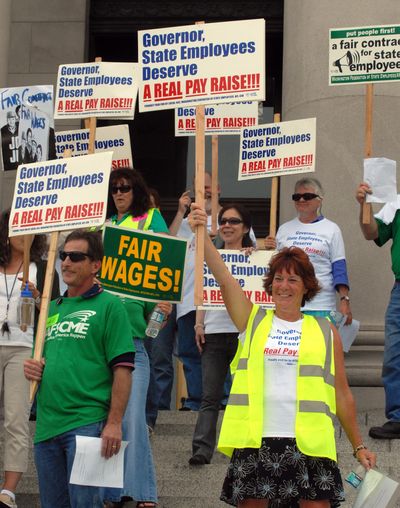
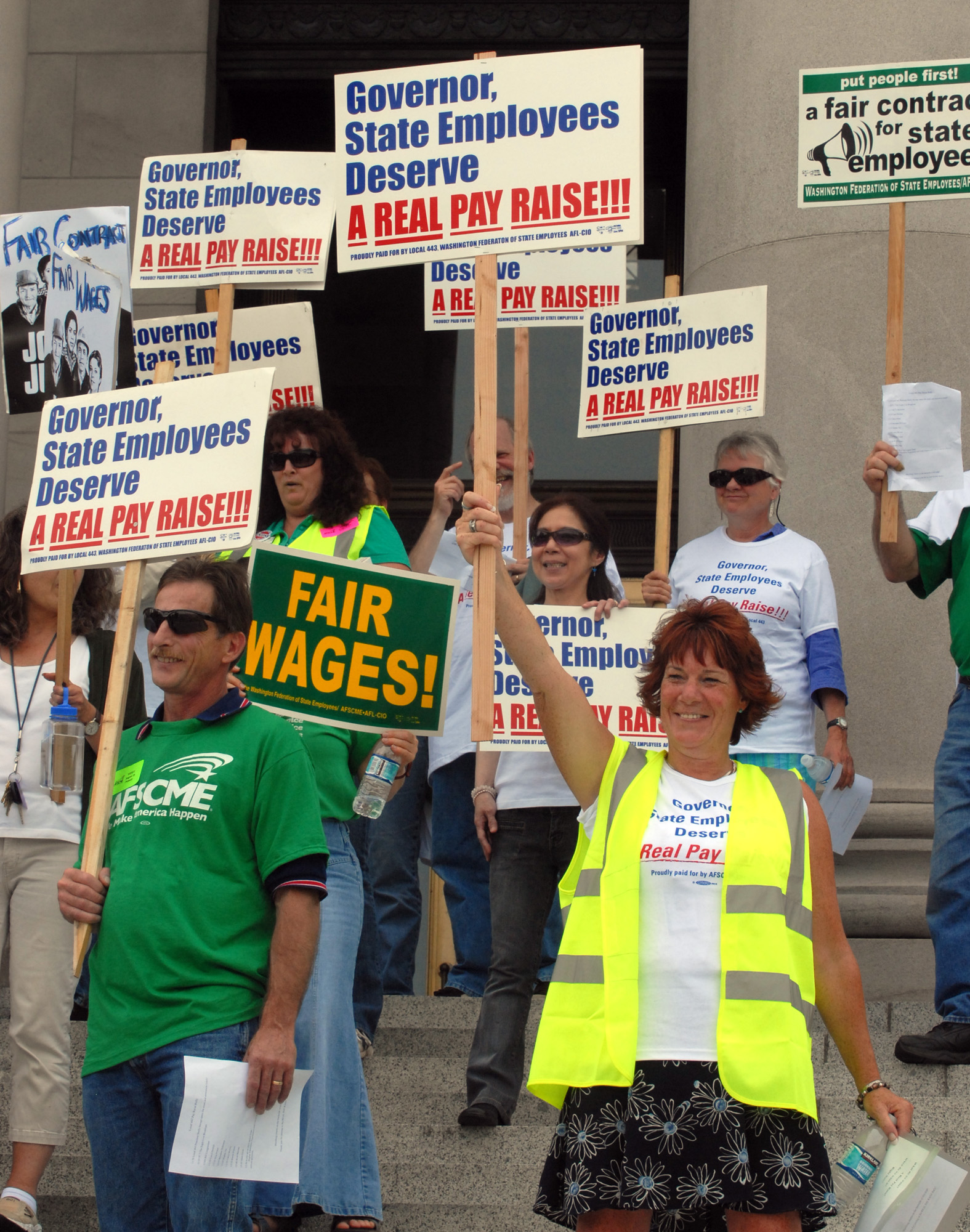
OLYMPIA – Citing the high cost of gas, food and housing, hundreds of state workers converged on the Washington Capitol on Tuesday to call for larger pay raises.
“We ain’t nobody’s working slave, we deserve a real pay raise,” the crowd of about 500 Washington Federation of State Employees chanted on the statehouse steps.
“We realize that we’re in a bad economy, but it’s unfair to take it out on the backs of state employees,” said Bridget Flory, a worker at the state Department of Labor and Industries.
Gov. Chris Gregoire’s budget office is in the midst of more than two dozen contract negotiations with bargaining units representing more than 60,000 of the state’s more than 100,000 employees. Among them: many employees at Washington State University, Eastern Washington University, the community colleges in Spokane and state agencies across Eastern Washington.
In the fiscal year 2007-2009 contract, most state employees got a 3.2 percent cost-of-living increase for the first year and 2 percent the second year.
“In two years we got half as much as the rest of the state got,” worker Matt Grate told the crowd. “Do you feel half as good as the rest of the state?”
They didn’t. Among the crowd’s chants: “Their 2 percent won’t pay the rent.”
Citing confidentiality of the talks, neither federation officials nor state budget director Victor Moore would say what cost-of-living increases are now being discussed. The goal, federation spokesman Tim Welch said, is a fair pay raise without breaking the budget. Fair compensation, he said, will help keep valuable state employees on the job.
“The important thing is to keep talking,” he said. “We continue to make progress.”
One issue that’s largely decided: health coverage. The two sides have agreed that the current split for health coverage costs – 88 percent paid by taxpayers, 12 percent by the employee – will stay the same.
The proposed two-year contracts will be sent to state lawmakers in January. The legislators can only approve or reject – not modify – the deals.
“What I always strive for is a fair but affordable contract,” said Moore. “Our definition of affordable and theirs is where the fight is.”
Also, he said, “the definition of what affordable is has changed from two years ago. These are tough times.”
That’s a point made often on the campaign trail by Gregoire’s main challenger, Republican Dino Rossi. Rossi recently called for a halt to public-employee contract negotiations until the state gets a better handle on how it will deal with a projected $2.7 billion budget shortfall over the next two years.
Rossi and other Republicans have also blasted Gregoire for bargaining with workers while the unions’ political arms are helping pay for Democratic election efforts.
Rossi was singled out for a special chant Tuesday, as the workers marched up the Capitol lawn.
“Hey, hey, ho, ho! Dino Rossi’s got to go!” the workers chanted.
State workers in 2002 won the right to collectively bargain for pay, with the first contracts taking effect in 2005. Prior to that, contracts only involved working conditions. Wages and cost-of-living increases were at the whim of legislative budget committees.
“Mr. Rossi needs to know that we’re not going back to collective begging again,” Washington State Labor Council President Rick Bender told the cheering group.
The same legislation allowed unions to include clauses in the contracts requiring state workers to either join a union or pay fees for collective bargaining and other services they get. Despite several attempts, dissident state workers have failed to undo the requirements.
Watching from the sidelines at Tuesday’s rally was Tom Henry, a staffer for the conservative Evergreen Freedom Foundation. With the projected $2.7 billion shortfall, he said, the state will be hard-pressed to come up with money for larger raises.
“I sympathize, because costs are hitting state workers like everyone else,” he said. “But if there’s no money in the bank, there’s no money in the bank.”