
Putin still ruling over Russia
Former president taking charge in midst of conflict

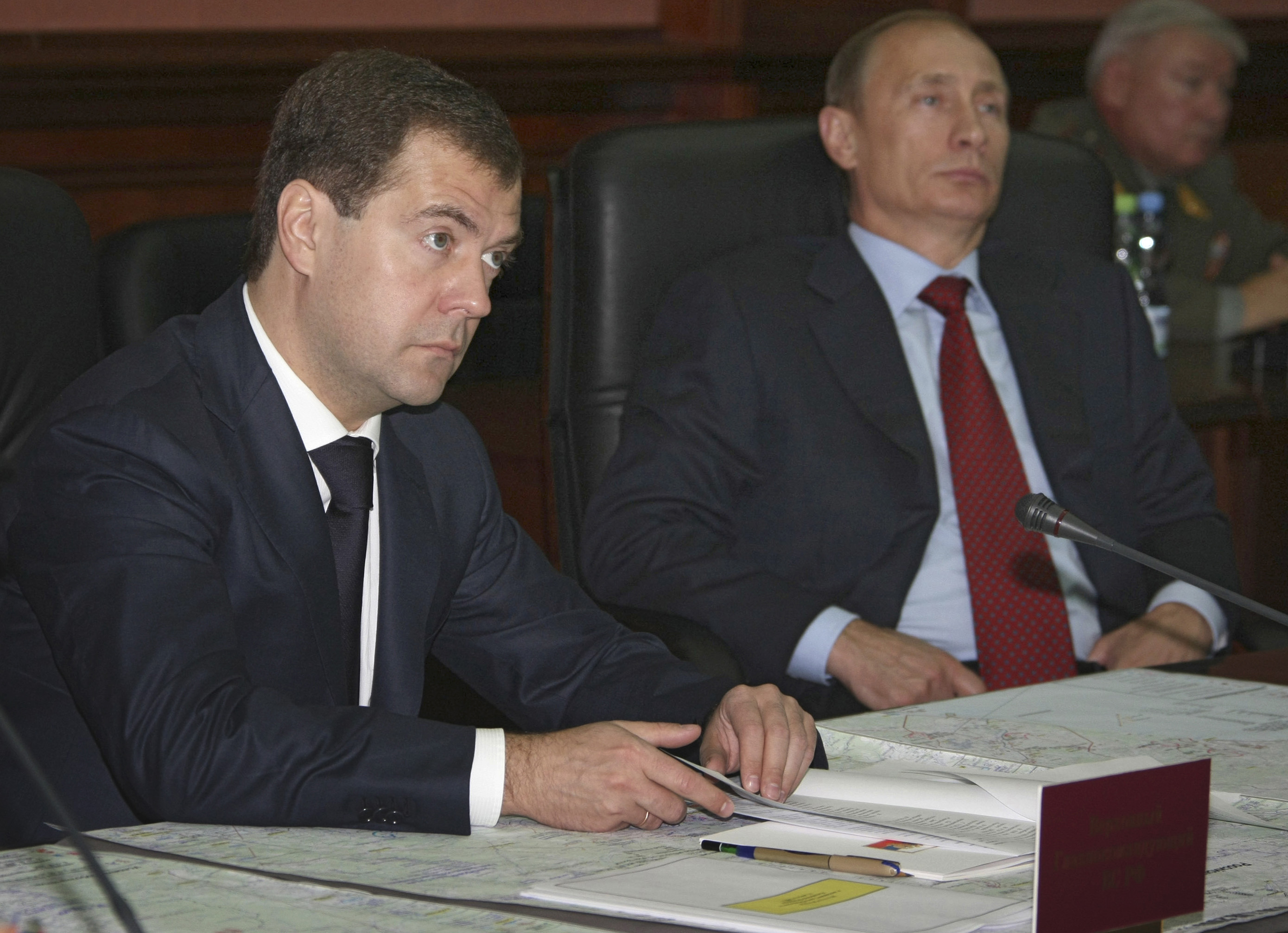
MOSCOW – There was little doubt about who was ruling Russia even before its armed incursion into Georgia this week. But the events of the past five days wiped away any pretense that President Dmitry Medvedev runs the country.
The violence between Russia and the former Soviet republic, nearly coinciding with Medvedev’s 100th day in office, has demonstrated how much control remains in the hands of his predecessor, Prime Minister Vladimir Putin, analysts say.
“I can tell you that recent developments between Russia and Georgia give us no proof that Dmitry Medvedev is an independent leader,” said Evgenii Kiselev, editor in chief of TVI television in Kiev, Ukraine, and a frequent commentator on the Echo Moskvy radio station.
For Alexander Golts, deputy editor of the Moscow-based Daily Journal, one episode stands out in particular. When Putin returned from Vladikavkaz, a Russian city near the war zone, he was shown on television giving orders to the president.
“One scene was very clear, when Putin began to tell the president what to do. It was not a private conversation. Putin wanted to show that he was in charge,” Golts said. “Everybody was shocked.”
Putin served as president from 2000 until earlier this year, systematically centralizing power in his own hands. He chose the relatively unknown Medvedev as his successor. Elected by a landslide, Medvedev took office in May, with his patron switching to the constitutionally less powerful post of prime minister. Ever since, people here have been analyzing the personal ties and division of power between the two.
Over the course of history, Russians have vacillated between wanting a firm hand to rule them and wanting to cast off that master’s rule. Czars tended to be either merciful, paternalistic rulers or strong and iron-handed, such as Ivan the Terrible. Few combined both qualities, although some tried. Even the Soviet dictator Joseph Stalin cultivated an image as a stern father.
Under Putin and Medvedev, it is as if the age-old desire for a strong czar and a merciful czar are being met at the same time.
At least until now, Medvedev has excited the hopes of Western-leaning Russians, who suggest he sincerely believes that the nation will truly prosper only when it follows the rule of law and becomes more open and democratic.
Putin, meanwhile, has earned broad popularity among Russians who feel that his eight-year presidency restored the nation’s international standing after the humiliations of the Soviet Union’s collapse. He also muzzled the nation’s broadcast media and marginalized the opposition.
Sergei Arutyunov, journalist and director of the Caucasus Institute of RAN, said Wednesday that the Russian-Georgian conflict also exposed a complicated dynamic in the Putin-Medvedev tandem.
“From the very beginning, we’ve been seeing attempts to put a wedge between Medvedev and Putin, but it has not worked. They work together very successfully,” Arutyunov said. In his view, each needs the other, since it is widely expected that Putin will run for president again in four years. Should some unpopular policy go awry, Putin can always say it was Medvedev’s idea.
Evgenii Minchenko, director of the International Institute of Political Expertise, offered a similar view. If Medvedev can put some distance between himself and controversial decisions such as the use of force against Georgia, he can maintain his image, especially in the West, as a possible reformer.
Tatyana Parkhalina, director of the Center for European Security, said she was struck by the fact that Medvedev made no significant statement about the conflict in the early going and was still vacationing on the Volga River with his family while Putin was headed toward the front.
State-controlled television, meanwhile, aired footage that cast Putin as the man in charge. Russians saw him striding through an outpost, talking with military commanders near the front and making bedside visits to injured civilians from the South Ossetian capital, Tskhinvali. It was only on Tuesday that Medvedev was depicted in a role of authority, appearing with French President Nicolas Sarkozy to announce that a cease-fire had been reached.