
Search on for rescue funds
Some counties have no budget for searches
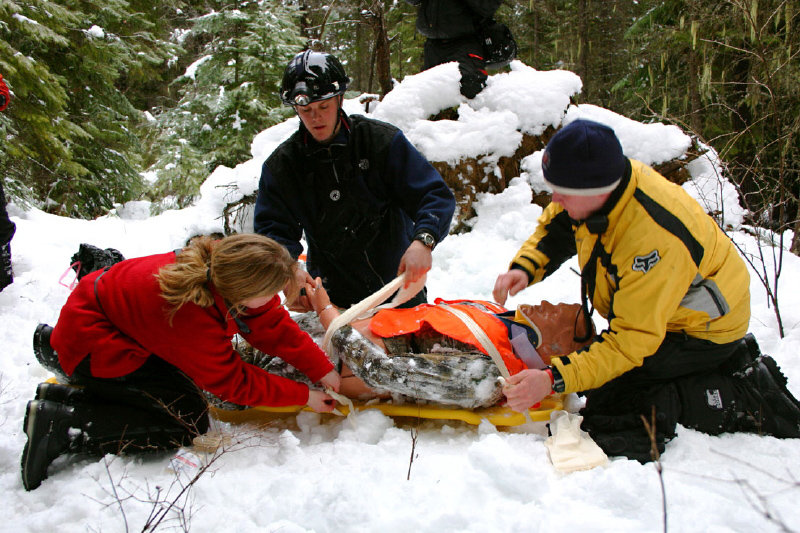
While many volunteer search-and- rescue (SAR) groups may work only a half dozen missions a year, staying trained and funded is a year-round effort.
“Our volunteers raise all the money,” said JoAnn Boggs, Pend Oreille County Emergency Services coordinator. “Since they organized in the late 60s, they’ve parked cars at the rodeo and sold fireworks to raise funds and build their own building on county property, yet they use their own snowmobiles and ATVs. They just bought eight new backpacks with GPS units all ready to go for the next emergency.”
The Priest Lake SAR has taken over the annual Huckleberry Festival as its main fundraiser. Coordinator Mike Nielsen, a retired law enforcement officer who donates roughly 20 hours a week, said, “The biggest part of my job is organizing and getting grants and donations.”
Sometimes the assistance is in the form of individual ingenuity.
For example, Mike Sudnikovich, Priest Lake SAR snowmobile team leader, saw a need after a difficult rescue in the Kent Lake area, so he modified and donated a snowmobile for bringing out victims where a toboggan litter isn’t an option.
“He took off the snowmobile seat so a litter could be mounted there while the rider could straddle the patient and bring him out to help,” Nielsen said.
But safety and effectiveness require gear, and that costs money, he added.
“Money from the Huckleberry Festival enabled our group to buy GPS mobile radios,” he said. “It’s hard to get snowmobilers to stop regularly and give you GPS updates on their position. Every minute counts in these rescues, and with these radios, they can keep on going and every 10 minutes my radio in the command post downloads the locations of each of my units in the field so I can tell where my people are and what areas have been searched.”
Six state senators from Western Washington introduced a bill last year calling for an assessment on insurance policies to help provide a layer of dependable funding for emergency management for disasters as well as search and rescue.
The proposal, which is likely to be reintroduced in some form this session, called for an annual surcharge of $2 per policy on homeowner’s insurance and a $4 surcharge on every commercial fire, multiple peril and property insurance policy.
SB5296 would have provided $200,000 for each Washington county plus $1 per person in the county population.
“It would fall short of what’s needed in larger areas, but it would be a godsend for smaller counties,” said Rick Anderson, Stevens County Emergency Services director.
While area counties, such as Pend Oreille in northeastern Washington and Boundary in North Idaho, appropriate no specific funds for search and rescue, Montana’s Flathead Valley Search and Rescue has a $132,000 annual budget. Montana county commissions have the authority to approve levies for search-and-rescue funding. Lincoln, Flathead and Missoula counties all have garnered voter support for the levies.
Meantime, federal Homeland Security funding, created following the 9-11 attacks in New York, has been a primary source for emergency services coordinators in the nation’s rural areas.
“It varies by county, but Homeland Security funds my position, although it has to do with more than just search and rescue,” said Anderson.
“A huge resource we have up north, whether it’s a law enforcement issue or a lost hunter, is the Border Patrol. They have been an absolute dream come true, especially after they were beefed up post 9-11.”