
Walking on water
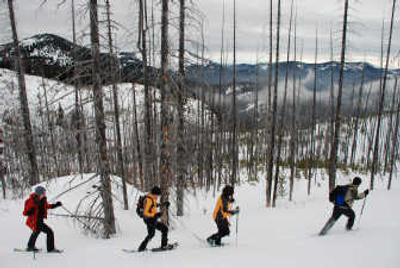
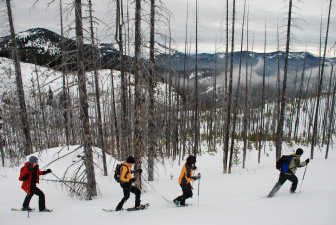
When the snow piles on and threatens to smother the enthusiasm for winter, snowshoeing enables any reasonably active person to stay above it all.
Heading out last weekend on a guided trek at Sherman Pass was a tutorial on the remarkably simple and ever-more-popular sport.
Just one group outing clearly indicated that:
•Snowshoeing appeals to a wide range of people for an equally wide range of reasons.
•Gear requirements are minimal.
•Anybody who can walk can meet the basic skill requirements.
•But good judgment is required, as it is with any activity that whisks you away from a plowed road.
Carol Cressey – often the lady to beat in the over-65 age group at local distance running events – has joined numerous Spokane Parks and Recreation outdoor trips, including a family snowshoe outing with her 4-year-old grandson.
Snowshoeing is among the many outdoor pursuits in her fitness repertoire of bicycling, running and hiking.
“I love to get out and go,” Cressey said on the van ride north from Spokane, noting she also sings in her church choir.
Lorie Campbell is considerably younger and less active, but just realizing winter doesn’t have to be dead time.
Last year, she and her husband tried out the sport in a Parks and Rec “Intro to Snowshoeing” class after concluding she’d frittered away too many winters inactively inside.
“I’ve lived in the Pacific Northwest 27 years and figured it’s about time I got out to see what I’ve been missing,” she said as the group hiked through a wintry wonderland at the crest of the Kettle River Range.
Even though her husband couldn’t accompany her last Saturday, Campbell had no trouble making quick friends with the group of six for the 5.5-mile scenic backcountry trek up and around Sherman Peak.
Rick and Charlotte Hastings are runners and bicyclists. “But we go a little stir-crazy during winter,” Rick said. “Charlotte’s knee bothers her a little, so skiing isn’t the best choice for us. That’s why we’re trying snowshoes.”
Group trips are convenient for exploring the sport. Some ski resorts, such as Schweitzer, offer guided treks, as do outdoors shops, including REI, Mountain Gear and Mountain Goat Outfitters. These trips usually are led by experienced snowshoers with insight on the sport. Free or cheap snowshoe rentals are available.
And it’s always better to have companions on winter outings for safety reasons and to help break trail.
“I like teaching snowshoe classes and leading these trips because I get to help people form their impression of snowshoeing,” said Wade Sumner, a veteran trip leader for Parks and Rec. “A lot of people enjoy our moonlight treks, and I think that’s because it’s more like playing. Adults don’t seem to get enough of that.”
Modern snowshoes are small and no significant change is required in your walking stride.
“Technique is a very small part of the beginner classes we teach because it’s so easy,” Sumner said. “The main point to get across is how to dress: Avoid cotton (cold when wet), leave the heavy coat home and wear layers, with a shell to block the wind, if necessary.”
Clothing not needed while hiking is carried with water and food in a daypack and put on during rest stops or changes in weather.
“Most beginners fail to realize how warm you’re going to get while you’re snowshoeing,” he said. “You won’t be freezing on a chairlift.”
Gaiters, to keep snow out of the boots, are generally the only extra gear most active people need to acquire for snowshoeing.
Even with a mix of novices and more experienced snowshoers, Sumner had little to explain as the group geared up to leave the Sherman Pass Sno-Park lot.
“Binding buckles go on the outside of your foot,” he said, explaining the difference between the right and left snowshoe. “Put the ball of your foot over the hinge of the crampon; pull the loop to snug the strap around your foot and then fasten the strap around your heel. Simple.”
Modern snowshoes are ultra-light, maintenance free and virtually a no-brainer to use even on varied terrain.
Good bindings pivot over a crampon or claw that provides traction going up and down and they articulate to make easier work of walking on sidehills.
“This is a good time to buy snowshoes,” Sumner said. “A lot of them will be going on sale pretty soon. I tell people to take the boots they will be wearing when they try out different snowshoe models so they can see which binding is the best match for the boot and the type of snowshoeing the plan to do.”
Participants in Parks and Rec trips can rent good-quality snowshoes and poles for a mere $7. Most trips, including van transportation, guide and rentals cost under $30.
“I love the fact that somebody else is doing the driving, especially in winter,” Campbell said.
Indeed, with everybody’s well-being in his hands, Sumner’s snowshoeing experience served the group well.
“When you’re in the backcountry, things can happen,” he said, admitting that he got off-route on one trip that turned into an endurance marathon for the entire group.
“Everybody felt the exhilaration of the accomplishment when we got back to the van. But when the leader evaluations came in a few days later, they weren’t too high.”
Last Saturday, the snowshoers reached the 6,440-foot high point of the trek on the south side of Sherman Peak around noon, after two hours of hiking with many brief breaks to regroup, chat, take photos and enjoy the peaks in the distance.
About that time, a forecast storm – what turned out to be the most sustained snowstorm in 15 years – was moving in. Mostly clear skies were growing dark; the wind had picked up and snowflakes began stinging faces.
On a different day, Sumner said he would have found a sheltered spot for the group to relax an enjoy lunch. On this day, however, he kept the group moving, breaking only for quick snacks, drinks and a standup lunch break in a sheltered area.
The roads were going to get very bad that day, and no trip is successful if you don’t get home safely, he said.