
Young public defender wins high court hearing
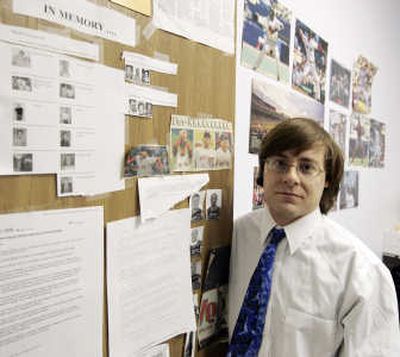

FRANKFORT, Ky. – One of the biggest capital punishment cases to come before the U.S. Supreme Court in a generation was put together largely by a young, fresh-out-of-law-school member of Kentucky’s overworked and underpaid corps of public defenders.
David Barron, 29, filed an appeal on behalf of two Kentucky death row inmates, arguing that the three-drug cocktail used in lethal injections across the country can cause excruciating pain, and thus amounts to cruel and unusual punishment in violation of the Eighth Amendment to the Constitution.
After three years of long hours on Barron’s part, the Supreme Court agreed to hear arguments in the case Monday.
“I can’t believe I’ve got a case before the Supreme Court and I’m not even 30 years old,” Barron said.
This is the first time in more than a century that the high court will address the legality of a method of execution. Thirty-six states use lethal injection, and executions across the U.S. have come to a halt in the meantime.
Barron, an assistant public defender, arrived in Kentucky in 2004, just over a year out of law school, to represent some of the worst of the worst – death row inmates. He was admitted to the Kentucky bar in July of that year and filed his lethal-injection challenge the following September, employing a strategy he had tested in other jurisdictions.
He was paired with John Palombi, a fellow public defender with at least a decade of experience.
The challenge was brought on behalf of convicted cop killer Ralph Baze and Thomas Clyde Bowling, who was found guilty of killing a couple. Barron lost the cruel-and-unusual argument at a trial and at the Kentucky Supreme Court. But he kept pushing the case, hoping to keep his clients alive a bit longer.
He beat long odds: The Supreme Court gets as many as 7,000 petitions a year but agrees to hear only 100 to 150 cases.
Lethal injections have come under legal attack around the country recently, with experts and others arguing that it is not the humane, painless method of execution it was supposed to be.
Legal experts said the Kentucky case apparently got the attention of the high court because it arrived fully developed – it went through a full-blown trial with more than 20 witnesses, who argued both sides of the question of whether inmates suffer extreme pain while immobilized, unable to cry out.
Death penalty proponent Kent Scheidegger, legal director of the Criminal Justice Legal Foundation, said the case gives the Supreme Court “a clear shot at the merits of the injection question.”
“The trial court took extensive testimony, building a substantial record. That makes a better case for review than one decided summarily in the trial court,” Scheidegger said.
The challenge is the ninth case the Kentucky’s public defenders have gotten before the high court in the past three decades. Among the others was the landmark 1986 ruling Batson v. Kentucky, in which the Supreme Court found it unconstitutional to dismiss a juror because of his race.
Barron works in the public defender’s capital post-conviction unit, a corps of 10 attorneys who handle appeals for Kentucky’s 38 death row inmates.
The unit’s chief is the only one who has ever argued a case before the U.S. Supreme Court. In fact, for this case, the public defender’s office is bringing in Donald Verrilli, a Washington lawyer who frequently appears before the high court, to argue the challenge.