
Alpaca ranches dot the plains
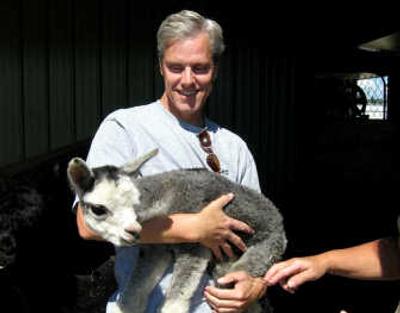
Out on the plains north of Coeur d’Alene, a quiet revolution in ranching is taking place. On the land once cleared for huge cattle herds, owners with small plots have turned to breeding alpacas.
Alpacas, and their close relative the llama, are slender, domesticated herbivores with long necks and small feet. They look like a cross between a goat and a camel. Alpacas are characterized by their thick, warm fleece, prized for use in a variety of products. Originally bred in the Andes mountains of South America, over the last 20 years, breeders have imported them to this country.
One breeder is Kevin Ilies who operates Moose Meadows Ranch on Clagstone Road outside of Athol. Ilies, his wife, Robyn, and their business partner, Gordon Black, run the 160-acre ranch owned by Robyn’s mother, Margret Stickney.
“Athol has been exploding with alpaca ranching,” Ilies said. “We’ve probably 100 to 120 animals in a two-mile radius.”
Ilies, whose stocky build and clean-shaved head make him look more like a biker than a rancher, is quick to tick off the reasons for raising alpacas:
“They know when they’re pregnant. They give birth in daylight hours. They go to the bathroom in one or two spots. They’re less harmful to the ground. They don’t challenge the fence. They have a soft-padded foot with two toenails. They’re low maintenance.”
Those aspects make alpacas easier to raise than cattle or horses, according to Ilies. He said they have less impact on the fields and are easy to clean up after. As browsers they are low-cost to feed with most ranches letting the animals range in fields and supplementing with hay and grain pellets.
More than 45 alpacas make their home at Moose Meadows and they come in all different colors. In the U.S., breeders recognize 22 different colors of alpaca fleece.
“We got into it initially as a tax break for buying this large a parcel,” Ilies said. “And then we really enjoyed the aspects of the alpaca business.”
Those aspects include breeding, fiber and agritourism.
Breeding
Because alpacas have only recently been introduced to North America, breeders with top bloodlines can command high prices for stud services or sales of offspring. Some sires sell for six figures.
Down the road from Moose Meadows is Janus Alpaca and Fiber Co. co-owned by Bob Shailer and Phil Lasswell. While Janus sells and is concerned about the fleece of its alpacas, it is most concerned with breeding better animals.
“There are two different groups. There are those that go in for the fleece and there are the farmers for the conformation,” Shailer said, referring to the ideal shape and proportion of the animal as defined by breeders.
A retired registered nurse, Shailer began raising alpacas in 1994 after breeding show dogs. Thin with a shock of white hair, he’s the opposite of Kevin Ilies. He moved to Athol last April from Cheney because he said the area is ideally suited to raising alpacas.
“The lifestyle is more laid back. Plus there’s the mountain views,” he said. “This area doesn’t have as many pine needles, which can cause abortions in the females.”
Janus Alpacas operates on 10 acres and currently has 35 alpacas with more than half of those having black fleece. According to Shailer, the black and gray fleeces are very desirable. Shailer said they own some of the top bloodlines in the country and that most of the herd is award winning.
“We do over 40 breedings for stud services (a year),” Shailer said. “That’s a lot.”
Alpacas start breeding when the females – or dams – are 14 to 18 months old. The dams carry the young for 11 months and can continue breeding every year through their normal lifespan of 15 to 20 years.
As a breeder, one of the most important aspects of alpacas is the way they birth. Besides the daylight births, alpacas have a very low infant mortality rate and generally do not need assistance during birth.
“Eighty-five to 90 percent of the time they birth out fine,” Shailer said.
The new alpaca, or cria, can stand and nurse 30 minutes to an hour after birth.
Fiber
At most ranches, a shearer comes out once a year and removes the fleece, leaving the animals with only the fur on their heads and lower legs, an awkward picture most sheep herders are familiar with. An alpaca’s fleece is divided into the heavy overcoat and the finer, softer undercoat. The fiber is processed, sorted and then turned into yarn or directly into other products.
Ilies works with Quail Run Fiber Mill in Spokane to produce quality products such as sweaters, socks, hats and yarn which he sells in a store on site.
“We send it over, he processes it, cleans it. He grades it and tells us what our best return of investment is,” Ilies said.
Smaller ranches, too, translate the fiber from their animals into profit.
Linda Juergensen owns Meadowlark Ranch next door to Janus. She owns five alpacas that she lets run on 2.5 acres along with a couple of Arabian horses. Despite her animals being mostly a hobby and companions, she sells the offspring her dams give her and sells the fiber to offset maintenance costs.
“I’ve taken all my fleece to Canada and turned it into yarn, and I’m getting $2.50 an ounce,” Juergensen said. “And that pays for my hay.”
Merlin and Anne Foss, owners of Alpacas of Briarwood on Remington Road west of Athol, have a hands-off approach to their fleeces.
“With our fiber, we have a guy that takes it and he pretty much does all the cleaning and sorting and makes the products and markets them and gives us a small percentage,” Merlin said.
Other ranchers are more concerned with the long-term prospects of alpaca fiber.
“The breeding side can’t just keep going – it’s going to level out sometime,” said Beverly Koerperich, who owns Summer Breeze Ranch outside Spirit Lake with her husband. “The more we’ve thought about it, the more we want to go in the fiber direction.”
Though the Foss’ originally got into alpacas for the show circuit and have won several awards with their sires, they are looking to get out of showing and reduce their herd.
“The show circuit has gotten so picky,” Merlin said. “You’re getting more and more animals that are just super, super bred. And it’s getting to where we can’t afford it.”
A paper released by the University of California in 2005 cites alpacas as the latest speculative bubble in the agriculture industry. It suggest that the market cannot bear the high prices demanded by breeding stock over the long term.
According to Koerperich, part of making the fiber industry more profitable is increasing the number of certified fiber sorters.
“It really makes a difference in the product,” she said. “If you have a mixed grade, then the coarse hair migrates out.”
It’s also a matter of using the complete fleece and being smarter about the products made from them.
“You can take the leg and belly fiber, which most people throw away, and make rugs with it,” she said.
Koerperich moved to north Idaho from Colorado and spent the last year researching alpacas before purchasing a package of eight pregnant females. She and her husband, a long-haul trucker, own 11 acres that supports goats, chickens and Great Pyrenees guard dogs in addition to alpacas.
“We enjoy having animals,” she said. “We’ve always had something.”
Agritourism
Many alpaca owners started by owning or breeding other animals.
“For a long time we’ve had exotics,” Merlin Foss said. “My wife started out with parrots. And then we’ve had emus and ostriches.”
That sense of the exotic helps support another aspect of the business: agritourism.
At Moose Meadows, Kevin Ilies offers tours of the ranch to groups ranging from school children to resort vacationers. Over the summer, he had weekly visits from StoneRidge, a recreation community in Blanchard.
“The tourism part of the ranch has really taken off this year,” Ilies said.
He cited the store he runs in a converted barn as a major part of attracting people interested in looking at the ranch.
“The most popular items are the teddy bears and the socks and gloves,” he said. “Most people like to buy the yarn that comes from our animals.”
He said that he is looking into receiving support from the Idaho Division of Tourism.
Alpaca owners seem to genuinely love their animals and are enthusiastic about sharing what they know with others. All of the ranches in this story mentioned that they get people driving by who stop and want to see the alpacas.
For those interested in raising their own alpacas, Kevin Ilies said it’s easy to do.
“They’re great for a person that has two-and-a-half acres, five acres on the aquifer,” Ilies said. “A small family can do it as a hobby easy with two or three animals.”