
Bison ranchers in short supply
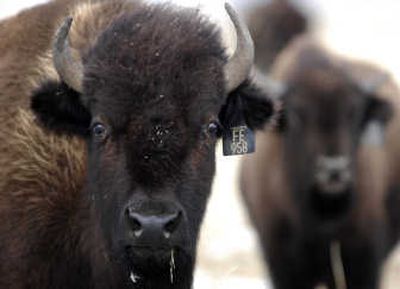
BOZEMAN – At the dawn of the 21st century, bison ranchers were in a desperate search for customers. Things were so dire that many went broke and others bailed out of the business.
Today, there’s a new search. But this time, the industry is looking for more people willing to raise bison. The American public has discovered it has a taste for bison meat.
“One of our major priorities for 2008 will be to bring new producers into the business to help meet the surging consumer demand,” the National Bison Association said in a December news release.
“In the past five years, the bison industry definitely has rebounded,” said Russ Miller, who manages media mogul Ted Turner’s 15 ranches, all but one of which run bison.
With 45,000 animals, Turner is by far the biggest bison rancher in the nation. The next largest is a Wyoming operation that runs about 3,000 head. Just on Turner’s Flying D Ranch south of Bozeman, about 3,500 bison roam, Miller said.
Turner has played a large role in the turnaround of the bison industry, in part through the construction of 54 Ted’s Montana Grill restaurants around the country, places where people are encouraged to sink their teeth into a slab of bison meat.
The restaurants have introduced bison to a wide swath of diners.
“They provide a good job of providing a good quality first bite of bison,” said Jim Matheson, assistant director of the National Bison Association.
In fact, a new Ted’s Montana Grill is scheduled to open in the Baxter Hotel in Bozeman in June, said George McKerrow, the company’s president and a partner in the enterprise with Turner.
Turner’s high-profile celebrity status clearly helps bring people in the doors, and they get a dose of Turner’s environmental ethic as well, which is part of marketing bison. Turner and other bison ranchers maintain that the shaggy giants are easier on the land than nonnative beef cows, plus the meat is higher in protein and lower in fat than most other meats.
The restaurants help move a lot of bison but they also have a secondary effect. If customers enjoy their meal, they start looking a little more closely at the bison meat they’re starting to see more regularly in supermarket coolers.
Another boost to the marketing comes from the increasing national preference for natural foods.
“The natural foods industry and the bison industry have kind of come together,” Matheson said.
“We’re a great little part of American agriculture that I think has a great future,” said Bob Dineen, president of Rocky Mountain Natural Meats in Denver. His company deals only in bison and distributes it around the country under the Great Range brand.
Dineen said demand is high enough that he’s paying 15 percent more for carcasses than he did a year ago, he’s getting ready to double his number of employees (he currently has 23), and he’s always looking for more supply.
There could be more on the way.
In 2007, the number of bison slaughtered rose by 17 percent to nearly 50,000 animals. Per pound prices rose to $2.04, an increase of 24 cents. And prices for breeding animals also rose by 20 percent, indicating more ranchers are planning to expand their herds.
At the November bison auction at Custer State Park in South Dakota, breeding bulls fetched $2,100 and mature cows brought $1,000.
Breeding animals in 2000 brought an average of $316 a head, well below the cost of raising them.
Still, the industry has a long way to go to catch up to its heyday in the 1990s, when breeding animals brought $3,000 and the bison association had more than twice its current membership. But in those days, the focus was on production instead of marketing and that’s what led to the meltdown of 2000 and 2001.
Bison meat has become a standard offering rather than a novelty in many nationwide grocery chains, particularly natural foods giants like Whole Foods and Wild Oats, and consumers are coming back for more, Dineen said.
Plus, the hide market is strong, and byproducts like organs have found a niche in the pet food industry.
“Our issue now is growing the industry on the cow-calf side, getting more producers involved and increasing the supply,” Dineen said.
That could be difficult. Lots of people who jumped into the bison business in the 1990s wound up with burnt fingers and smaller wallets.
“A lot of people got out of the business,” said Dan Day, a bison rancher from Kalispell and president of the Montana Bison Association. “I really doubt it’ll ever get to the point that it was.”
His group has about 30 percent of the membership it had a decade ago, he said, and though some ranchers recently joined his group, he said he’s not aware of any new bison ranch startups in Montana.
The increased production is coming largely from established operations that are expanding, which means the people who stuck it out through the bad times are seeing a rapidly growing market again, with three consecutive years of double-digit growth. Today, U.S. and Canadian bison ranchers own about 500,000 animals.
Turner, too, is planning for additional growth, Miller said.
“We’re expanding because we don’t yet have all of our ranches fully stocked,” he said. “We have no second thoughts about raising an indigenous species on the Great Plains.”