
Past, future represented in rock structures
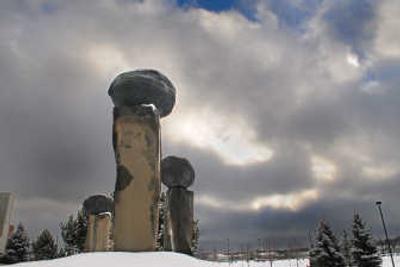
“What’s with the dinosaur eggs, anyway?”
That’s what one student said in 1998 when an outdoor art work was installed on the lawn at the Riverpoint Higher Education Park. The art installation – titled “Cooperation” – is a grouping of free-standing rock sculptures by artist Michihiro Kosuge located between the Phase I classroom building and the Health Sciences Building in the growing University District just east of downtown Spokane.
The large, standing columnar stones are made of basalt – representing old material native to that site, according to the Tokyo-born artist. The smaller boulders on top, with their carved and textured surfaces, are intended to be reminiscent of pictographs created by the first inhabitants of the region.
They also are reminiscent of stone monuments found elsewhere in the world, such as Stonehenge in England.
Kosuge, a professor at Portland State University, stated that while the stone in the artwork reflects old material and that higher education aims toward the future, it is appropriate that the future remembers the past. That’s part of what “Cooperation” is about.
Art, of course, is intended to create beauty and evoke emotion, to stimulate the mind and cause people to think – even if the unintended thought is of dinosaur eggs.
“Cooperation” is one example of the many pieces of public art that now grace communities throughout the state thanks to the Washington State Arts Commission’s Art in Public Places Program, which was established by the legislature in 1974. Each time a new state building is constructed, one-half of one percent of the state portion of construction costs is used to acquire artwork for the building. Community representatives develop criteria, select artists and review proposals for new artwork.
As a result, there are now more than 4,500 works of art located at state agencies, public schools, colleges and universities all over Washington, according to Janae Huber, collections manager for the Washington State Arts Commission’s Art in Public Places.