
Tiles take shape from unwanted glass
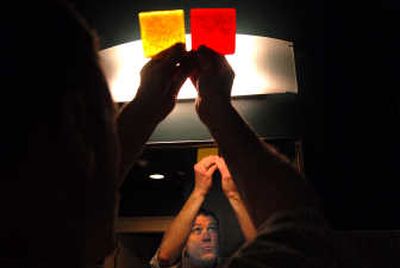
Spokane resident Jeff Hazen makes jewelry – for floors and walls.
In the garage of his South Hill home, the Gonzaga University employee crafts tiles out of recycled glass, creating unique pieces that have a translucent, liquid-like look that’s vastly different from the mass-produced ceramic varieties available at big-box home improvement stores.
“They give designers something else to consider when they’re designing a living space,” Hazen says. “Sometimes, they can look like gemstones on the wall.”
Hazen began tinkering with recycled glass in the early 1990s, when he acquired a small kiln for $20. He took a class on glass crafts and experimented with colors and shapes when he wasn’t at work, first as an environmental engineer and now as an instructor/technician in Gonzaga’s chemistry department.
“I’m not sure what initially intrigued me,” Hazen says. “In the early ‘90s, there was a lot of interest in recycling, and I decided I wanted to be part of it.”
Hazen’s craft eventually evolved into a business, Ridgewalker Tiles. His tiles have been used in the bathrooms of the Snohomish (Wash.) Library, the city of Sandpoint’s water treatment center, and most recently in the Saranac Hotel, the mixed-use building on downtown’s east end that Spokane developer Jim Sheehan has renovated using “green” products and strategies.
Hazen gets his glass from a variety of sources. Most often, he learns of a manufacturer trying to discard surplus plate or stained glass. Hazen once rode a bus to Seattle, then drove home a rental truck chock-full of buckets containing chipped glass.
Hazen also sometimes uses broken windshields from cars and old beer bottles.
To make the tiles, Hazen crushes the glass and places it in tile-shaped molds. He puts the molds in a kiln, then heats the kiln to a particular temperature, depending on the type of glass he’s using.
Working with glass requires less energy than working with clay because glass becomes nonabsorbent at around 1,550 degrees compared with about 2,400 degrees for clay.
Even though he’s working with a previously manipulated material, Hazen usually can alter the color of the tiles he creates by adding metal or iron oxide to the mix. He also plays with the tiles’ appearance by varying the type of glass he uses, crushing it either finely or coarsely, and letting it linger at a particular temperature for a certain length of time.
“Using recycled glass does limit the number of different tiles you can make a little bit, but not very much,” Hazen says. “It’s amazing how many different colors and textures can be made using 100 percent recycled glass. It would be possible to make a tile that is completely custom and probably never be ordered again.”
Hazen says making tiles by hand is hard work, but he gets satisfaction out of walking into a room bedecked in a product he says will outlive him – rather than sitting in a landfill.
“My bag is finding a use for a material that otherwise doesn’t have a use,” he says. “I’m solving an engineering problem.”