
Forester cares for PF trees
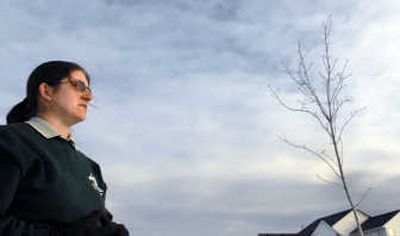
It was the sort of scene that makes Angel Spell wince.
The puny trees at a subdivision under construction off Highway 41 were far too small to be planted along the street, and their crooked, misshapen tops didn’t bode well for their survival over the long haul.
“They’ll make it, but the cost of maintenance will be too much,” Spell said as she inspected the red maple saplings. “I see these trees, and it breaks my heart.”
Had the developer shown Spell the trees before they were planted, she would have said he should buy better specimens. Trees should be at least two inches in diameter if they’re going to have a good chance of flourishing in a street tree environment.
Inspecting plantings is part of Spell’s job as Post Falls’ city forester. She also works to educate the public about the city’s rules for tree plantings and removal and about how they can improve the quality of the city’s urban forest.
It’s a tough job. With the exception of some part-time help, Spell heads a department of one. Still, Post Falls has been named a “Tree City USA” by the Arbor Day Foundation for the past 11 years.
The city gives away thousands of trees each year thanks to donations from individuals and businesses interested in the cause.
But all that effort doesn’t guarantee success at each project.
At least half of the trees Spell inspects are either the wrong size or type, are of inferior quality or have been improperly planted. “Fixing the problem is usually expensive and time-consuming,” Spell said.
“Sometimes it’s just a matter of education. Sometimes it’s a matter of contractors trying to do things as quickly as possible for less money,” she said.
“I’ll review a landscape plan and say, ‘This is a beautiful plan,’ and then they’ll make tree substitutions or change everything during installation,” Spell said.
Common mistakes include topping trees, planting trees too deeply, installing them in poor drainage areas or too close to buildings, choosing trees that will grow to be too tall for a particular location and planting grass all the way up to the tree trunks which causes later damage when lawnmowers hit the trees.
The cost of these problems is often a short life span. Spell said the average urban tree lives just seven years.
When developers call Spell to inspect trees and installation ahead of time she can often advise them on how to avoid problems. Many developers do just that.
The contractor working on a new business complex on Lincoln between Third and Railroad had Spell come out to look at his trees, resulting in a nice row of red maples along the Centennial Trail. They couldn’t be planted along the street as originally planned because of a water line.
Greenstone Homes places a high priority on the trees in its developments, including Post Falls’ Montrose neighborhood, said company president Jason Wheaton.
While many developers plant trees in drainage swales along the road in front of their homes, Greenstone places swales between houses and plants trees in conventional park strips along the streets, Wheaton said. Those conditions are more favorable to the trees than the wet swales, he explained.
Of course, planting trees in swales is less expensive. That’s why many developers use that method.
“It has to be good business,” Wheaton said of investing in landscaping. When a developer like Greenstone spends years building a neighborhood the trees in the earlier areas had better do well if the company wants to sell houses built later in the process, he explained. If a developer constructs a subdivision in a year the trees don’t matter as much.
That’s where city requirements factor into landscaping.
Post Falls has an extensive list of approved street trees, planting requirements and other rules governing trees. Violating those rules could result in the city forcing the developer to correct the mistake, the city correcting the problem at the developer’s expense or the city forcing the developer to forfeit its construction bond.
The city will force a contractor to correct mistakes in electrical, plumbing and wastewater systems, but the forest ordinance doesn’t carry the same weight.
“I look at trees as infrastructure, but historically that hasn’t been the case,” Spell said. “It’s a matter of changing attitudes.”
Most tree ordinance compliance is achieved through voluntary cooperation and contractors are rarely penalized when they don’t follow the rules.
Trees are frequently an afterthought for many developers even though quality trees can improve property values by 3 to 7 percent — an excellent return on investment considering their part of building costs doesn’t even come close to that percentage, Spell said.
And the benefits go beyond that first sale. As the trees grow and mature they even enhance properties aesthetically as well as offer shade to cut down on summer cooling bills, Spell said. “Everything that we’re doing now improves the community for generations to come.”