
Giuliani undone with Florida-or-bust strategy
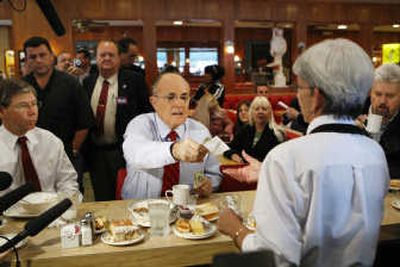
WASHINGTON – Tuesday’s dismal showing in Florida by former New York Mayor Rudy Giuliani capped a dramatic political slide from national GOP presidential front-runner to also-ran – thanks in part to a campaign strategy that bypassed the Iowa caucuses and New Hampshire and South Carolina primaries.
With his Florida-or-bust campaign strategy disintegrating in an instant, Giuliani found himself in the same place that former Sen. Fred Thompson and Reps. Duncan Hunter and Tom Tancredo found themselves: looking for a way out.
Giuliani was expected to exit the race today.
Giuliani’s critics and supporters blamed his fall on the unconventional campaign strategy that focused more on collecting convention delegates than on notching early primary victories. Conventional political wisdom is that success in the early primaries produces momentum, which leads to later primary wins, which leads to enough delegates for the party nomination.
“His campaign was built on the assumption that it could do it their way,” said Peter Brown, assistant director of Quinnipiac University’s Polling Institute. “The message back was: ‘Don’t mess with Mother Nature and skip Iowa, New Hampshire and South Carolina.’ It’s tough to tout yourself as the most electable Republican when week after week you’re getting beat by Ron Paul.”
It wasn’t supposed to be this way. In 2007, Giuliani was riding high in the national polls.
Giuliani’s campaign carried an air of inevitability early on: It rarely mentioned GOP rivals by name and constantly touted Giuliani as the only Republican candidate strong enough to defeat Sen. Hillary Clinton, D-N.Y., in November.
Campaign officials said Giuliani’s national lead was “momentum proof,” insisting that he could lose the early primary and caucus states, win Florida and take major Feb. 5 states like New York, New Jersey, Connecticut and California.
The “momentum proof” line came back to haunt the campaign as former Arkansas Gov. Mike Huckabee got momentum from winning in Iowa, McCain benefited by winning in New Hampshire and former Massachusetts Gov. Mitt Romney got momentum by winning Michigan.
Giuliani, meanwhile, fell off the media radar screen and, at times, looked like a candidate in search of an issue. Toughness against terrorism was supposed to be his signature because of his handling of New York after the Sept. 11, 2001, attack on the World Trade Center.
But terrorism became less of an issue to voters, supplanted by economic fears.