
John Blanchette: Winger’s dreams within reach
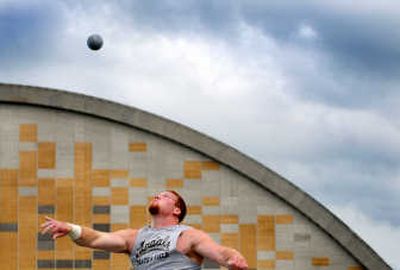
This is a lonesome time of year on the track at the University of Idaho.
Finals week and graduation are a month gone, along with most of the students. The funnel of competition – from the everybody-come local meets to conference to regionals and now on to nationals – has winnowed the team down to a few hearty survivors. The sky spits out a few drops and a fierce wind blows, making the day inhospitable, but Russ Winger nevertheless jackknifes his 6-foot-3, 275-pound thrower’s body to lace on a pair of racing flats and declares, “I’m feeling fast today.” And, yes, a few quick sprints ensue, though no sparks scorch the track.
Later, recovering near the hammer cage where teammate Marcus Mattox is spinning out throws, Winger kicks around the idea of brewing his own beer. In many areas – performance, aspirations, dinner – he is a go-big kind of guy, but his instincts in this case tell him to start small.
“I’d hate for it to be bad,” Winger tells his coach, Julie Taylor, “and then have to drink 30 bottles of terrible beer.”
“I’d hate for you to drink 30 bottles, period,” she replies, perhaps uncertain that he didn’t mean in one sitting.
Somehow, the conversation segues into the subject of what uniform Winger plans on wearing at the U.S. Olympic Trials later this month, and agents. And it can be seen this training day – intense one minute, languorous the next – is just part of the same exciting-but-awkward transition from college to career that consumes every graduate, even as Winger prepares for his last stab at winning the NCAA championship which has eluded him.
“It means a lot to me,” he insisted, “but if I had a choice between making the Olympic team and a national title, I’d go with the Olympics.”
Not that he has to trade.
Winger heads to Des Moines, Iowa, and this week’s NCAA meet as one of the favorites in the shot put – he, Arizona’s Zack Lloyd and Arizona State’s Ryan Whiting are all within a few centimeters of each other – and a contender in the discus, in which he topped 200 feet last year. But they’re also among the top six nationally when pros and collegians are lumped together, not a particularly common circumstance in an Olympic year. And if it takes a 70-foot throw to earn a trip to Beijing, Winger is willing and able – he reached 69-101/4 indoors earlier this year.
He’s been an NCAA runner-up three times indoors and knows “this is my last shot,” he said.
“But if I wasn’t going to continue to train and compete, it would be more of a sad time. I’m definitely looking forward to what’s next.”
Winger’s development into one of America’s elite throwers at age 23 is one of those happy accidents endemic to track and field, and he continues to be as surprised as anyone.
“It wasn’t until my last year of high school that I realized I could be a track athlete in college,” he said, “and it wasn’t until a couple of years ago that I realized people actually do make a living at it.”
Taylor, for one, didn’t immediately size him up as one of those people. He was a 60-foot shot putter at Pine Creek High School in Colorado Springs, and recruited himself to Idaho with about two feet of red hair cascading down his back. Taylor regarded him as “off the wall” – especially having witnessed the all-business approach of Joachim Olsen, now the Olympic bronze medalist, at Idaho just a year before.
And then Winger announced, “I’m going to be your next 70-foot shot putter.”
This required a certain amount of chutzpah – Winger didn’t have a throwing coach his senior year of high school.
“But it told me he had a lot of confidence in his ability and was willing to work hard to be at that level,” Taylor said. “He knew J.B. (Olsen) was no slacker. And it showed me his competitiveness.”
And there were some innate gifts. Though he described himself as “kind of a chubby kid,” Winger actually ran on Pine Creek’s sprint relay team – for a school record that still stands – and Mattox noted that he has a 32-inch vertical leap. That explosiveness is as significant a tool as his considerable strength.
The progress was rapid – he threw 65-91/2 by his sophomore year, and last year easily surpassed the Olympic A standard to reach 68-31/4, the 10th-best mark in the world and the kind that begins to open doors to major European meets, sponsorships and future paydays.
Winger wouldn’t mind if a sponsor stepped forward before the Trials in Eugene – otherwise, he will wear Idaho’s colors. But he’s already made plans to spend next year living and training in West Lafayette, Ind., where his girlfriend – NCAA-leading javelin thrower Kara Patterson of Vancouver – has another year remaining at Purdue. One option after that is the U.S. Olympic Training Center in Chula Vista, Calif., and a four-year assault on London in 2012.
“It wouldn’t surprise me,” said Mattox, who came into Idaho the same time as Winger. “Being the best is always on Russ’ mind. He’s not out here to get second.”