
Blackwell’s logging credentials impressive
Editor’s note: This is the ninth in a series of articles exploring the history of Spirit Lake and its environs as the community nears its centennial in August. Spirit Lake native Keith Spencer became interested in local history when he came across some old photographs while remodeling his home. He and his wife, Janette, researched the photos’ origins, began collecting old documents for posterity and now can’t seem to stop.
During research for this series, it became apparent that media interest during the early days had focused on the charms of both the railroad and the amazing Village of Spirit Lake.
Little was written about the Panhandle Lumber Co., which really was the “elephant in the jungle.” Other than the occasional brief note regarding death or mangling in the workplace, logging and lumbering were obviously not regarded by the media with the same excitement as railroads and such.
Frederick Blackwell did indeed build a huge empire, which included sawmills, railroads, cement plants, financial institutions and cities. However, do note that the young Blackwell in Pennsylvania was a logging man, who came to Coeur d’Alene to seek new opportunities for lumbering in the endless virgin forests of North Idaho.
Make no mistake, Blackwell’s primary intent was to log timber and cut lumber. His initial effort was the incorporation of the William Howard Land and Lumber Co. (a Pennsylvania company) in 1901, whose chief claim to fame was the purchase of more than 100,000 acres of prime timber in North Idaho. The Blackwell group sold this company in 1905 for a huge profit, without having cut a single stick of timber.
Facts are scarce, but the Panhandle Lumber Co. suddenly appeared on the record in 1906 by announcing plans for a mill at Hayden Lake. While the Panhandle was incorporated as an Idaho Corp., it is apparent that many of the “deep-pocket” stockholders of the previous Pennsylvania operation were also involved in this new adventure. Plans quickly expanded to include logging operations in much of Kootenai, Bonner and Pend Oreille counties. This area was mostly wilderness, and Blackwell had little choice but to build railroads and cities to support his planned logging and lumbering operations. He quietly accumulated another 100,000 acres of stumpage, mostly in the Spirit Lake area, including the eastern slopes of Mount Spokane and the Pend Oreille Valley – enough timber to last at least 40 years. When the Panhandle finally called it quits in 1940 there was still plenty of timber, which was sold to Diamond Match for a good profit. In regards to Blackwell’s lumbering credentials in North Idaho, Panhandle Lumber was second only to the giant Weyerhaeuser Syndicate, which operated in Clearwater County near Lewiston.
As with the railroad, Spirit Lake was selected as the center of Panhandle operations. administrative offices were located at Spirit Lake, and, in fact, the only remaining trace of the Panhandle Lumber Co. is the administrative office building, moved closer to the lake and now known as the Fireside Lodge.
The Panhandle Lumber Co. could do little until rails reached Spirit Lake over a spur constructed from Clagstone, using the rails of D.C. Corbin’s newly completed Spokane International Railroad. The first actions were the clearing and grading of the mill site, soon followed by construction of a temporary mill to provide timbers and lumber to build the main mill. It also ended up supplying most of the lumber for constructing Spirit Lake and many ties for the railroad.
Unlike the rest of Blackwell’s empire which was scrupulously managed, Panhandle Lumber had a few warts. Its most notable sin was accomplished after the ideal site for the new mill was selected. Seems that there was a serious problem. The bull chain of the huge mill would rise from wimpy and part-time-flowing Spirit Creek. Blackwell had the perfect place for a giant modern mill and there was no millpond. The ever-clever Blackwell came up with the perfect solution. He built a dam at the north end of the complex and raised the level of the lake about five feet.
Some insist that this never happened, but according to formal documentation it certainly did. For many years, one could see traces of the ancient shoreline, and I have early pictures of tree stumps sticking out of the water. What do you think would happen today, if some empire builder arbitrarily raised the level of some pristine lake? Ahh, for the good old days when life was simple.
The mill
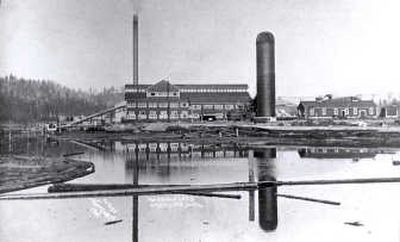
With a deep-water 35-acre millpond secured, construction began on the main mill. Typically, Blackwell went first-class, picking W.A. Wilkerson, one of the premier designers of large mills in the United States, to design the facility.
With a first-class crew, work progressed rapidly and timber-cutting crews began logging operations in December of 1907. The April 3, 1908, issue of the Spirit Lake Herald said it best: “The Panhandle Lumber Co. Limited has nearly completed the most modern sawmill in the world at Spirit Lake. The superstructure of the mill was started on Oct. 30, 1907, and it is expected that the mill will start its ceaseless grind about May 20, 1908.”
This mill was to become one of the largest in North Idaho, with a cutting capacity of 50-million board feet per year. The main building housed two independently operated double-cut band saws and a large re-saw operation. The second floor housed the lathe mill with the third floor used as the saw-filing facility. Its footprint was 54 by 192 feet; the mammoth steel refuse burner was 100 feet high and set on a concrete base 24 feet in diameter.
The adjacent powerhouse of brick construction deserves special mention, not only because it powered the main mill, but also because it provided power for the electric motors in the planing mill, power for the massive railroad shop complex and power to run the pumps for the extensive water system.
Note that the Panhandle provided both electricity and water to the entire city. Steam was generated by a 500-horsepower Murray-Corliss steam engine, with electricity generated by two large Westinghouse steam turbine/generator units (one used at a time).
As the years went by, demand for power increased and the electricity-generating component became a bit overtaxed at times. My Uncle Merle used to joke about how the lights in town dimmed every time a large slab was thrown into the “hog.” This powerhouse was both the heart and soul of the entire area until the company disbanded in 1940.
The rest of the mill complex included a large and efficient planing mill, a sizable dry kiln, a covered sorting dock (green chain), a large timber dock, several large lumber sheds, a combined machine shop/forge facility and a yard capable of storing more then 40 million board feet of lumber.
Lumber could be loaded onto flat cars inside the lumber storage facility and in later years, the Panhandle took over operation of the railroad roundhouse, which was used for maintenance of its considerable rolling stock. At peak operation, 500 workers supported the mill operations.
Logging around and above Spirit Lake
Not surprisingly, the Panhandle first picked the low-hanging fruit (forests immediately adjacent to Spirit Lake). Initially, logs were loaded onto horse drawn wagons and sleighs for transport either to the mill or a railroad siding. For short distances, especially to the water, horses also dray-hauled single logs along a greased pole track.
This was a slow and inefficient way to move logs, and the use of horses was soon mostly abandoned, replaced by the use of cable-drum steam driven donkey engines. By 1914, the hills around the beautiful lake had been pretty much denuded and they now looked pretty ugly (another wart).
Panhandle logging above Twin Lakes
Perhaps the most interesting and certainly the least understood of the Panhandle logging operations took place south of Spirit Lake at Upper Twin Lake in the Fish Creek area. In the early 1920s, well after the departure of Blackwell from the scene, the Panhandle decided it was time to exploit its large holdings in that area.
Even with Blackwell gone, the Panhandle continued its creative thinking. When everyone expected construction of another flume into Upper Twin Lake, the company incorporated the Idaho Logging Railroad. The ILR was eventually extended 11 miles up Fish Creek toward Mount Spokane to a place called Art Webb’s Landing.
The landing was used for many years as a central collection point for much of the timber taken out of the area. It must be noted now that the ILN was no repeat of Blackwell’s very fancy Idaho and Washington Northern Railroad, which by then was owned by the Milwaukee Railroad. The roadbed was neither graded nor ballasted. There was little tangent track and the rails were often routed around large tree stumps. The track was so bad that the crews sarcastically referred to the ILN as the “Haywire Pacific.”
According to legend something was “off the rust” (derailed) a lot. Even with a modern loader, it was not easy to repair damaged track and place any wayward rolling stock back onto the tracks. Even so, this rickety little railroad, with its faithful Shay locomotives, carried untold millions of logs to the Spirit Lake mill. Since there was only one switch coming off the main line at Seasons and no other place to turn the train around, it is apparent that each empty log train had to back the entire distance from Spirit Lake to the end of the line. That must have been a really scintillating trip.
The Twin Lakes sector provided for lots of tall tales. To make matters worse, times were tough, and with Blackwell gone, the Panhandle operation was not as honorable as earlier; the company was engaging in a fair amount of skullduggery.
As an interesting example, the Webb Landing loading crew did not work for the Panhandle. They were contract employees (gyppos) and were paid by the amount of logs loaded over a period of time. The “scaler,” a Panhandle employee measured the logs and kept track of the amount loaded. The crew discovered that they were getting a short scale (cheated) and complained to Panhandle management. Nothing happened so the whole group, including my dad (Forrest “Skip” Spencer) went on strike. They were immediately fired. So much for their loading career, or so all thought.
Several months later, a high-level Panhandle executive appeared at our back door and asked when Dad was going to start his winter job (repairing the Panhandle rolling stock). He responded “I’m not – don’t you remember you fired me?”
Dad was not really a logger, but was a machinist by trade and the only one available to the company. The executive didn’t know what to do. After a brief silence, Dad said: “I will be back to work tomorrow, but only if you hire the whole log loading crew back next spring and promise to quit cheating us.” The relieved manager quickly agreed to the deal and all were happily re-employed the following spring.