
Plastic anxieties: Seeking BPA-free alternatives
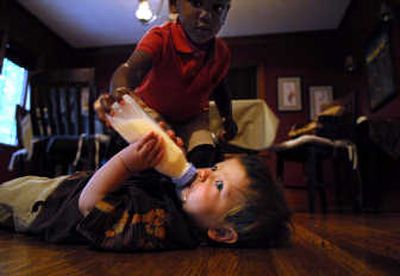
It’s supposed to be the “safe” cupboard.
You know, the one in the kitchen where your toddler rummages while you cook dinner. Instead of glass jars or knives or other potential dangers for little hands, it contains food-storage containers, sippy cups and old baby bottles.
In other words, the safe cupboard is full of plastic.
Increasingly, though, people are concerned about the amount of plastic in their lives and the health threat it could be posing, especially to infants and children.
News about bisphenol-A (BPA), a chemical many common plastic products contain, is prompting people to replace their plastic products with either BPA-free alternatives or products made from other materials such as wood and glass.
Spokane resident Stacey Conner is one such person. The mother of three children under age 3 recently disposed of the clear, hard-plastic, Philips Avent-brand bottles she’d been using for her 10-month-old son, Quinn, as he transitioned from breastfeeding.
Conner had heard the concerns before, but she didn’t take action until a Canadian friend e-mailed her an article about BPA and about that country’s recent decision to prohibit its use in baby bottles.
“I’m not a freaker-outer,” she says. “I also don’t often make a change. But once Canada (announced its pending ban), I noticed.”
Conner belongs to a preschool cooperative and said none of the other mothers in her children’s class scoffed at her decision to replace her BPA plastic.
“Nobody said, ‘Well, that’s nonsense,’ ” she says. “I feel like it’s becoming more and more accepted.”
Patricia Hunt, a professor at Washington State University’s School of Molecular Biosciences, says she’s glad to see more people taking the concerns about BPA seriously.
Ten years ago, while working at Case Western Reserve University, Hunt and her colleagues discovered changes in the chromosomal behavior of eggs in healthy mice after their water bottles had accidentally been damaged and started leaching BPA into their water. The team’s findings were published in 2003.
More recently, Hunt was part of a group of researchers that published a review of studies that showed the dangers of BPA. Meanwhile, the National Toxicology Program, a division of the U.S. Department of Health and Human Services, issued a brief in April warning that there is some concern that exposing fetuses, infants and children to low levels of BPA can cause changes in behavior and the brain, prostate gland, mammary gland and the age at which girls hit puberty.
The plastics industry has refuted the studies’ results and touts the health and safety advancements made possible by plastic over the last century. It outlines its stance at www.bisphenol-a.org.
Numerous studies have shown, though, that BPA mimics the role of estrogen in the body. And studies on baby bottles demonstrate that the chemical leaches from plastic when liquid is heated inside them, such as when hot water is poured in or when a bottle of water or milk is warmed in a microwave.
Various studies on rodents have suggested that exposure to the chemical in humans could increase the rates of miscarriage, Down syndrome, childhood hyperactivity and prostate and breast cancer in adulthood.
That’s news that Spokane resident Renée Roehl, 55, wishes she’d learned 25 years ago. When diagnosed with stage 2 breast cancer last winter, she asked herself, “You’re the poster child of good eating. You exercise all the time. You’ve been doing yoga for 35 years. So how did you get this?”
She says her oncologist told her it likely was genetic, but Roehl doesn’t know of anyone in her family who has had breast cancer. Her family doctor, a homeopath, pointed to another possible cause: the five-gallon plastic water jugs she’d had delivered to her house for more than two decades.
Roehl is a water connoisseur.
“If you drink a lot of water, you have an acquired taste for what you like,” she says. “I don’t like the taste of chlorine. … I loved the taste of the water I was getting.”
Before the cancer hit, she would often carry around plastic bottles filled with the water from her five-gallon jugs, often leaving the bottles in her car where they would get warm on hot days.
Roehl has the type of breast cancer that thrives on estrogen, so her homeopath’s concern is that BPA leached from her plastic water jugs, invaded her body, disguised itself as estrogen and fed her cancer cells until they were fat and happy.
Rather than undergoing typical cancer treatments, as her oncologist recommended, Roehl is treating the disease naturally, including trying to starve the cancer cells of estrogen by replacing her plastic products with glass and eliminating most soy from her diet, since it can act like an artificial estrogen, as well.
After about a month following that routine, Roehl said she felt like the main lump had flattened out somewhat, but she’s due for an ultrasound soon.
“It didn’t get here overnight, and I don’t expect it to go away overnight,” she says.
Hunt says she’s hearing stories similar to Roehl’s, but there’s no way now to prove that BPA has played a role in those situations.
“Right now, we know a lot about mice and rats,” Hunt says. “If we could just know more about people, but we’re hard to study.”
She says relying on the rodent model for now, though, will continue to raise awareness of the issue, educate parents about alternatives to plastic products they can use with their children and encourage consumers to demand safer products when alternatives don’t yet exist.
“The major thing is we’re more aware, and that’s how we make change,” Hunt says.