
High & Mighty
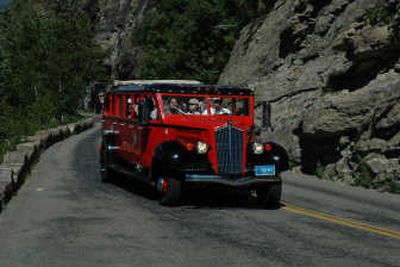
When early Glacier National Park engineers sketched out a transmountain highway crossing the Continental Divide, no one knew about SUVs, nor RVs.
Builders chipped out a narrow, two-lane road that cuddled cliffs like a mountain goat trail. It trotted high up to a rugged, top-of-the-world saddle touched by humans only a few months per year.
Nattily dressed automobile drivers first crossed Going-to-the-Sun Road over Logan Pass in 1933. Today, the grand dame of scenic highways still elicits the same hair-raising thrills and “wows” at panoramas just as it did then.
The 75-year-old garland strung through Glacier’s heart is preserved as a National Historic Landmark in all its glory – skinny enough to clip off side mirrors, too curvy for RVs, and shoulderless, affording no margin of error.
Few people know the 50-mile road better than those who drive its historic red jammer buses.
“I never get tired of its magnificence,” says Joe Kendall, better known as “Jammer Joe,” a veteran driver from Illinois.
Water spews, roaring down mountainsides. Scooped-out valleys, toothy ridge spines and sky-scraping, pointed horns stand as glacial fingerprints.
Wildflower meadows bloom in Crayola colors. Bighorn sheep browse; fat marmots scream warnings. Giant white snow walls linger well into July.
Drive yourself, or ride a jammer; your eyes will bounce between exquisite scenery and the road’s engineering handiwork.
Birth of a marvel
Engineered over a 20-year period, Going-to-the-Sun Road climbed with pullouts for gawking and a 6 percent grade to save drivers the trouble of downshifting.
The original plan called for 15 switchbacks up the west side of Logan Pass. Engineers scrapped that in favor of The Loop, one huge hairpin, instead.
Congress appropriated $2 million for construction, resulting in artistry like the Triple Arches spanning a vertical cliff. Multihued rocks gathered onsite and cemented together by mortar became retaining walls, bridges, tunnels and arched culverts over waterfalls – all appearing as if they sprang naturally right from the mountainside.
Hanging by ropes, workers excavated rock using only small blast explosives and minimal power tools. With power equipment unable to reach the East Side Tunnel, crews cut its 405-foot length by hand-boring 5.33 feet per day.
“It’s such a great accomplishment because they did it with picks, shovels and elbow grease,” says Jammer Joe.
Of all the man-made creations on the road, nothing pays grander tribute to the scenery than the 192-foot-long West Side Tunnel. Two alcoves frame the perfect sweep of the Glacier Wall to Heavens Peak.
To drive or to ride
From the West Glacier entrance, the skinny Sun Road putters pleasantly through McDonald Valley along the largest of the park’s blue lakes.
Languid, red-rock-rimmed pools along McDonald Creek break into frothy foxtrots. Avalanche chutes harbor grizzlies scouring hillsides for bulbs.
The serene, fir-scented drive is made for photo stops, walks through the deep, moss-bedecked rain forest and soaking hot feet in frigid water.
But at Logan Creek, the road grunts up 12 miles to Logan Pass. Not for the acrophobic, the Going-to-the-Sun Road shimmies along vertigo-inducing drops thousands of feet above the valley floor.
For many, the scenery is too dramatic to look at while driving. You can hop free park service shuttles that stop at 17 locations on the Sun Road between July 3 and Labor Day, but you’ll get the inside history riding the red park icons.
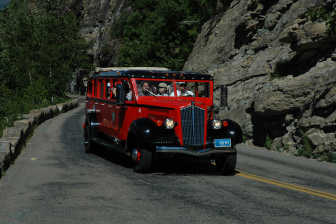
Vintage, 25-foot-long White Motor Co. buses still tour over Logan Pass as they did in the 1930s. The 17-passenger touring sedans sport rollback canvas tops for open-to-the-sky views.
Jammer Joe remembers working at Lake McDonald Lodge in the summers of 1949 and 1950, when the jammers were an elite group of drivers who garnered their name from jamming the gears on the cantankerous, standard-transmission buses.
“Now, I’m just shiftless,” he jokes about his renovated, automatic bus.
Glacier’s 33 red buses are the largest and oldest continually operating fleets of touring coaches that drove the big Western parks. Tours ($35-$78; 406-892-2525) depart daily for Logan Pass, conditions permitting.
A look at the past
Today, the Going-to-the-Sun Road affords a glimpse of history as workers cling once again to the side of 1,000-foot cliffs while it undergoes federally funded construction to fix its ailing roadbed.
Voluminous snows, avalanche swaths, torrential downpours and 475,000 vehicles per year wreak havoc with the road.
Despite construction, the entire route is scheduled to remain open through mid-September. During peak hours, drivers will see a maximum traffic delay of 30 minutes.
Delays afford a chance to watch state-of-the-art road technology at work in a cliff-ridden environment: Cranes and bobcats jockey for position along one narrow lane, like working on a tightrope. For visitors, it’s a taste of the chutzpah required to build the scenic road.
Sleeps and eats
Pair a drive on the Going-to-the-Sun Road with lodging at one of two National Historic Landmarks.
Dial back your expectations to early park days, as rooms are small with tiny bathrooms converted from original closets. The hotels lack televisions, elevators and air-conditioning, but are loaded with ambiance.
The Belton Chalet (888-235-8665) was the first of Great Northern Railway’s hotels opened in 1910 to attract wealthy easterners to the park. In West Glacier across from the train depot, the lodge rooms ($145-$170) are flavored with the past: push-button lights and original wood floors. Nine have private decks with antique rocking chairs for soaking up the sunset.
Dine at the Belton Grill on fish, game and meat entrees roasted on the lodge’s old boiler made into a grill, then sign up for a wake-up call to catch Northern Lights or grizzly bear sightings.
The much larger Lake McDonald Lodge (406-892-2525), built in 1913, centers its three-story original hunting lodge lobby around a massive stone fireplace. Trophy specimens hanging from cedar railings represent most of the park’s wildlife. Many main lodge rooms ($160) overlook the lake, where the circa 1930 boat the DeSmet tours.
End the day at Russell’s Fireside Dining Room with the wild game sampler appetizer of bison, venison or elk followed by the New York Strip topped with mushrooms sautéed in Moose Drool beer.
Once you’ve seen Going-to-the-Sun Road, you’ll want to see it again. And again.
“Glacier’s mountains are so special, so full of grandeur,” lauds Jammer Joe.
Going-to-the-Sun Road allows everyone to climb to mountain goat heights to feel that same wonderment.