
Wiretap links Eliot Spitzer with prostitutes
WASHINGTON – New York Gov. Eliot L. Spitzer’s political future was thrown into doubt Monday after he was identified as an anonymous client heard on a federal wiretap arranging to pay money and buy train tickets for a high-priced New York prostitute to meet him at a Washington hotel.
A person familiar with the case said Spitzer was one of the unnamed clients of a New York area prostitution ring mentioned in federal court documents unsealed last week. Spitzer, a rising star in the Democratic Party who has been in office 14 months, did not directly address the allegations in a Monday news conference, and he made no mention of resigning. But his political career seemed in limbo Monday night amid speculation that he was preparing to step down.
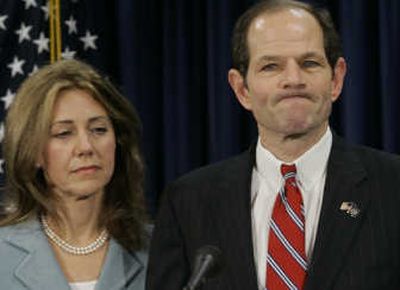
“I have acted in a way that violated the obligations to my family and that violate my, or any, sense of right and wrong,” Spitzer, 48, said in a statement, with his wife, Silda Wall Spitzer, at his side. “I have disappointed and failed to live up to the standard that I expect of myself.”
His political opponents in the state legislature were calling for his resignation, and even sympathetic analysts said the governor – after a series of scandals and bruising battles with the legislature – did not have a reservoir of goodwill to draw upon that might help him overcome this latest controversy.
“This is not even a nail in the coffin – this is a spike,” said Douglas Muzzio, a political science professor at Baruch College. “It would be difficult for him to govern. His moral authority is nonexistent.”
The Mann Act, a 1910 federal statute, prohibits crossing state lines to engage in prostitution. Also, Republicans in Albany said that if Spitzer tries to keep his job, they will likely investigate whether his state police bodyguards, who provide 24-hour protection, were complicit in his actions, and whether any state money or facilities were used.
“I can’t see him getting through this,” said Republican state Sen. Martin J. Golden, a former police officer. “Interstate transportation for sexual purposes is a federal crime.”
Spitzer has not been charged with any crime. The U.S. attorney’s office in New York had no comment on the case.
If Spitzer does resign, he would be replaced by Lt. Gov. David A. Paterson. Paterson, the state’s senior black elected official, is legally blind and would be New York’s first black governor.
The wiretap was set up for a federal investigation of an exclusive prostitution ring, known as Emperors Club VIP, that charged well-heeled clients as much as $5,500 an hour for “exclusive, beautiful, educated companions of fine family and career backgrounds” while ensuring “privacy and discretion when dating and traveling,” according to the company’s Web site.
The site has been shut down.
Last Thursday, federal authorities – using an agent posing as a client and wiretaps that recorded about 5,000 calls – arrested four people connected with the prostitution ring, including alleged ringleaders in New Jersey, Mark Brener, 62, and Cecil Suwal, 23, known as “Katie,” who ran day-to-day operations. Also arrested was Tanya Hollander, 36, of Rhinebeck, N.Y., and Temeka Rachelle Lewis, 32, of Brooklyn.
The charge sheet for the four provided details about clients soliciting women, including an unidentified “Client-9,” who called Lewis to say that he had sent a package, believed to be a monetary deposit, and wanted to have a prostitute named “Kristen” take the train from New York’s Pennsylvania Station to Union Station in Washington on Feb. 13 and meet him in a hotel in the District of Columbia.
A source familiar with the investigation, speaking on the condition of anonymity, said Client-9 was Spitzer.
On Sunday, Spitzer reportedly told his staff that he had been implicated in the prostitution ring, the New York Times reported on its Web site.
The Washington hotel was later identified as the Mayflower.
According to the details in the charge sheet, Client-9 appeared to be a regular user of Emperors Club VIP services. When Lewis, awaiting the deposit, asked whether the client had used the correct mailing name, Client-9 replied, “Yup, same as in the past, no question about it.”
The client also asked Lewis if he could give Kristen “extra funds” as a deposit for future services. Lewis explained that it was not standard practice, but that she was willing to make an exception for Client-9.
Spitzer’s travel schedule shows he spent the night of Feb. 13 in Washington to attend a congressional hearing the next day, Valentine’s Day.
Spitzer made a name for himself as New York’s crusading attorney general, taking on white-collar criminals and prosecuting securities fraud cases. He also broke up two prostitution rings.
Spitzer ran for governor in 2006 as a reformer who would shake up the sometimes gridlocked politics of Albany, and his landslide 69 percent of the vote was the largest margin ever in a New York gubernatorial race. But his popularity waned as he became enmeshed in a series of scandals and political missteps, including allegations that his staff used New York state troopers to collect potentially damaging political information against his chief rival in Albany, Joseph L. Bruno, the state Republican leader. Spitzer later apologized to Bruno.
Spitzer also proposed a plan to give state driver’s licenses to illegal immigrants, but that created a firestorm of protest and complicated the presidential campaign of Sen. Hillary Clinton, D-N.Y., who was asked in a debate whether she supported it and is seen as having flubbed her answer.