
Stint at Point Guard College helped Toliver elevate game
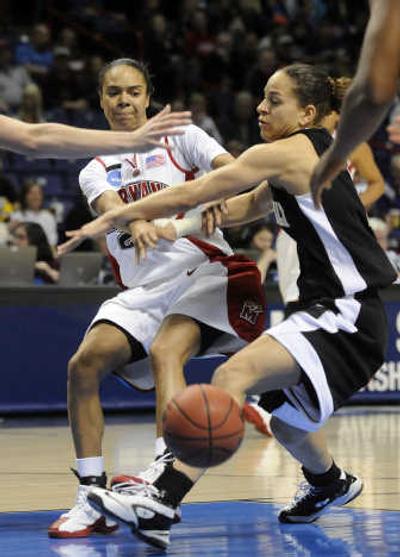
Kristi Toliver, like many of her experienced teammates on the Maryland women’s basketball team, has packed a lot into the last three years.
A national championship, a disappointing sophomore season in which she was removed from the starting lineup prior to the NCAA tournament, a week at Point Guard College – yes, there is such a thing – and a stellar junior season that continues with a showdown against Stanford tonight in the Spokane Regional final at the Arena.
Through it all, Toliver has emerged as a polished player that U.S. Olympian Diana Taurasi called the best point guard in the college game “hands down” after Toliver had 18 points and five assists in an October exhibition game against the national team.
“It took me a few years to figure out what a real point guard has to do,” Toliver said. “It’s not just scoring, it’s not just dishing the ball. Like (Stanford’s) Candice (Wiggins) said, it’s being the glue that holds everything together, to be the steady one, to be the emotional leader. I think I’ve incorporated all that into my game. It’s a tough job, but I’m glad I have the responsibility.”
Few, if any, do it better. Toliver averages 16.8 points. She’s a career 41 percent 3-pointer shooter and 87 percent at the foul line. She set a single-season ACC record for assists this year.
As a freshman, she made one of the biggest shots in program history with a step-back 3-pointer that evened the score against Duke late in regulation of the 2006 NCAA championship game. She added a couple of key free throws in overtime as the Terps won, 78-75.
“I’m the same, confident kid that would shoot it again,” Toliver said, “but I’m also two years older and two years smarter. And I think I have more of a complete game than I did then.”
To get there, Toliver endured some tough times. Maryland’s encore to the 2006 title was a second-round upset loss to Mississippi, an opponent the Terps ripped by 31 during the regular season. Toliver came off the bench in Maryland’s two tournament games.
“I was taken by surprise when the decision was made, but I think I responded very optimistically,” she said. “I didn’t try to get down on myself or anyone else or point fingers.”
Toliver and coach Brenda Frese discussed Point Guard College after Toliver’s freshman year, but she opted to perform off-season work at Maryland. After last season, the topic came up again and Toliver decided to enroll.
Point Guard College, run by ex-Virginia point guard Dena Evans and held in Toliver’s hometown of Harrisonburg, Va., was five days of non-stop hoops, on court and in the classroom, from 7 a.m. to midnight.
“It’s the best thing I’ve ever done,” Toliver said. “I felt like I just needed to fall in love with the game again. After it (sophomore season) was all over I was kind of disinterested and sick of the game for a second. It got my passion back.”
“The thing that’s different about Kristi is not only does she score, but she passes the ball well,” Wiggins said. “If you don’t guard her, she’s going to score it. If you guard her, she’ll step around you and she’s going to dish it. It makes her unique.”
Toliver scored just eight points in Saturday’s win over Vanderbilt, but she had eight assists and lost out on a couple more when teammates missed from point-blank range.
“She just has a really good sense of the game,” Vanderbilt coach Melanie Balcomb said. “She’s extremely confident, she can change speeds and take you off the dibble, penetrate and dunk to those posts.”
Toliver wasn’t sure how many points she scored, but she knew the end result.
“We won by 14,” she smiled.
She’d like to win three more games. That would mean a second title in three seasons.
“When I was a senior in high school I said I’m coming to Maryland to win four straight,” Toliver recalled. “My freshman year we got one. We didn’t think it was going to be that hard to do it again, but when you get everybody’s best game it’s a lot easier to say it’s going to happen than to actually have to live it. Last year was tough – different chemistry, playing a lot of great teams in non-conference and conference.
“I think we forgot how hard it was my freshman year. Now I’m a junior and we’ve had the highs and lows and we know what it takes to continue to survive and advance. And that’s what it’s all about.”