
Geared up to give back
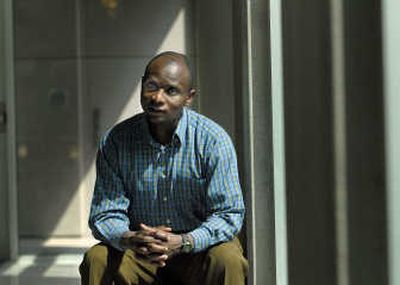
As college graduates toast their accomplishments in the coming weeks, they might consider Patrick Muturi.
Muturi, a 35-year-old from Kenya, will graduate Friday with a nursing degree from Washington State University. Muturi said celebrating isn’t the most important part of graduation.
“It’s good to have a graduation ceremony,” he said, “but the most important thing is the future, and what we can do in society.”
If Muturi is particularly serious about his mission in life, it may be just that he has an amplified sense of his good fortune. Growing up in a family of subsistence farmers in Kenya, Muturi came to America on a WSU scholarship as a runner in the 1990s. He’s since become a professional marathoner, a U.S. citizen, an Army soldier, and now the holder of two bachelor’s degrees. He hopes to work in the Veterans Affairs system in Seattle, helping soldiers returning from the war in Iraq.
“The opportunity to go to school, to have a job – these luxuries, I don’t take them for granted,” he said. “We should realize our position so we can bless others, so we can answer their prayers.”
Muturi is one of some 437 WSU-Spokane students who will graduate Friday. University-wide, more than 2,400 WSU students will graduate this weekend. Other colleges will have ceremonies over the next several weeks.
Muturi is finishing a four-year degree that has become one part of the health sciences focus of WSU and Eastern Washington University in Spokane. A new nursing building is set to open at the Riverpoint campus during the next academic year, and the first 20 medical students in a new program will start classes in the fall.
Muturi’s interest in nursing is influenced by the benefits he and his family experienced through missionary health care in Kenya and by seeing the faces of his fellow soldiers as they returned from Iraq when he was stationed in Fort Carson, Colo., for three years.
“I have a deep desire to work with the vets, because I’m a vet myself,” he said. “That would be the minimum I can do for our men and women in uniform, because I think they sacrifice so much.”
Muturi grew up in Kiambu, Kenya, in a family of nine. Like many Kenyans – who have a worldwide reputation as distance runners – Muturi found himself running every day, not in training but just to get around.
His school was an hour’s run each way, he said. “And that was not training,” he said.
In 1993 he competed in the world junior games in Buffalo, N.Y., and shortly after that he won a scholarship to WSU as a cross-country and distance runner. He experienced intense culture shock in New York, he said, but even Pullman seemed like a big city compared to his home.
Partway through a decorated college track career, though, Muturi became acutely sensitive to the difficulties of his family back in Kenya, who were struggling to meet their basic needs while he was living in the land of plenty.
“I was going through tremendous pressure because I come from a place where I was the breadwinner,” he said. “My folks back home were going hungry. … I didn’t feel like a blessing to those people.”
Muturi left his All-American college career and turned pro, helping his family with the earnings from marathons. It was a challenge, considering that he stayed in school and completed his bachelor’s degree in international business. He then served three years in the Army, running in several international competitions while helping process soldiers heading to and from the Iraq war.
That helped direct him toward a career in nursing.
He hasn’t seen his family for eight years, and his mother was recently denied a visitor visa to come here for this weekend’s graduation ceremonies. “That was disappointing,” he said.
Muturi will participate in WSU-Spokane ceremonies Friday, and he’ll be one of several graduates singled out for honors during ceremonies Saturday in Pullman.
He said his journey to America has left him sharply aware of the differences in the quality of life between the rich and poor, and he looks toward the day when he puts his education toward helping the less fortunate.
“I grew up in a place where there wasn’t anything, and I have the opportunity to be here, in a place where there is everything,” he said. “What is it God wants me to do with that?”