
Economy steadying
WASHINGTON – Coupled with better-than-expected first-quarter growth numbers, new government employment statistics point to an economy that’s not robust but appears safe from deep contraction.
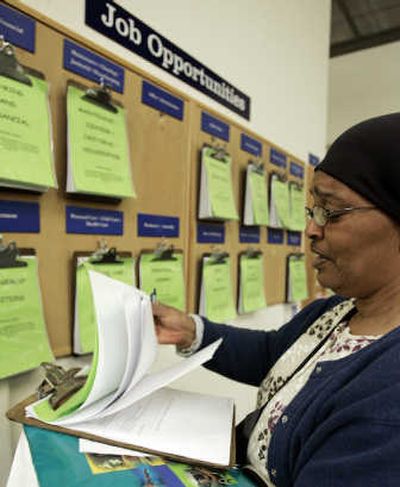
Employers shed jobs in April for the fourth consecutive month, the Labor Department reported Friday, but they did so at a much slower pace than analysts expected, and the unemployment rate actually improved to 5 percent.
That positive news came on top of a Wednesday report that showed the economy grew 0.6 percent over the first three months of 2008 despite fears of recession. Total job losses in the quarter were 240,000. Historically, job losses stretching over several successive months is a sure sign of recession, but the sum of job losses remains far below that of past recessions.
“While there is no question the economy is struggling, just how anyone could confuse the current environment with the worst economy since the Great Depression is baffling,” the Wachovia Economics Group, part of Charlotte, N.C.-based bank Wachovia, said in a research report Friday that revised earlier projections of a recession.
Employers cut 20,000 jobs in April, well below the 80,000 expected in the consensus forecasts of mainstream economists. The unemployment rate dipped slightly from 5.1 percent to 5 percent.
The areas where jobs were lost remained consistent, mainly centered in sectors particularly hard hit by the housing downturn – construction, manufacturing and retail trade. Jobs were added in health care and professional and technical services.
More than 306,000 part-time workers were added to payrolls in April. That brought the national number of part-time workers to 5.2 million, inflating the overall employment rate and suggesting a sluggish jobs market at best.
“This level was 849,000 (jobs) higher than in April 2007. These individuals indicated that they were working part time because their hours had been cut back or because they were unable to find a full-time job,” the Bureau of Labor Statistics report said.
The Labor Department’s broadest gauge for work force health – which includes the unemployed, marginally attached workers and those working part time for economic reasons – rose to 9.2 percent of all workers in April, from 9.1 percent in March.
In a note to investors, Nigel Gault, chief economist for forecaster Global Insight, warned that with construction and manufacturing employment “still declining sharply, hours worked down and part-time employment up, this report can’t be taken as a signal that the economy is out of the recession woods.”
Still, this week’s growth and jobs data suggest that the economy may be finding its footing after a tumultuous half-year marked by a deep housing slump and turmoil in the credit markets.
“We have been able to withstand some very strong corrections and continue to show some growth,” Commerce Secretary Carlos Gutierrez told McClatchy on Friday.
“We don’t like to see jobs decline, so it’s bittersweet. We’re very pleased that unemployment is 5 percent. … That continues to be low in historical standards.”
Speaking in Missouri on Friday, President Bush said he expected the economy to rebound later this year because of an economic stimulus plan passed in February. As of Friday, 7.7 million checks collectively worth $7 billion had been sent, with 122 million more scheduled to be sent by the end of June.
“When you’re affecting 130 million households, with over $150 billion, a pro-growth package, it’s going to affect us positively,” Bush said.
The Bush administration chose to highlight the improvement in the unemployment rate and that the economy is shedding fewer jobs compared with March’s decline of 81,000 jobs.
But Democrats, who hope to recapture the White House because of high gasoline and food prices and a sluggish job market, saw a political opening in Friday’s jobs report. They pointed out that nearly one in five workers has been unemployed for longer than four months and is finding it hard to get back into the work force.
“Today’s employment report provides no comfort to those who want to work but can’t find a job, especially those who have exhausted their regular unemployment insurance benefits or soon will,” said Chad Stone, chief economist for the liberal Center for Budget and Policy Priorities. “Congress should quickly enact temporary extended unemployment benefits both to support the slumping economy and to provide needed assistance to those workers.”
House Speaker Rep. Nancy Pelosi, D-Calif., said in a statement that the “jobless numbers, combined with slowing consumer spending and nearly flat wage increases, are additional evidence of the need for Congress and the president to work in a bipartisan way on additional steps to get our economy back on track.”