
Northern Exposure: Flowers melt the snow

Spring provides an extravagant outdoor color explosion that is easy to miss. Wildflowers begin to emerge in Northern Idaho as soon as the snow melts in fields and under trees and bushes. It’s a good time to grab that new digital camera and make some beautiful memories. Wildflowers, for those who take the time to notice, are gorgeous living things. We can appreciate their picturesque petals, but in the past the plants offered the Native Americans and the pioneers more than good looks. They were an essential part of their diet and medicine. The term “hunter and gatherer” is used to describe how food was obtained before there were grocery stores and pharmacies. What plants to dig and harvest was passed down from one generation to the next. Indians also showed the first pioneers how to live off the land. The list of flowering plants in our area is long, but some of the most commonly seen plants also have the most interesting historic credentials.
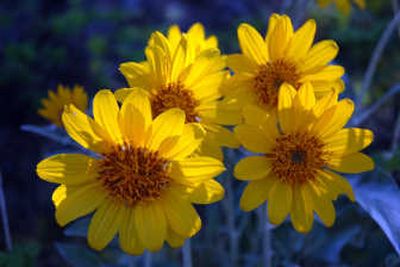
Arrowleaf balsamroot: This large sunflower is hard to miss. Its bright yellow flowers stand out on drier exposed slopes and fields. Native Americans would peel and eat raw the tender inner portion of the young immature flower stems. They also ate the large roots and seeds. The roots are tough and woody and taste like balsam. To make them palatable, the Indians would bake them several days in a fire pit.
Medicinally the large coarse leaves were used as a poultice for wounds, cuts and burns. The roots were boiled, and the solution was applied to the wound. Indians also drank a tea from the roots for tuberculosis and whooping cough.
Dogtooth Violet or Glacier Lily: This small, yellow lily is one of the first flowers to appear after the snow melts. It also is one of the most spectacular and can be very common in undisturbed areas. It is a natural food source for bears, ground squirrels and other wildlife. The bulbs of this lily were only used as an occasional food source of the Indians. These deep-seated bulbs were difficult to dig. The bulbs can be eaten raw or boiled, and the leaves can be eaten as a salad plant.
The bulbs and leaves occasionally impart a burning sensation.
Yellowbell: Shortly after Glacier Lilies bloom another pretty but less common yellow-flowered plant emerges. Black and grizzly bears, pocket gophers and ground squirrels dig for the Yellowbell’s corm. A corm is similar to an underground tuber or bulb. The corm contains starch and is edible raw or cooked. Raw, it tastes like potatoes and, when cooked, it tastes like rice. The starchy corm was a minor portion of the Native American diet. Indian women would gather the corms in early May. They would wash, boil and often mix the corms with that of the Bitterroot plant. The fruiting pods are also edible.
Camas: The Camas plants turn fields a beautiful pastel light blue. Up close, the petals provide a blue background for the bright yellow stamens. The bulb of the Camas can be eaten at any season, but best in the autumn. Some Camas species are poisonous and can cause death. The edible bulbs have a potato-like flavor. Camas played a significant role in early western history, more than any other plant. It was a chief vegetable diet of the Northwest Indians. It was used extensively by the Lewis and Clark expedition. Father DeSmet referred to Camas as the “queen root of this clime.”
Wild rose: The fruit of the wild rose, or rose hips, can be eaten raw or stewed. North American Indians had a variety of medicinal uses for this plant. They even believed that in breathing the roses’ sweetness one wwould enjoy a happy, soothing and relaxing feeling. Flowers soaked in rain water were used to bathe sore eyes as well as applied to aching foreheads to ease discomfort. From scrubbed roots of the rose a tea was made and believed to be effective against colds. Rose hips contain more vitamin C than an orange and the seeds are rich in vitamin E. A tea was made from the petals and combined with mint that was taken internally for sleep.
Fairy slippers: All orchids appear to be dependent upon mycorrhizal (fungal) relationship in the soil. When orchids are taken from their native location, the spot in the garden most likely does not contain the fungus. The small bulb of this plant is edible but should not be harvested due to its rarity and dependency on certain growing conditions.
Western springbeauty: The corms, stems and leaves of the Springbeauty are edible. Raw, they have a radish like taste. Boiled tubers have the taste and texture of a baked potato. Flathead and Kutenai Indians called Springbeauties Indian potatoes because the roots reminded them of the larger domestic potato introduced by the white man. After a long and hard winter, Indians welcomed the sight of the Springbeauty, the first crop which they dug in early spring. Tubers are prized by grizzly bears and are eaten by rodents.
The list of the colorful flowers continues, but the fact is that almost all the plants were used as a food source and/or had some medicinal value for the Native Americans and later, the homesteading pioneers.
Larkspur flowers and seeds were ground up and soaked in rubbing alcohol and applied to eliminate body lice. This was used for more than one hundred years on the Western frontier. The flower’s history is a fascinating exploration after finding, admiring and identifying a favorite wildflower.
Certainly it is best to continue to use today’s grocery stores and pharmacies for our needs. The food and drugs are certified safe and the wild flowers need as much help as can be given just to survive undisturbed. One author and expert on wildflowers recommends that that any wildflowers that are going to be harvested should be watched carefully for the entire growing season from the sprout to the seed pod and harvested the next season, which will ensure a more accurate, safe identification.
Most of us don’t have the motivation or patience to eat wild flower plants. The colors and fragile nature of the flowers is enough reason to seek out these living things.