
College programs aid transition from reservation
CHENEY – Leaving home for college can be a little scary for anyone.
“But for Native people, where life on the reservation is community oriented, it can be a downright fearful thing to be in a place where the focus is on just you as an individual, where your culture and even how you look is so totally different,” said Shane Garcia, 28, a senior social work major at Eastern Washington University from Second Mesa, Ariz., and an enrolled member of the Hopi and Santo Domingo Pueblo tribes.
“It is important for our students to have a home base, a place where they can go where they don’t have to explain themselves, where they don’t have to explain being Indian, where they’re not isolated,” said Deirdre Almeida, American Indian Studies Program director. “It can be very difficult coming out of one cultural thought pattern into another and being the only one like you in a classroom.”
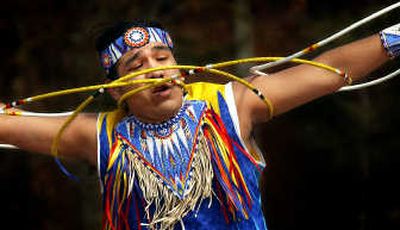
AISP is the college’s oldest ethnic studies program, and it is celebrating its 40th anniversary with the annual Spirit of the Eagle Powwow Friday and Saturday and a series of events for alumni May 15 and 16.
Many of the university’s 235 self-identified Native students regularly come to the Longhouse, AISPs building on campus, for the various cultural events and support services there. And a number of them earn a minor in American Indian studies, as do non-Native students whose disciplines – social work, education, planning, nursing, public health administration, etc. – bring them into contact with Native populations, Almeida said. It helps bring cultural relevance to those disciplines.
Recruitment is a strong part of what AISP does. Denise Jackson, 19, a sophomore at Eastern, is a Port Gamble S’klallam tribal member from Nespelem, Wash., on the Spokane Indian Reservation. She is the first in her family to attend college.
Long before she enrolled, she had been in contact with Nicole DeVon, AISPs counselor/recruiter, a link she said she needed to even consider higher education.
“It needs to be personal, one-on-one,” DeVon said. “Because of our small number of students and because we are an invisible minority for the most part, it becomes more critical to retain students. If we don’t make it personal for our students, we lose them.”
DeVon said that nationally, about 1 percent of students at state and private (non-tribal) colleges are American Indian, “but at Eastern, we’re 2 percent of the student body.”
Education at a particular school often becomes a family tradition. Wendy Wynecoop, 43, a liaison for the school district at Wellpinit High School in Wellpinit, Wash., took classes at EWU in the 1980s and is finishing her degree through the online extended learning program. Her son, Monty Ford Jr., 22, is a senior communications major on campus, and her daughter, Chanel Ford, 19, is a junior (she did Running Start in high school) studying public relations and communications, also on campus.
“It was natural for us (to attend EWU) because there are a number of Native students there, so it can be comfortable for us,” Wynecoop said. “It’s just one hour away, near yet far.”
That distance factor was important for Jackson, too: “There’s a good education program, but it’s close to home, and I need that.”
It was neither family tradition nor closeness to home that brought Garcia, who had been a construction worker and firefighter, to EWU. It was the fact that his girlfriend, who he met in Durango, Colo., was coming to the area.
But he realized he really wanted to go back to the reservation and help with substance abuse. Education would be the key, said Garcia, president of the EWU Native American Students Association.
Culture and traditions are important to him, which is why he said he wants to maintain a strong Native presence at the university – and why the upcoming 40th anniversary powwow is such an emphasis. Put on free to all by NASA, the powwow at Reese Court is expected to draw 600 people – tribal members from as far away as Canada, Montana and the Southwest (including Hopi traditional dancers from Arizona) and members of the public.
There will be traditional dancing, singing and drumming along with Indian tacos and vendors selling artwork, crafts and clothing. The students will present a free salmon dinner Saturday, during which there will be dances presented by other ethnic clubs from campus, including Hawaiian and Polynesian clubs and the African African Alliance.
“This is not traditional at a powwow, by any means, but we want to include the diversity from our campus in this celebration,” Garcia said.
The significance of the survival of 40 years of an American Indian Studies program and an annual powwow isn’t lost on the Native students.
“It is a celebration of our culture,” said Denise Jackson, vice president of NASA and hopes to learn the Salish language and teach it at reservation schools, “but we are also interested in other ethnic groups learning about our culture and to bring us all together.
“And it also lets everyone know we’re still here.”