
Community builders in West Central
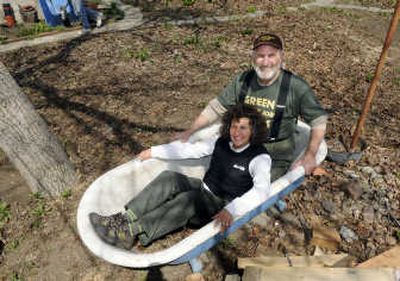
Patrick and Connie Copeland Malone believe in rebuilding the social capital of their West Central Neighborhood.
While that might sound like some sort of sociology project, their work in Spokane is very basic. The Copeland Malones are grass-roots community organizers.
They are, if you will, urban missionairies who are employing a series of faith-based approaches to civic needs. Their work as a couple dates back nearly 20 years, the last 14 of them in Spokane.
Together, the Copeland Malones have designed a series of overlapping programs to strengthen the fabric of West Central to alleviate poverty, provide alternatives to gang affiliation and get kids headed in the right direction.
“Every kid in this neighborhood should have a future,” Patrick Copeland Malone said.
The heart of their work is currently embodied in Project Hope which seeks to provide alternatives to gang violence and help youth find pathways out of poverty through “green collar” jobs and urban agriculture. The Copeland Malones are among the volunteers who formed Riverfront Farms last year.
In a recent press release, Patrick Copeland Malone wrote that “our work will be in building a movement through a broad-based collaboration of all sectors of society for the long-term sustainability and ‘greening’ of all residents and all neighborhoods.”
Project Hope offers a God’s Gym program for youth at Salem Lutheran Church, 1428 W. Broadway Ave., each Friday at 7 p.m.
Its Jobs Not Jails component seeks to get youth working through community-based agriculture or a clothing sales initiative called Hood Gear, which is being supported through a partnership with Action Sportswear, 1625 W. Broadway Ave.
“We are looking at West Central as a laboratory,” Copeland Malone said.
The Copeland Malones met 20 years ago on the beach at Seaside, Ore., and made a pact to pursue lives of community service both through their jobs and their volunteer efforts.
They spent a year working for a food bank and homeless outreach program in Chicago in 1990 and 1991 through Lutheran Volunteer Corps, an experience they said further solidified their commitment to community service.
Both had grown up in Spokane, so by the time they returned in 1994, they knew they wanted to help people at the grass-roots level. Patrick Copeland Malone even wrote a 20-year plan filled with optimistic ideas about community building. One of their long-range goals is to create a housing trust and housing cooperative to curb escalating housing costs.
“It feels good to do something that has an immediate impact,” Connie Copeland Malone said.
A graduate of Whitworth University, she worked for Christ Clinic in West Central for 11 years before switching to become the community outreach minister at Salem Lutheran. She had previously worked for a number of years on the staff of Young Life, a faith-based youth program.
Patrick Copeland Malone has bachelor’s and master’s degrees from Eastern Washington University. He worked as mission outreach director for First Presbyterian Church in Spokane from 1994 to 2000. He then headed the Institute for Neighborhood Leadership to train about 1,500 community activists at COPS substations and on neighborhood councils. He is currently a community developer through the Washington State University Extension Service.
Last week during an interview at a residential garden lot on West Boone Avenue, the Copeland Malones were greeted by a series of neighbors who stopped off to offer their help.
“Sustainability is a huge thing,” said Joy Peltier-Jones, a graduate student in urban planning at EWU and a volunteer for Riverfront Farms, which seeks to create a vegetable supply for area food banks.
“Local food is important to our local economy,” she said.
Another neighbor stopped to help move garden soil that had been dumped along the curb and needed to be shoveled out of the way of traffic.
“I think we all want to help,” Peltier-Jones said.
The Copeland Malones are among a growing movement in the U.S. to reduce people’s impact on the environment. Since coming to Spokane, they have chosen to live and raise their two children in group settings. They are currently sharing a residence with Sibyl Garske, an 83-year-old widow who would not have been able to remain in her home without the Malone family moving in to help share the costs, the Copeland Malones said.
They have learned over the years that residents in poorer neighborhoods are often more cooperative with one another than they are in places where people have more money and greater independence, they said.
“People work together better here because they realize they have to. That’s not a bad thing,” Connie Copeland Malone said.
Patrick Copeland Malone said, “We’re enriched through that. It’s interdependency. We need each other.”